2014 · Fernández-Gajardo et al. — Novel therapeutic strategies for traumatic brain injury: acute antioxidant reinforcement.
Super-Abstract
This review examines antioxidant-based strategies for treating traumatic brain injury (TBI), including hydrogen-rich saline, arguing that oxidative stress is a central driver of secondary brain damage after trauma. Hydrogen-rich saline appears as one of several candidate antioxidants — alongside mitochondria-targeted compounds, NADPH inhibitors, and polyphenols — in a landscape where no therapy has yet achieved definitive clinical success.
Commentary
Traumatic brain injury is a heterogeneous and complex condition that has resisted conventional therapeutic development. This review makes a compelling mechanistic case that oxidative stress — through excitotoxicity, mitochondrial dysfunction, apoptosis, and neuroinflammation — drives much of the secondary injury cascade. Hydrogen-rich saline is presented as one antioxidant candidate among several, valued for its ability to cross the blood-brain barrier and selectively neutralise the most cytotoxic reactive oxygen species. The review does not provide new experimental data; it synthesises existing preclinical and early clinical findings. The translational potential of H₂ specifically is framed as promising but requires further controlled trials before clinical recommendations can be made.
Key quotes
- „Evidence strongly suggests that oxidative stress is a cornerstone event leading to and propagating secondary injury mechanisms such as excitotoxicity, mitochondrial dysfunction, apoptosis, autophagy, brain edema, and inflammation.“ — the rationale: why antioxidants are a logical TBI target
- „TBI has defied conventional approaches to diagnosis and therapy development because of its heterogeneity and complexity.“ — the clinical challenge driving the search for new strategies
- „the role of agents such as … hydrogen-rich saline, sulforaphane, U-83836E, omega-3, and polyphenols is covered.“ — H₂ saline as one of several antioxidant candidates reviewed
Our assessment
This is a narrative review covering multiple antioxidant strategies for TBI, with hydrogen-rich saline as one entry among many. It provides useful mechanistic context but does not constitute direct evidence for H₂ efficacy in human TBI. Limitations: not a systematic review; no meta-analysis; the field of neuroprotection after TBI has seen many promising preclinical agents fail in clinical trials. H₂ data included are predominantly from animal models.
Study design
- Type: narrative review (multi-agent comparison) · Focus: acute antioxidant strategies for secondary TBI · H₂ form reviewed: hydrogen-rich saline (intravenous)
- Result: no primary data; narrative synthesis positions H₂ saline as a promising antioxidant candidate for TBI based on its radical-scavenging profile and BBB penetration; clinical translation remains to be established
Abstract
Traumatic brain injury (TBI) is the most important cause of disability in individuals under the age of 45 years and thus represents a significant social and economic burden. Evidence strongly suggests that oxidative stress is a cornerstone event leading to and propagating secondary injury mechanisms such as excitotoxicity, mitochondrial dysfunction, apoptosis, autophagy, brain edema, and inflammation. TBI has defied conventional approaches to diagnosis and therapy development because of its heterogeneity and complexity. Therefore, it is necessary to explore alternative approaches to therapy development for TBI. The aim of this review is to present a therapeutic approach for TBI, taking into account the evidence supporting the role for oxidative stress in the pathophysiological processes of secondary brain injury. The role of agents such as mitochondria-targeted antioxidants (melatonin and new mitochondria-targeted antioxidants), nicotinamide adenine dinucleotide phosphate (NADPH) inhibitors (antioxidant vitamins and apocynin), and other compounds having mainly antioxidant properties (hydrogen-rich saline, sulforaphane, U-83836E, omega-3, and polyphenols) is covered. The rationale for innovative antioxidant therapies based on current knowledge and particularly the most recent studies regarding this field is discussed. Particular considerations and translational potential of new TBI treatments are examined and a novel therapeutic proposal for TBI is presented.
Source & links
Screenshot of the PubMed page
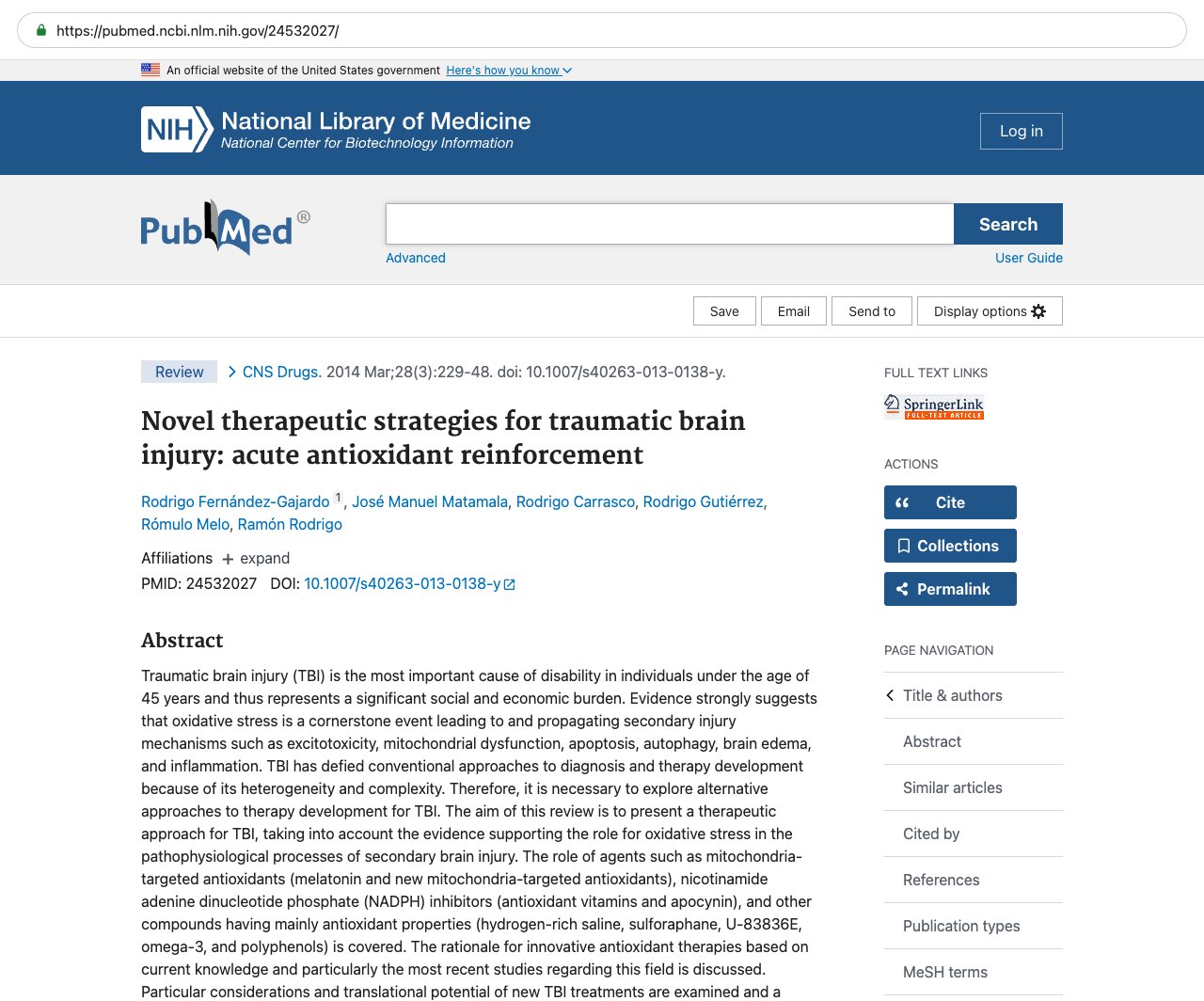
This page mirrors the published abstract (© the authors / publisher) for reference and citation. The canonical source is the PubMed record linked above. This is not medical advice.