2019 The journal of maternal-fetal & neonatal medicine : the official journal of the European Association of Perinatal Medicine, the Federation of Asia and Oceania Perinatal Societies, the International Society of Perinatal Obstetricians Review / Meta-analysis Saline / IV
2019 · Wang et al. — Neonatal hypoxic-ischemic encephalopathy: emerging therapeutic strategies based on pathophysiologic phases of the injury.
Super-Abstract
This 2019 review proposes a phase-based treatment framework for neonatal hypoxic-ischemic encephalopathy (HIE), a major cause of infant death and disability. Hydrogen-rich saline appears alongside other neuroprotective agents as a candidate free-radical scavenger in the earliest injury phase, potentially complementing standard mild hypothermia therapy.
Commentary
Neonatal HIE results from oxygen deprivation around birth and unfolds in three pathophysiological phases (I–III), each requiring different therapeutic approaches. The authors advocate for „transformative medicine“ — applying the right intervention at the right phase before damage becomes irreversible. In Phase I (acute injury), alongside mild hypothermia and excitatory amino acid blockers, hydrogen-rich saline is mentioned as a free-radical scavenger alongside erythropoietin. The paper covers a broad landscape of emerging therapies, including stem cell transplantation and acupuncture. H₂ receives one mention among many candidates — it is not the central focus of this review. The evidence base for H₂ in neonatal HIE cited here is preclinical.
Key quotes
- „in phase I, mild hypothermia, free radical scavenger (erythropoietin, hydrogen-rich saline), excitatory amino acid receptor blocker, and neuroprotective agents should be administered.“ — H₂-rich saline listed as one of several Phase I neuroprotective agents in the proposed framework
- „we propose the different phases as intervention targets, based on the pathophysiologic changes in phases I, II, and III of neonatal HIE.“ — the core concept: phase-matched treatment strategy
- „stem cell transplantation is expected to become the most promising therapeutic candidate for treatment of severe neonatal HIE with its sequelae.“ — the authors' strongest endorsement goes to stem cells, not H₂ — context is important
Our assessment
This is a broad narrative review of emerging treatments for neonatal HIE — hydrogen-rich saline is one of many agents mentioned, not the paper's primary focus. The evidence for H₂ in this neonatal context is preclinical; no neonatal clinical trial data for H₂ are presented. The phase-based treatment framework is conceptually useful. Limitations: the paper is primarily a framework proposal rather than a systematic evidence review; H₂ evidence for neonatal HIE specifically is sparse in 2019; extrapolation from adult or animal models to critically ill newborns is especially hazardous.
Study design
- Type: narrative review / framework proposal · n: n/a (preclinical and clinical literature on multiple therapies) · H₂ delivery: hydrogen-rich saline (mentioned as Phase I candidate)
- H₂ role in review: listed as free-radical scavenger in Phase I alongside erythropoietin; not the primary focus · Primary focus: multi-phase treatment framework for neonatal HIE including hypothermia, neuroprotectives, stem cells
Abstract
Neonatal hypoxic ischemic encephalopathy (HIE) is an important cause of neonatal death and disability. At present, there is no unified standard and specialized treatment method for neonatal HIE. In clinical practice, we have found that a gap remains between preclinical medical research and clinical application in the treatment of neonatal HIE. To promote an organic combination of preclinical research and clinical application, we propose the different phases as intervention targets, based on the pathophysiologic changes in phases I, II, and III of neonatal HIE; moreover, we suggest transformative medicine as a principle that may improve the therapeutic effect by blocking the progression of the disease to an irreversible stage. For instance, in phase I, mild hypothermia, free radical scavenger (erythropoietin, hydrogen-rich saline), excitatory amino acid receptor blocker, and neuroprotective agents should be administered to neonates with moderate/severe HIE; in phase II, following phase I treatment, anti-inflammatory agents, neuroprotective or nerve regeneration agents, and stem cell transplantation should be administered to patients; in phase III, anti-inflammatory agents, neuroprotective or nerve regeneration agents, and stem cell transplantation should be administered to patients. As soon as the patient's condition has stabilized, acupuncture, massage, and rehabilitation training should be performed. Following further study of stem cells, stem cell transplantation is expected to become the most promising therapeutic candidate for treatment of severe neonatal HIE with its sequelae.
Source & links
Screenshot of the PubMed page
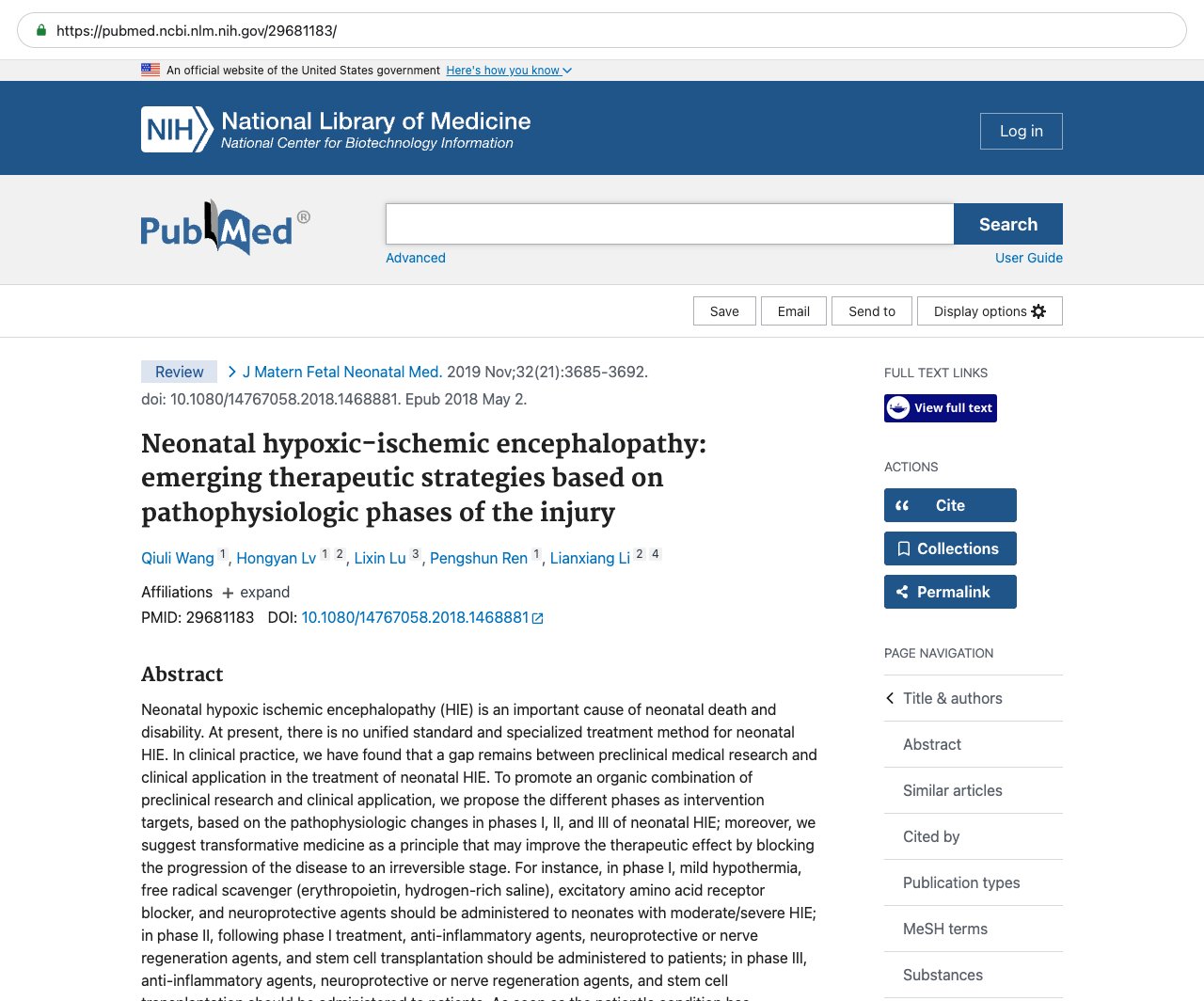
This page mirrors the published abstract (© the authors / publisher) for reference and citation. The canonical source is the PubMed record linked above. This is not medical advice.