2020 · Holweg — A Lean Magnesium-Zinc-Calcium Alloy ZX00 Used for Bone Fracture Stabilization in a Large Growing-Animal Model
Super-Abstract
This animal study evaluated biodegradable magnesium-zinc-calcium (ZX00) screws for bone fracture fixation in growing sheep, finding no significant difference in screw degradation between fractured and non-fractured bones, and — importantly — no negative effect of incidental hydrogen gas formation on fracture healing. This is preclinical veterinary orthopaedic research; the H₂ gas in this study is an unwanted byproduct of implant degradation, not a therapeutic agent. (Acta Biomaterialia, 2020.)
Commentary
The focus of this study is biodegradable orthopaedic implant material science, specifically the ZX00 magnesium alloy formulated without rare-earth elements. Magnesium implants degrade in vivo and release hydrogen gas as a chemical byproduct — traditionally considered a concern in orthopaedic applications because gas pockets can theoretically interfere with healing. This study provides reassuring preclinical data: despite chronologically different gas release patterns at proximal and distal screw positions, complete osteotomy consolidation was achieved in all animals within 12 weeks, with no negative influence attributed to hydrogen gas. This is relevant for medical device safety, not for therapeutic H₂ medicine.
Key quotes
- „There was no negative influence from hydrogen-gas formation on fracture healing.“ — the key safety finding: H₂ from implant degradation did not impair bone healing
- „Despite the proximal and distal screws showing chronologically different gas release, the osteotomy showed complete consolidation.“ — H₂ gas release varied spatially but healing was complete in all cases
- „no significant difference between the osteotomized bone and the control group was found regarding the change in screw volume over implantation time.“ — fracture healing process did not meaningfully alter the implant degradation rate
Our assessment
This is an animal study (large growing-sheep model) in the field of biodegradable orthopaedic implants — it is preclinical research and does not involve therapeutic hydrogen administration. The H₂ gas studied here is an incidental byproduct of magnesium degradation, not an intentional therapeutic agent. This paper is not evidence for or against the therapeutic use of molecular hydrogen. It is relevant for the safety assessment of biodegradable magnesium implants. Results from sheep cannot be directly extrapolated to human patients without further clinical investigation.
Study design
- Type: in-vivo animal study (large growing-animal model) · Model: sheep with surgical osteotomy (fracture simulation) vs. non-osteotomy control; Mg-0.45Zn-0.45Ca (ZX00) screws · H₂ context: H₂ gas as byproduct of biodegradable Mg-alloy implant degradation (not therapeutic)
- Result: complete fracture consolidation at 12 weeks in all animals; no significant difference in screw volume change between osteotomy and control groups; no negative influence of H₂ gas formation on bone healing
Abstract
Over the last decade, demand has increased for developing new, alternative materials in pediatric trauma care to overcome the disadvantages associated with conventional implant materials. Magnesium (Mg)-based alloys seem to adequately fulfill the vision of a homogeneously resorbable, biocompatible, load-bearing and functionally supportive implant. The aim of the present study is to introduce the high-strength, lean alloy Mg‒0.45Zn‒0.45Ca, in wt% (ZX00), and for the first time investigate the clinical applicability of screw osteosynthesis using this alloy that contains no rare-earth elements. The alloy was applied in a growing sheep model with osteotomized bone (simulating a fracture) and compared to a non-osteotomy control group regarding degradation behavior and fracture healing. The alloy exhibits an ultimate tensile strength of 285.7 ± 3.1 MPa, an elongation at fracture of 18.2 ± 2.1%, and a reduced in vitro degradation rate compared to alloys containing higher amounts of Zn. In vivo, no significant difference between the osteotomized bone and the control group was found regarding the change in screw volume over implantation time. Therefore, it can be concluded that the fracture healing process, including its effects on the surrounding area, has no significant influence on degradation behavior. There was also no negative influence from hydrogen-gas formation on fracture healing. Despite the proximal and distal screws showing chronologically different gas release, the osteotomy showed complete consolidation. STATEMENT OF SIGNIFICANCE: Conventional implants involve several disadvantages in pediatric trauma care. Magnesium-based alloys seem to overcome these issues as discussed in the recent literature. This study evaluates the clinical applicability of high-strength lean Mg‒0.45Zn‒0.45Ca (ZX00) screws in a growing-sheep model. Two groups, one including a simulated fracture and one group without fracture, underwent implantation of the alloy and were compared to each other. No significant difference regarding screw volume was observed between the groups. There was no negative influence of hydrogen-gas formation on fracture healing and a complete fracture consolidation was found after 12 weeks for all animals investigated.
Source & links
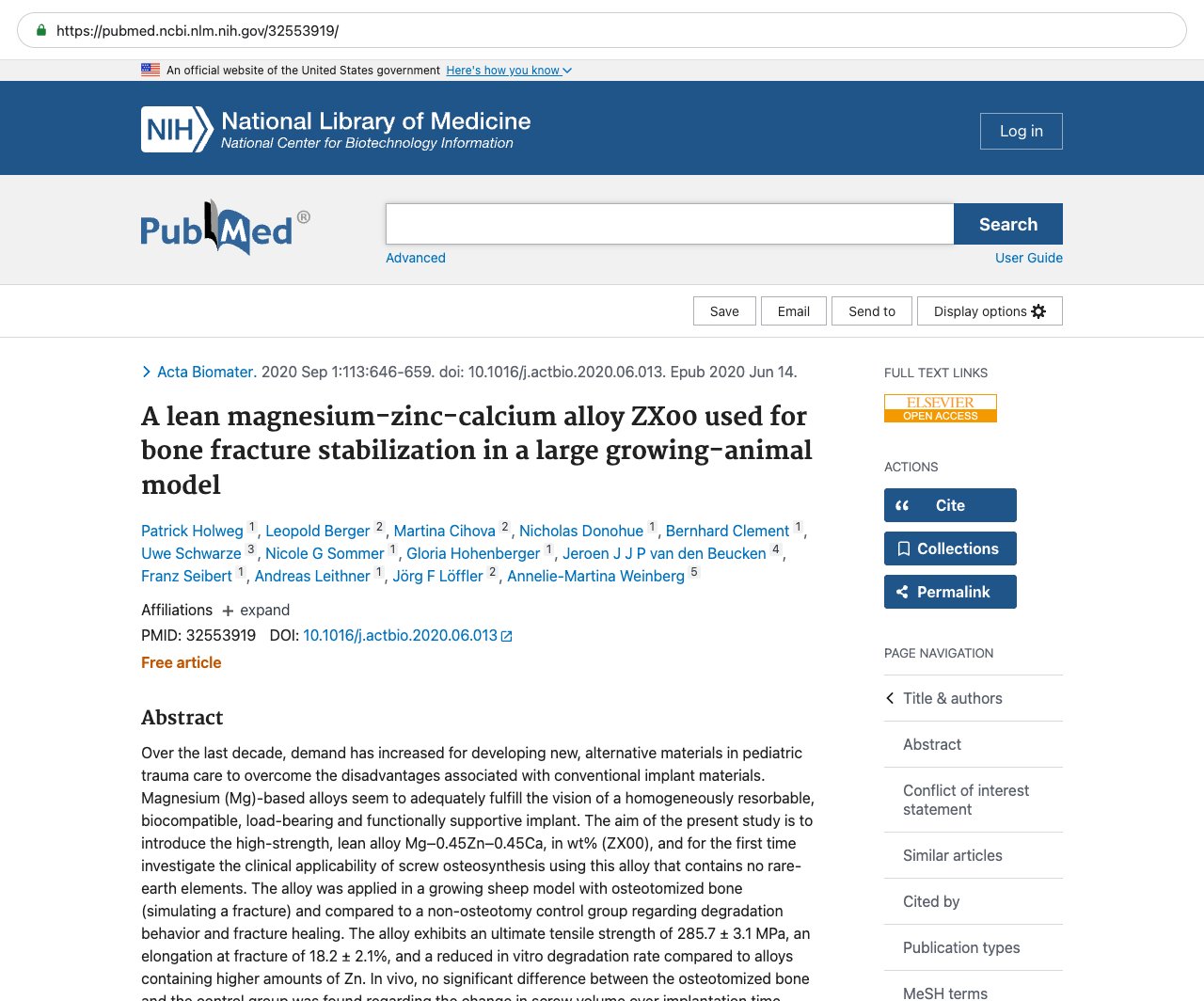
Screenshot of the PubMed page
This page mirrors the published abstract (© the authors / publisher) for reference and citation. The canonical source is the PubMed record linked above. This is not medical advice.