2020 · Ishihara — Molecular hydrogen suppresses superoxide generation in the mitochondrial complex I and reduced mitochondrial membrane potential.
Super-Abstract
In isolated mitochondria and cultured cells, molecular hydrogen altered the direction of electron flow at complex I, suppressed superoxide generation by 51 %, and reduced mitochondrial membrane potential by 11 %. This in-vitro study provides a mechanistic account of how H₂ may reduce oxidative damage at the mitochondrial level — a finding distinct from the classical hydroxyl-radical scavenging hypothesis. Results are preliminary and limited to isolated systems.
Commentary
For years the dominant explanation for H₂'s antioxidant effect was direct scavenging of hydroxyl radicals (•OH). This study by Ishihara and colleagues proposes an additional or alternative mechanism: H₂ acts at mitochondrial complex I to shift electron flow from reverse electron transport (RET) back to forward electron transport (FET), thereby reducing the „electron leakage“ that generates superoxide. The experimental approach — measuring NADH dynamics and H₂O₂ (as a proxy for superoxide) in isolated mitochondria, plus membrane potential via TMRE in cultured cells — is technically solid for this type of research. The quantified suppression of superoxide (~51%) and membrane potential (~11%) are meaningful numbers. However, isolated mitochondria and cultured cells are a far cry from the complex redox environment of living tissue. Additionally, the proposed H₂ concentration of 25 µM used experimentally must be evaluated against physiologically achievable concentrations in vivo.
Key quotes
- „H2 solely reduced mitochondrial membrane potential of the cultured cells by 11.3% as assessed by TMRE.“ — H₂ modulates mitochondrial energetics in cultured cells
- „a suppression of superoxide generated predominantly from complex I by 51.1%.“ — 51% reduction in superoxide at complex I — the key quantitative finding
- „H2 may function as a rectifier of the electron flow affecting the mitochondrial membrane potential to suppress oxidative damage in mitochondria.“ — authors' mechanistic hypothesis: H₂ as an electron-flow regulator
Our assessment
This is an in-vitro mechanistic study using isolated mitochondria and cultured cells — not an animal or human study. The proposed electron-flow mechanism adds a credible layer to H₂'s antioxidant story, going beyond classical hydroxyl-radical scavenging. Limitations: isolated mitochondria and single cell lines cannot capture the complexity of in-vivo redox biology; the H₂ concentration used (25 µM) may exceed what is achievable in target tissues; the physiological relevance of membrane potential changes needs contextualisation. This is mechanistically interesting but hypothesis-generating only.
Study design
- Type: in-vitro mechanistic study · Model: isolated mitochondria (NADH/succinate assays) + cultured cells (TMRE membrane potential) · H₂ delivery: dissolved H₂ at 25 µM
- Outcome: H₂ at 25 µM induced reverse electron transport (RET) in isolated mitochondria; with NADH present, shifted RET to FET and suppressed complex I superoxide by 51.1%; reduced mitochondrial membrane potential in cultured cells by 11.3% (TMRE assay)
Abstract
Molecular hydrogen (H2) is recognized as a medical gas applicable to numerous diseases including neurodegenerative diseases, metabolic disorders, and rheumatoid arthritis. Although the efficacy of H2 is reportedly attributed to its scavenging capability against the hydroxyl radical, the mechanisms underlying its therapeutic efficacy are not fully understood. Herein, we estimated the role of H2 in the energy converting system of the mitochondria, the source of reactive oxygen species. To investigate the effects of H2 on mitochondrial function, direction of electron flow, superoxide generation, and mitochondrial membrane potential were investigated. Forward electron transport (FET) or reverse electron transport (RET) was assessed by monitoring the decrease or increase of β-nicotinamide adenine dinucleotide hydrate (NADH, - or +, μM, respectively) in the presence of β-nicotinamide adenine dinucleotide (NAD+) and/or succinate in the isolated mitochondria. H2O2 converted from superoxide by superoxide dismutase (SOD) was measured to estimate electron leakage in the mitochondria. The effects of H2 on mitochondrial membrane potential were observed by staining cells with the fluorescence probe, teramethylrhodamine ethyl ester (TMRE). Despite the absence of succinate, a distinct RET was observed (from +0.0313 ± 0.0106 μM to +1.20 ± 0.302 μM) by adding 25 μM H2. In the presence of 5 μM NADH, RET by succinate inverted to FET from +1.62 ± 0.358 μM to -1.83 ± 0.191 μM, accompanied by a suppression of superoxide generated predominantly from complex I by 51.1%. H2 solely reduced mitochondrial membrane potential of the cultured cells by 11.3% as assessed by TMRE. The direction of electron flow was altered by H2 depending on the NAD+/NADH ratio, accompanied by suppression of superoxide generation H2 could suppress superoxide generation in complex I in vitro and reduce membrane potential in vivo. H2 may also neutralize semiquinone radicals to reduce superoxide produced in complex III. H2 may function as a rectifier of the electron flow affecting the mitochondrial membrane potential to suppress oxidative damage in mitochondria.
Source & links
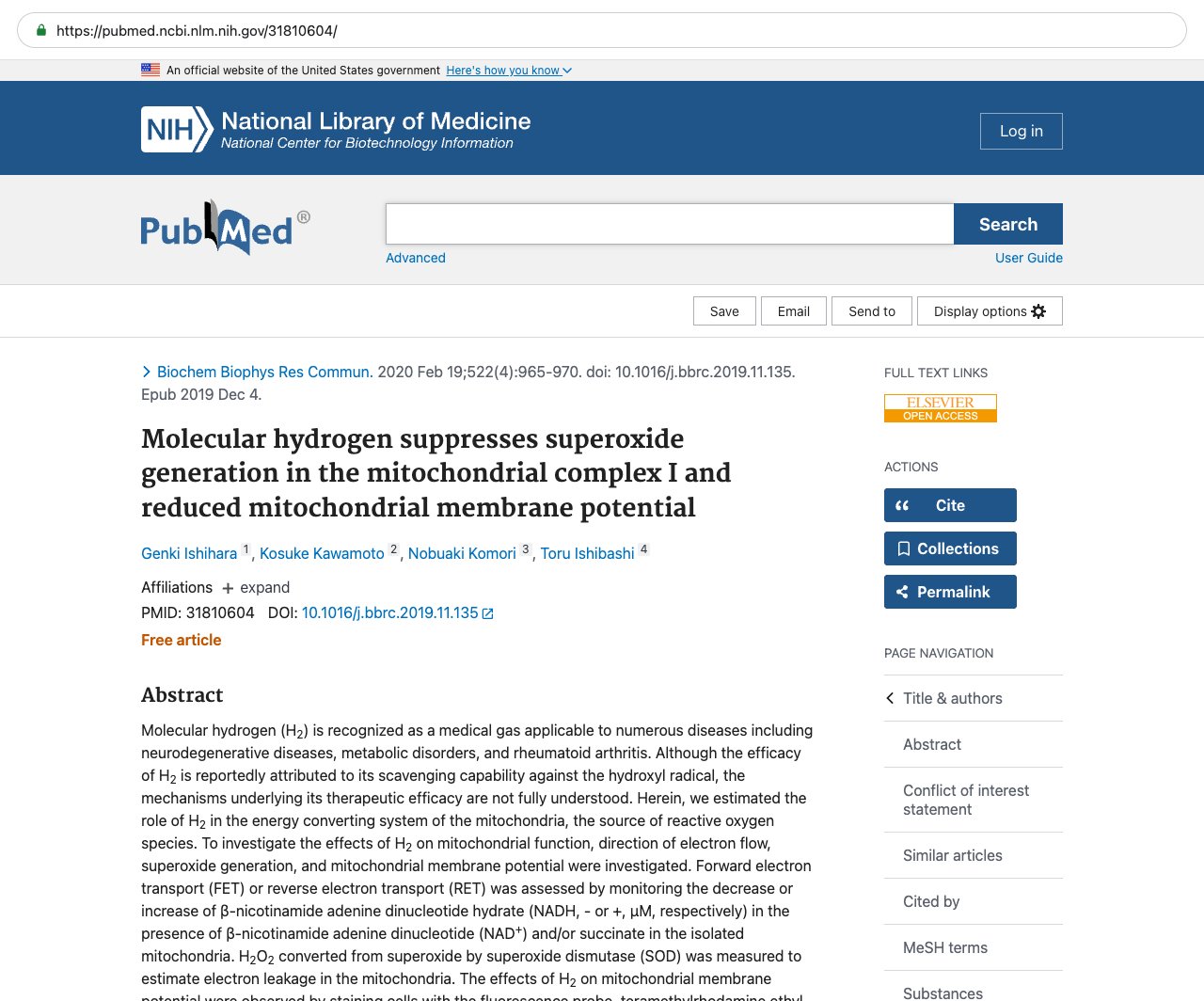
Screenshot of the PubMed page
This page mirrors the published abstract (© the authors / publisher) for reference and citation. The canonical source is the PubMed record linked above. This is not medical advice.