2016 · Zheng — Molecular Hydrogen Therapy Ameliorates Organ Damage Induced by Sepsis
Super-Abstract
This review summarises animal-based evidence suggesting that molecular hydrogen can reduce inflammatory cytokine release, oxidative stress, and organ damage in sepsis models, improving survival rates across brain, lung, liver, kidney, and intestinal tissues. It is a literature review of animal experiments — not a human clinical trial.
Commentary
Sepsis — life-threatening organ dysfunction caused by a dysregulated host response to infection — remains one of the most lethal conditions in intensive care. This review by Zheng and colleagues synthesises animal evidence on molecular hydrogen's potential in sepsis, published in Oxidative Medicine and Cellular Longevity. The authors survey findings across multiple organ systems: brain, lung, liver, kidney, small intestine, and others. The common thread is that H₂ reduces pro-inflammatory cytokine release (TNF-α, IL-6, IL-1β) and oxidative stress markers, thereby attenuating secondary organ damage and improving experimental survival rates. The review covers a remarkably broad range of indications — from neurological to metabolic to oncological — as side nodes, since H₂'s proposed mechanisms (antioxidant, anti-inflammatory) are relevant to many disease states. However, clinical data in actual sepsis patients are not present; all referenced evidence is from animal models. The authors call H₂ therapy „a prospective method against sepsis“ — an appropriately tentative framing for a preclinical evidence base.
Key quotes
- „Molecular hydrogen therapy is able to significantly reduce the release of inflammatory factors and oxidative stress injury.“ — the dual mechanism: anti-inflammatory and antioxidant
- „Thereby it can reduce damage of various organ functions from sepsis and improve survival rate.“ — the proposed multi-organ protective effect in animal models
- „Molecular hydrogen therapy is a prospective method against sepsis.“ — the authors' conclusion — forward-looking, not a clinical recommendation
Our assessment
This is a review of animal studies — no human clinical data for sepsis are included. The breadth of the review is both a strength (showing H₂'s cross-organ potential) and a weakness (animal models of sepsis often fail to translate to human clinical outcomes, as the history of sepsis drug development has repeatedly shown). The mechanistic rationale is scientifically sound: H₂ reduces cytokines and oxidative damage in controlled experimental conditions. However, no human clinical trials in septic patients are cited, and clinical translation for this severe condition remains unproven. The review should be read as a research direction, not as evidence of clinical efficacy.
Study design
- Type: narrative review of animal experiments · n: n/a (literature analysis) · H₂ delivery: various methods reviewed (not specified per study)
- Outcome: narrative synthesis of animal sepsis models; reported effects: reduced inflammatory cytokines, reduced oxidative stress, improved multi-organ function (brain, lung, liver, kidney, intestine), improved animal survival rates — all from animal/preclinical models
Abstract
Since it was proposed in 2007, molecular hydrogen therapy has been widely concerned and researched. Many animal experiments were carried out in a variety of disease fields, such as cerebral infarction, ischemia reperfusion injury, Parkinson syndrome, type 2 diabetes mellitus, metabolic syndrome, chronic kidney disease, radiation injury, chronic hepatitis, rheumatoid arthritis, stress ulcer, acute sports injuries, mitochondrial and inflammatory disease, and acute erythema skin disease and other pathological processes or diseases. Molecular hydrogen therapy is pointed out as there is protective effect for sepsis patients, too. The impact of molecular hydrogen therapy against sepsis is shown from the aspects of basic vital signs, organ functions (brain, lung, liver, kidney, small intestine, etc.), survival rate, and so forth. Molecular hydrogen therapy is able to significantly reduce the release of inflammatory factors and oxidative stress injury. Thereby it can reduce damage of various organ functions from sepsis and improve survival rate. Molecular hydrogen therapy is a prospective method against sepsis.
Source & links
Screenshot of the PubMed page
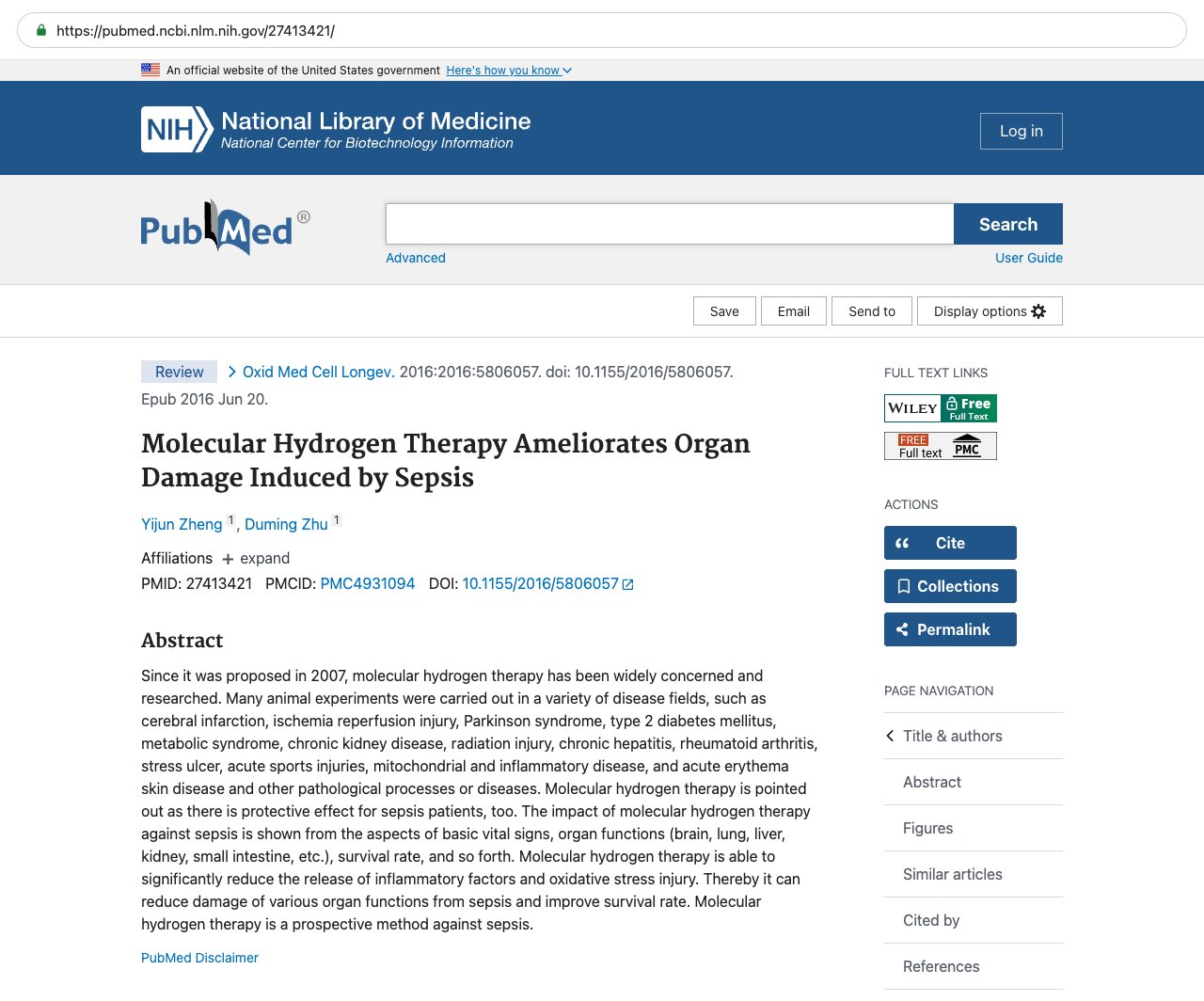
This page mirrors the published abstract (© the authors / publisher) for reference and citation. The canonical source is the PubMed record linked above. This is not medical advice.