2026 · Paparella — Medical Gases as Emerging Regulators of Paediatric Endocrine and Neurodevelopmental Pathways: A Mini-Review
Super-Abstract
Gaseous signalling molecules — including molecular hydrogen (H₂), nitric oxide, carbon monoxide and hydrogen sulphide — are increasingly recognised as modulators of the developing brain and endocrine system in children. This mini-review surveys preclinical and clinical literature from 2007–2025 on how these gasotransmitters influence synaptic plasticity, neurotransmission, bone biology and puberty control. The authors highlight particular relevance for conditions marked by oxidative stress, such as autism spectrum disorder, ADHD, and chromosomal syndromes including Klinefelter and Turner. (Acta Paediatrica, 2026.)
Commentary
This mini-review is primarily a scoping exercise rather than an efficacy assessment: it maps which mechanistic pathways gasotransmitters affect and where translational gaps remain. The inclusion of H₂ alongside other medical gases reflects a growing interdisciplinary interest in redox-modulating therapies for paediatric populations. The authors are careful to note that direct clinical applications in children remain limited, and that most mechanistic insights come from preclinical models. The review's value lies in articulating a research agenda rather than establishing proven clinical benefit. Omics-based profiling and biomaterial-supported delivery systems are presented as key enablers for future trials.
Key quotes
- „gasotransmitters modulate synaptic plasticity, neurotransmission and neuroinflammation, influencing disorders such as autism spectrum disorder, attention-deficit/hyperactivity disorder and outcomes after perinatal hypoxia.“ — the neurodevelopmental relevance of gaseous molecules including H₂
- „Although paediatric clinical applications remain limited, advances in omics-based profiling, mechanistic studies and biomaterial-supported gas delivery are rapidly expanding the therapeutic horizon.“ — honest summary of the current state of translational readiness
- „Integrating gasotransmitter biology into paediatric endocrinology and neurodevelopment may support future diagnostic, preventive and targeted therapeutic strategies.“ — the authors' forward-looking conclusion
Our assessment
This is a literature overview (mini-review), not an original experiment. No new clinical data are presented; the authors synthesise existing preclinical and early clinical work on several medical gases together. H₂-specific evidence within this review is embedded among multiple gases and remains mostly preclinical. Conclusions about therapeutic potential in children are speculative and appropriately framed as future directions. Readers should not interpret this as clinical evidence for H₂ therapy in paediatric endocrine or neurodevelopmental conditions.
Study design
- Type: mini-review (narrative synthesis) · n: n/a (literature survey, 2007–2025) · H₂ delivery: various (as reviewed from primary sources)
- Scope: gasotransmitters (NO, CO, H₂S, H₂) in paediatric endocrinology and neurodevelopment · Conditions covered: ASD, ADHD, perinatal hypoxia, Klinefelter syndrome, Turner syndrome, osteogenesis, puberty regulation
- Conclusion: mechanistic plausibility established preclinically; paediatric clinical applications remain limited; future work requires omics profiling and validated delivery systems
Abstract
AIM: Medical gases, including nitric oxide, carbon monoxide, hydrogen sulphide and molecular hydrogen, have emerged as key regulators of redox balance and cellular signalling. This mini-review examines their relevance to paediatric endocrine and neurodevelopmental pathways, domains particularly sensitive to oxidative and inflammatory disturbances. METHODS: We surveyed preclinical and clinical studies published between 2007 and 2025 on gas-mediated regulation of metabolic-redox homeostasis, bone biology, pubertal control and neurodevelopment. Additional attention was given to conditions marked by oxidative stress, such as Klinefelter and Turner syndromes. RESULTS: Evidence shows that gasotransmitters modulate synaptic plasticity, neurotransmission and neuroinflammation, influencing disorders such as autism spectrum disorder, attention-deficit/hyperactivity disorder and outcomes after perinatal hypoxia. They also participate in metabolic regulation, osteogenesis, osteoclast activity and hypothalamic control of puberty. These mechanistic insights highlight the emerging translational potential of gas-mediated pathways in paediatric health. CONCLUSION: Although paediatric clinical applications remain limited, advances in omics-based profiling, mechanistic studies and biomaterial-supported gas delivery are rapidly expanding the therapeutic horizon. Integrating gasotransmitter biology into paediatric endocrinology and neurodevelopment may support future diagnostic, preventive and targeted therapeutic strategies.
Source & links
Screenshot of the PubMed page
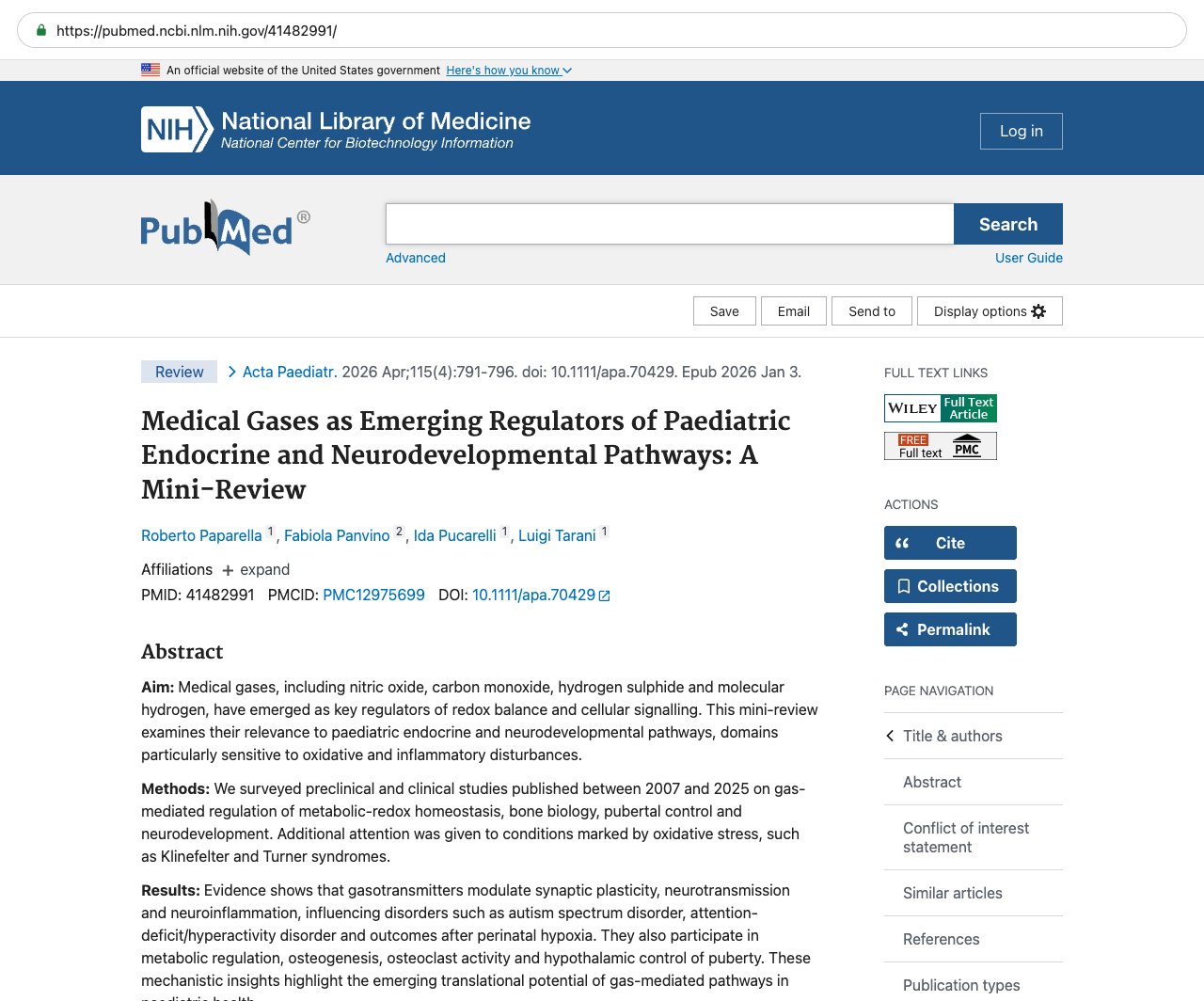
This page mirrors the published abstract (© the authors / publisher) for reference and citation. The canonical source is the PubMed record linked above. This is not medical advice.