2024 · Lin — Hydrogen-treated CoCrMo alloy: a novel approach to enhance biocompatibility and mitigate inflammation in orthopedic implants.
Super-Abstract
Treating the surface of a metal alloy used in orthopedic implants with hydrogen reduced free radicals by 85% in cell models, improved cell compatibility, and promoted new bone formation in an initial animal test. The approach involves electrochemically charging the alloy surface with hydrogen to just a shallow depth. (Journal of Materials Chemistry B, 2024.)
Commentary
CoCrMo alloys are widely used in orthopedic implants such as hip and knee replacements. Their high chemical stability, while protective against corrosion, can impair integration with surrounding tissue and trigger inflammatory responses. This study used an electrochemical cathodic hydrogen-charging method to create a hydrogen-rich surface layer approximately 106 nm deep. The resulting H-CoCrMo surface showed an 85.2% reduction in free radicals in cell tests, improved hydrophilicity (contact angle dropped from 83.5° to 52.4°), and an 11.4% increase in hydroxyapatite deposition coverage. Osteosarcoma cell activity was suppressed to 50.8%. An in-vivo test (unspecified animal model) suggested promotion of new bone formation and reduced inflammatory response. This is an early-stage biomaterials study — effects in cell culture and one animal test do not confirm clinical outcomes in human implant recipients.
Key quotes
- „This hydrogen-rich surface demonstrated a reduction of 85.2% in free radicals, enhanced hydrophilicity as evidenced by a decrease in a contact angle from 83.5 ± 1.9° to 52.4 ± 2.2°.“ — the main in-vitro surface chemistry result: dramatic reduction of free radicals
- „The cell study results revealed a suppression of osteosarcoma cell activity to 50.8 ± 2.9%.“ — cytotoxicity finding against a bone cancer cell line — context for implant biocompatibility
- „the in vivo test suggested the promotion of new bone formation and a reduced inflammatory response.“ — preliminary animal data — not yet validated in human implant surgery
Our assessment
This is an in-vitro and early preclinical animal study on a biomaterials surface modification. The hydrogen treatment of CoCrMo is a novel concept with plausible antioxidant mechanisms. However, results from cell cultures and a single animal test cannot be extrapolated to outcomes in human orthopedic implant surgery. The study does not describe what animal was used, how many, or over what period. Long-term stability of the hydrogen-rich surface layer in a biological environment is not established. This is exploratory materials science — considerable further development is needed before clinical relevance can be assessed.
Study design
- Type: in-vitro cell study + preliminary animal study · Model: cell lines + unspecified animal in-vivo test · H₂ delivery: electrochemical cathodic hydrogen charging of CoCrMo alloy surface (~106 nm depth)
- Result: 85.2% free radical reduction; improved hydrophilicity; +11.4% hydroxyapatite deposition; 50.8% osteosarcoma cell suppression; new bone formation and reduced inflammation in preliminary animal test — no human data
Abstract
In recent decades, orthopedic implants have been widely used as materials to replace human bone tissue functions. Among these, metal implants play a crucial role. Metals with better chemical stability, such as stainless steel, titanium alloys, and cobalt-chromium-molybdenum (CoCrMo) alloy, are commonly used for long-term applications. However, good chemical stability can result in poor tissue integration between the tissue and the implant, leading to potential inflammation risks. This study creates hydrogenated CoCrMo (H-CoCrMo) surfaces, which have shown promise as anti-inflammatory orthopedic implants. Using the electrochemical cathodic hydrogen-charging method, the surface of the CoCrMo alloy was hydrogenated, resulting in improved biocompatibility, reduced free radicals, and an anti-inflammatory response. Hydrogen diffusion to a depth of approximately 106 ± 27 nm on the surface facilitated these effects. This hydrogen-rich surface demonstrated a reduction of 85.2% in free radicals, enhanced hydrophilicity as evidenced by a decrease in a contact angle from 83.5 ± 1.9° to 52.4 ± 2.2°, and an increase of 11.4% in hydroxyapatite deposition surface coverage. The cell study results revealed a suppression of osteosarcoma cell activity to 50.8 ± 2.9%. Finally, the in vivo test suggested the promotion of new bone formation and a reduced inflammatory response. These findings suggest that electrochemical hydrogen charging can effectively modify CoCrMo surfaces, offering a potential solution for improving orthopedic implant outcomes through anti-inflammatory mechanisms.
Source & links
Screenshot of the PubMed page
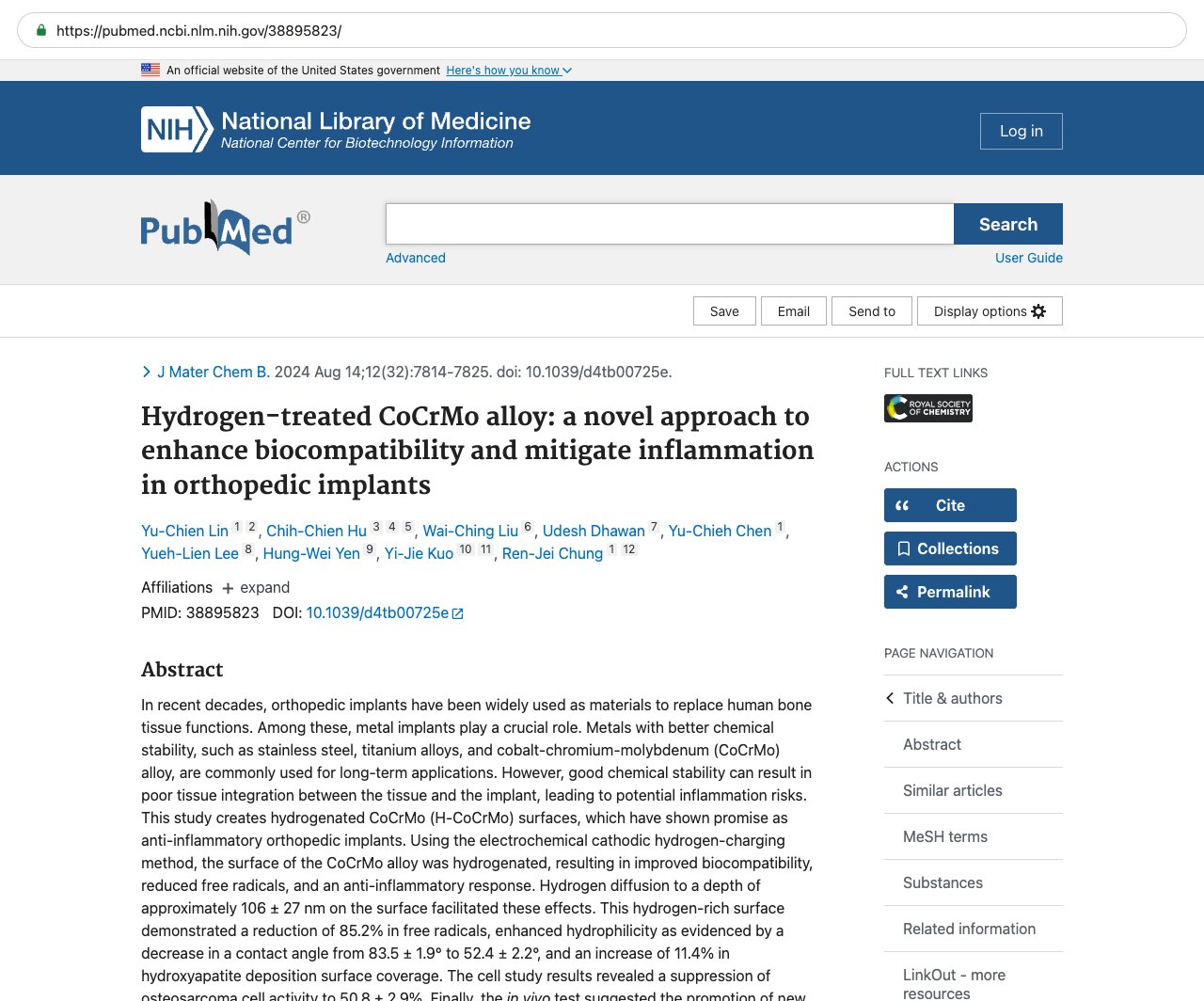
This page mirrors the published abstract (© the authors / publisher) for reference and citation. The canonical source is the PubMed record linked above. This is not medical advice.