2024 · Ichikawa — Realizing brain therapy with „smart medicine“: mechanism and case report of molecular hydrogen inhalation for Parkinson's disease.
Super-Abstract
A case report describes symptomatic improvement in a Parkinson's disease patient — including reduced body bending and hand tremor — following hydrogen inhalation, alongside a mechanistic argument that H₂ can enter the brain and neutralise the hydroxyl radicals that oxidise dopamine in the midbrain. The authors frame H₂ as a „smart medicine“ that bypasses the barriers blocking conventional central nervous system drugs. (Medical Gas Research, 2024.)
Commentary
The mechanistic argument here is clear and chemically grounded: in Parkinson's disease, hydroxyl radicals generated by the Fenton reaction oxidise dopamine in the midbrain's substantia nigra, accelerating neurodegeneration. H₂, due to its small molecular size, crosses the blood-brain barrier and cell membranes freely — and selectively reduces hydroxyl radicals (the most damaging ROS) without disturbing the redox signalling needed for normal cell function. The case report component documents real symptom improvement in one patient. The authors' enthusiasm (the Michael J. Fox reference) is sincere but also a reminder that this is a narrative paper with minimal clinical data. The case report does not include pre/post rating scales, detailed imaging, or blinding.
Key quotes
- „hydrogen entering the midbrain can convert the hydroxyl radicals into water molecules and inhibit the oxidation of dopamine.“ — the mechanistic core: H₂ neutralises hydroxyl radicals in the dopaminergic midbrain
- „we focus on the etiology of neurological diseases, especially Parkinson's disease, and present a case in which hydrogen inhalation improves the symptoms of Parkinson's disease, such as body bending and hand tremor.“ — the clinical report: symptom improvement in one patient
Our assessment
A mechanistically compelling narrative combined with a single case report. The Fenton-reaction / hydroxyl-radical rationale for H₂ in Parkinson's disease is well-established in the laboratory literature and biologically coherent. Limitations: n=1; no control; no standardised rating scales (e.g. UPDRS); no blinding; the paper is partly theoretical/philosophical in character. The tone is enthusiastic beyond what the evidence warrants. This should be read as a mechanistic hypothesis paper with one illustrative case — not as clinical evidence of efficacy. Larger randomised trials in Parkinson's disease are what is needed.
Study design
- Type: mechanistic review + single case report · n: 1 Parkinson's disease patient · H₂ delivery: inhalation
- Mechanism proposed: H₂ crosses the blood-brain barrier → enters midbrain → neutralises Fenton-generated hydroxyl radicals → reduces dopamine oxidation
- Case outcome: reported improvement in body bending and hand tremor; no standardised scales or blinding; no adverse effects mentioned
Abstract
The Michael J. Fox Foundation has been funding research on Parkinson's disease for 35 years, but has yet to find a cure. This is due to a problem with the philosophy behind the development of modern medical treatments. In this paper, we will introduce "smart medicine" with a substance that can solve all the problems of central nervous system drugs. The substance is the smallest diatomic molecule, the hydrogen molecule. Due to their size, hydrogen molecules can easily penetrate the cell membrane and enter the brain. In the midbrain of Parkinson's disease patients, hydroxyl radicals generated by the Fenton reaction cause a chain reaction of oxidation of dopamine, but hydrogen entering the midbrain can convert the hydroxyl radicals into water molecules and inhibit the oxidation of dopamine. In this paper, we focus on the etiology of neurological diseases, especially Parkinson's disease, and present a case in which hydrogen inhalation improves the symptoms of Parkinson's disease, such as body bending and hand tremor. And we confidently state that if Michael J. Fox encountered "smart medicine" that could be realized with molecular hydrogen, he would not be a "lucky man" but a "super-lucky man."
Source & links
Screenshot of the PubMed page
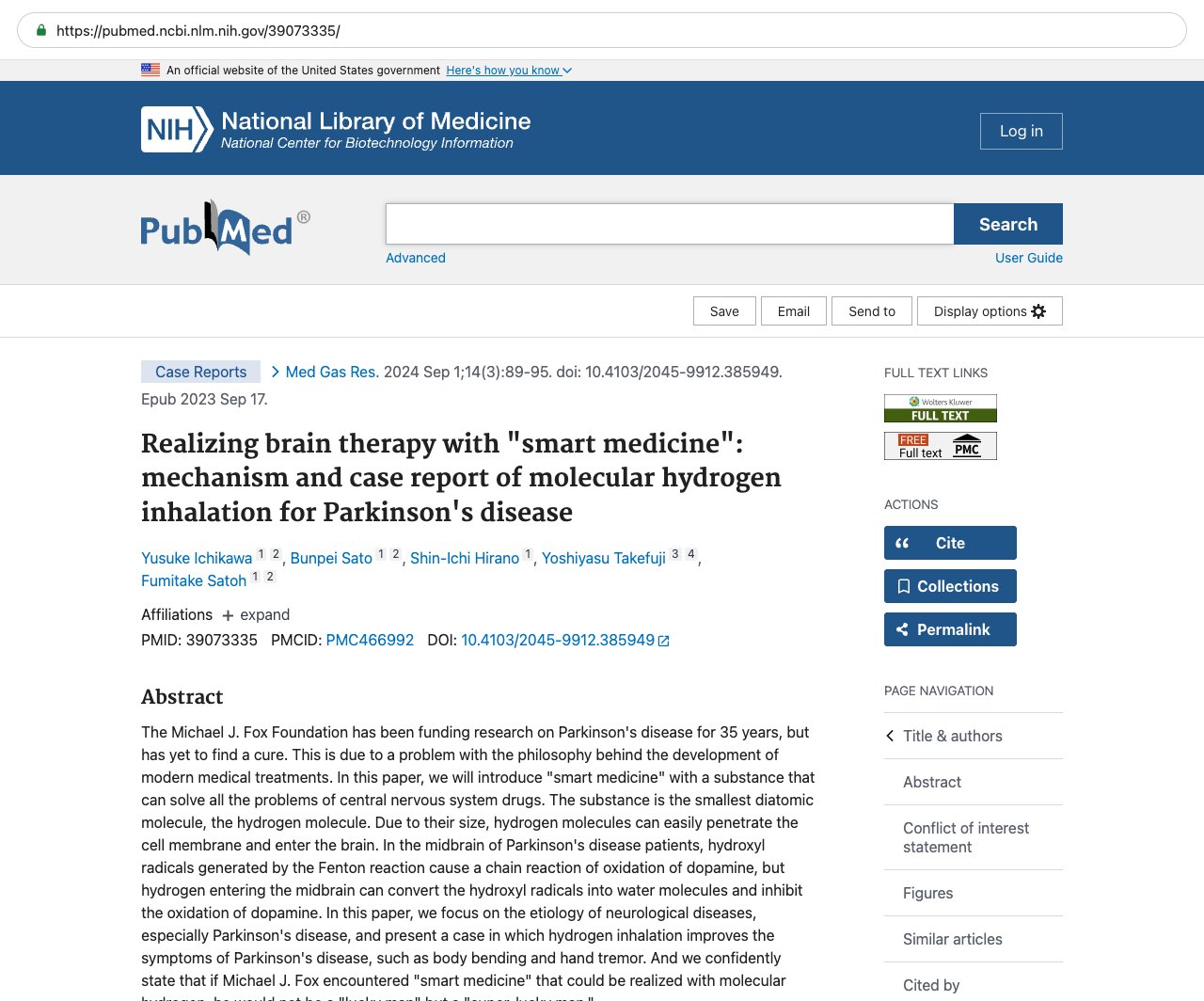
This page mirrors the published abstract (© the authors / publisher) for reference and citation. The canonical source is the PubMed record linked above. This is not medical advice.