2026 Journal of stroke and cerebrovascular diseases : the official journal of National Stroke Association Mechanism / Preclinical Inhalation
2026 · Wang — Hydrogen gas inhalation alleviated cerebral ischemia/reperfusion injury by regulating mitophagy in SH-SY5Y cells and mice via PTEN-induced kinase 1/Parkin pathway.
Super-Abstract
Inhaling molecular hydrogen (H₂) after a stroke-like event (cerebral ischemia/reperfusion) significantly reduced brain tissue damage, neuronal death, and neurological deficits in both mouse models and cell cultures. The key mechanism: H₂ activates the Nrf2/PINK1/Parkin pathway, which clears damaged mitochondria via mitophagy and suppresses both oxidative stress and inflammatory signaling. These are preclinical findings; no human trials are reported here. (Journal of Stroke and Cerebrovascular Diseases, 2026.)
Commentary
This mechanistic study adds an important layer to how H₂ may protect the brain after stroke: not merely by scavenging radicals, but by actively promoting the cellular cleanup of dysfunctional mitochondria — a process called mitophagy. The PINK1/Parkin pathway is a well-established mitochondrial quality-control axis, and the finding that H₂ engages it is a biologically plausible and testable claim. The study uses both an in-vivo mouse model (MCAO/R) and human neuroblastoma cells (SH-SY5Y), and importantly also employs a specific Nrf2 inhibitor (ML385) to confirm causality. However, all results are from animals and cell lines — translation to clinical stroke therapy remains unproven and likely distant. The inhalation approach used here also differs substantially from what might be feasible in an acute stroke setting.
Key quotes
- „H₂ inhalation markedly alleviated neurological deficits, reduced cerebral infarct volume and histopathological damage, inhibited neuronal apoptosis, and promoted mitophagy in MCAO/R mice.“ — primary in-vivo result: broad neuroprotection observed in stroke mouse model
- „inhibition of Nrf2 with ML385 significantly reversed the mitochondrial protective and anti-apoptotic effects of H₂ in OGD/R-exposed cells.“ — causal confirmation: Nrf2 is required for H₂'s protective mechanism
- „H₂ as a potential therapeutic method for CIRI“ — authors' framing — cautious potential, not proven clinical treatment
Our assessment
A methodologically solid preclinical study that advances mechanistic understanding of H₂ neuroprotection. The dual in-vivo/in-vitro design with pharmacological pathway confirmation (ML385 Nrf2 inhibition) strengthens the causal argument. Limitations to state honestly: all evidence is from rodent models and cancer-derived cell lines — no human data, no safety or dosing data for clinical use. MCAO/R in mice is an imperfect model of human ischemic stroke. The paper does not quantify H₂ concentration during inhalation or compare doses. Bottom line: a meaningful mechanistic contribution to H₂ neuroscience, not a basis for clinical recommendations.
Study design
- Type: preclinical mechanistic study (in-vivo + in-vitro) · n: C57BL/6 male mice (3 groups: Sham, MCAO/R, MCAO/H₂); SH-SY5Y cells (4 groups) · H₂ delivery: inhalation (in-vivo, mice); H₂-saturated medium (in-vitro, cells)
- Result: H₂ reduced infarct volume, neurological deficits, apoptosis; enhanced mitophagy via PINK1/Parkin; Nrf2/HO-1 upregulated; NF-κB suppressed; effect abolished by Nrf2 inhibitor ML385 — confirming pathway dependency
Abstract
BACKGROUND: Cerebral ischemia-reperfusion injury (CIRI) causes severe neuronal damage following restoration of cerebral blood flow, and mitochondrial dysfunction acts as a core pathological driver of this process. Molecular hydrogen (H₂) has exhibited promising neuroprotective effects in multiple neurological disease models, yet it remains unclear whether H2 alleviates CIRI by modulating mitophagy and its upstream regulatory signaling pathways. METHODS: In vivo experiments were performed using male C57BL/6 mice subjected to middle cerebral artery occlusion/reperfusion (MCAO/R) with mice randomly divided into three groups: Sham group, MCAO/R group, and MCAO/H₂ group. In vitro, human neuroblastoma SH-SY5Y cells were exposed to oxygen-glucose deprivation/reoxygenation (OGD/R), with four experimental groups: Control group, OGD/R group, OGD/R + H₂ group, and OGD/R + H₂+ML385 group (5 μM ML385, a specific Nrf2 inhibitor, pretreated for 1 h before OGD). Neurological function was assessed via neurological deficits score (zea-Longa); Cerebral infarct volume was measured by TTC staining; Neuronal histopathological damage and apoptosis were evaluated via HE, Nissl, and TUNEL staining; Cell viability was detected using CCK-8 assay; Cell apoptosis, mitochondrial reactive oxygen species (ROS) levels, and mitochondrial membrane potential (MMP) were analyzed by flow cytometry; Protein expression levels were quantified by Western blotting. RESULTS: In vivo experiments demonstrated that H₂ inhalation markedly alleviated neurological deficits, reduced cerebral infarct volume and histopathological damage, inhibited neuronal apoptosis, and promoted mitophagy in MCAO/R mice. In SH-SY5Y cells, H₂ treatment significantly improved cell viability, attenuated oxidative stress and mitochondrial dysfunction, and enhanced mitophagy via activation of the PINK1/Parkin pathway. Mechanistically, H₂ maintained cellular redox homeostasis, cleared damaged mitochondria, upregulated the Nrf2/HO-1 antioxidant pathway, and suppressed NF-κB-mediated inflammatory signaling. Notably, inhibition of Nrf2 with ML385 significantly reversed the mitochondrial protective and anti-apoptotic effects of H₂ in OGD/R-exposed cells. CONCLUSION: Our findings revealed that H2 exerts significant neuroprotective effects against CIRI by attenuating oxidative stress, inhibiting neuronal apoptosis, and improving mitochondrial function. These effects are closely associated with the activation of the Nrf2/PINK1/Parkin-mediated mitophagy pathway, highlighting H₂ as a potential therapeutic method for CIRI.
Source & links
Screenshot of the PubMed page
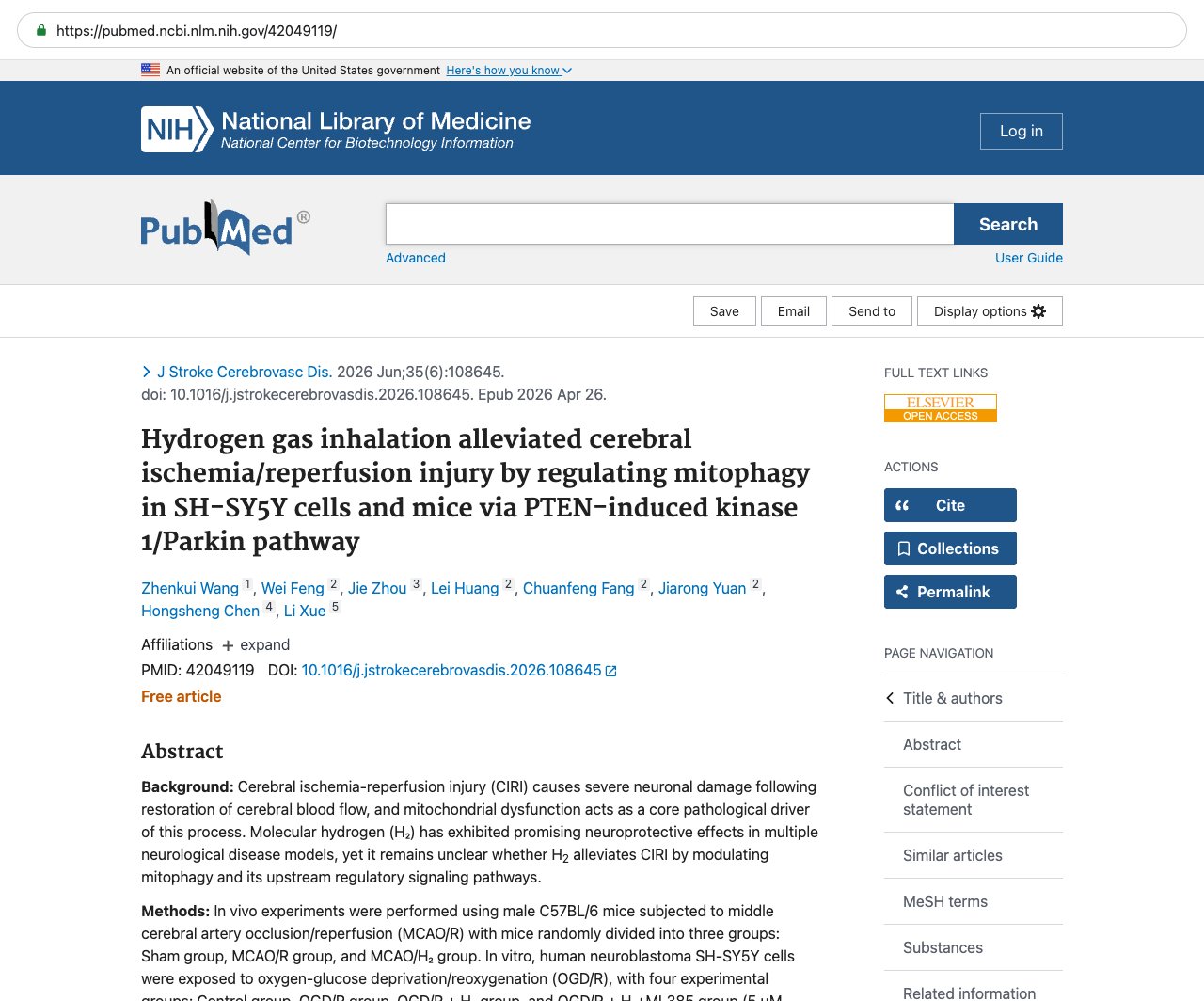
This page mirrors the published abstract (© the authors / publisher) for reference and citation. The canonical source is the PubMed record linked above. This is not medical advice.