2024 · Cui — High-concentration hydrogen inhalation mitigates sepsis-associated encephalopathy in mice by improving mitochondrial dynamics
Super-Abstract
Inhaling high-concentration hydrogen (67%) improved the 7-day survival rate and recognition memory in septic mice — through protection of the mitochondria (the power plants of nerve cells) and less inflammation. (Preclinical study, CNS Neuroscience & Therapeutics, 2024.)
Commentary
This preclinical animal study investigates sepsis-associated encephalopathy (SAE) — a brain injury with poor prognosis in which mitochondrial function plays a key role. The sepsis model was induced by ligating and puncturing the cecum (cecal ligation and puncture); the mice inhaled 67% H₂ for one hour each at 1 and 6 hours after surgery. Result: the 7-day survival rate rose, and recognition memory (measured with the Y-maze and Morris water maze tests) improved. At the molecular level, H₂ raised the antioxidant enzymes SOD and CAT in the brain, lowered pro-inflammatory cytokines in the blood, and improved mitochondrial function (membrane potential MMP and ATP in the hippocampus). Mechanistically, H₂ increased the fusion and biogenesis proteins (MFN2, PGC-1α, NRF2, TFAM) and lowered the fission protein DRP1 — i.e. the mitochondria were stabilized. For honesty: this is a mouse study with a very high H₂ concentration (67%), not human evidence — but it provides a clean mechanism for the neuroprotective effect.
Key quotes
- „Inhalation of 67% H2 improved the 7-day survival rates and recognition memory function of septic mice, alleviated brain antioxidant enzyme activity (SOD and CAT), and reduced serum proinflammatory cytokine levels.“ — the central proof of effect in the animal model
- „H2 inhalation also enhanced the expression of MFN2 and mitochondrial biogenesis-related factors (PGC-1α, NRF2, and TFAM) and decreased the expression of fission protein (DRP1), leading to improvement in mitochondrial function.“ — the mechanism: stabilized mitochondrial dynamics
- „Its mechanism might be mediated by enhancing mitochondrial biogenesis and mitochondrial dynamics.“ — the authors' cautious conclusion („might“)
Our assessment
The study deepens the mechanism of why H₂ acts neuroprotectively — it shows concretely the mitochondrial level and thus complements the classic antioxidant picture from Ohsawa 2007. For everyday applications it is only indirectly relevant: it concerns an intensive-care emergency inhalation with 67% H₂, not hydrogen water for everyday use — a transfer to consumer products is not permissible. Its value lies as a mechanistic building block. Limitations, stated honestly: purely preclinical (mouse), a very high and clinically unusual H₂ concentration, and the authors themselves phrase the mechanism cautiously with „might“.
Study design
- Type: preclinical (mouse model, sepsis by cecal ligation and puncture) · n: — (mouse groups) · Duration: 1 h inhalation each, 1 h and 6 h post-surgery; 7-day observation · H₂ delivery: inhalation of 67% H₂
- Result metrics: ↑ 7-day survival; ↑ recognition memory (Y-maze, Morris water maze); ↑ SOD/CAT; ↓ pro-inflammatory cytokines; ↑ MMP/ATP; ↑ MFN2/PGC-1α/NRF2/TFAM; ↓ DRP1
Abstract
Sepsis-associated encephalopathy (SAE) is a neuronal injury with poor prognosis. Mitochondrial dysfunction is critical in SAE development, and hydrogen gas (H2) has a protective effect on septic mice. This study aimed to investigate the effect of high concentration (67%) of H2 on SAE and whether it is related to mitochondrial biogenesis and mitochondrial dynamics. A mouse sepsis model was induced by cecal ligation and puncture. The mice inhalated 67% H2 for 1 h at 1 and 6 h post-surgery, respectively. The 7-day survival rate was recorded. Cognitive function was assessed using the Y-maze test and Morris water maze test. Serum inflammatory factors, antioxidant enzymes, as well as mitochondrial function indexes including mitochondrial membrane potential (MMP) and ATP in the hippocampal tissue were evaluated 24 h after surgery. Mitochondrial dynamic proteins (DRP1 and MFN2) and biosynthetic proteins (PGC-1α, NRF2, and TFAM) in the hippocampal tissue were detected. Moreover, the morphology of mitochondria was observed by transmission electron microscopy. Inhalation of 67% H2 improved the 7-day survival rates and recognition memory function of septic mice, alleviated brain antioxidant enzyme activity (SOD and CAT), and reduced serum proinflammatory cytokine levels. H2 inhalation also enhanced the expression of MFN2 and mitochondrial biogenesis-related factors (PGC-1α, NRF2, and TFAM) and decreased the expression of fission protein (DRP1), leading to improvement in mitochondrial function, as evidenced by MMP and ATP levels. Inhalation of high concentration (67%) of H2 in septic mice improved the survival rate and reduced neuronal injury. Its mechanism might be mediated by enhancing mitochondrial biogenesis and mitochondrial dynamics.
Source & links
Screenshot of the PubMed page
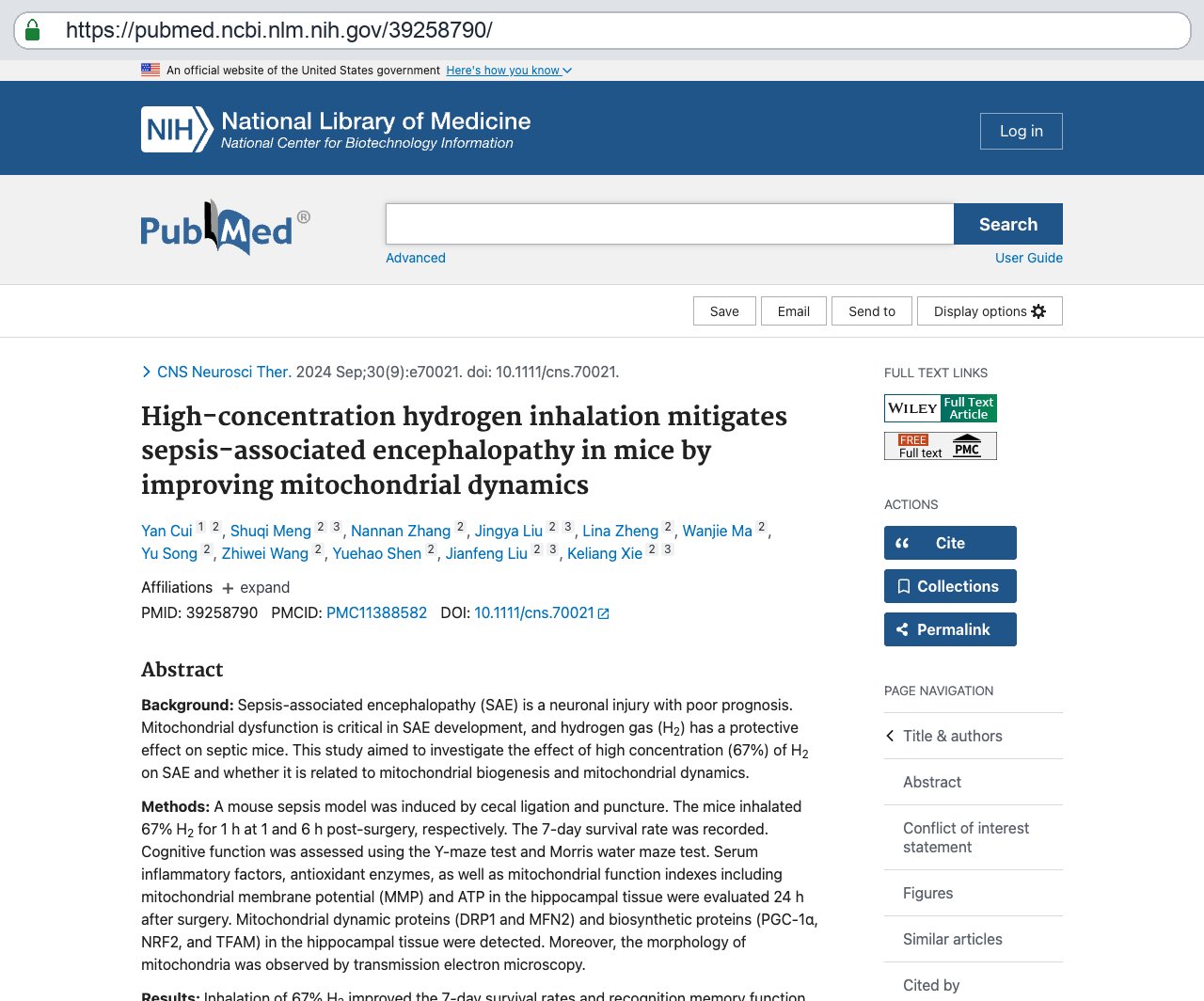
This page mirrors the published abstract (© the authors / publisher) for reference and citation. The canonical source is the PubMed record linked above. This is not medical advice.