2026 · Zhao — Molecular hydrogen triggers TRPC4-TRPC4AP-dependent reversible calcium transients via extracellular influx
Super-Abstract
For the first time, researchers have identified a specific ion channel — TRPC4, activated via its binding partner TRPC4AP — as the molecular target through which inhaled hydrogen gas triggers rapid, reversible calcium signals in living cells and in the brains and skin of living mice. These calcium transients enhanced cell motility and were completely absent when TRPC4 or TRPC4AP genes were knocked out, establishing a direct mechanistic link between H₂ and calcium signalling. (Theranostics, 2026.)
Commentary
This is one of the most mechanistically detailed studies published on how H₂ exerts its biological effects at the molecular level. The identification of the TRPC4-TRPC4AP calcium channel axis as an H₂ sensor is significant: it provides a specific, testable molecular mechanism rather than the generic „antioxidant“ framing that dominates much H₂ literature. The dual Arg730/Arg731 motif in TRPC4 as the H₂-sensitive site adds precision. Two-photon in-vivo calcium imaging in mouse motor cortex is a technically demanding validation. The RNA sequencing data further support cytoskeletal remodelling as a downstream consequence. The study is almost entirely preclinical (cell lines and mice); no human data are reported. However, as a mechanistic foundation for understanding H₂ biology, this is an important contribution.
Key quotes
- „H2 elicited rapid and reversible [Ca2+ i]t across multiple cell types in a Ca2+- and concentration-dependent manner, an effect that was absent in TRPC4⁻/⁻ or TRPC4AP⁻/⁻ cells.“ — the causal link between H₂ and calcium signalling via specific gene knockouts
- „The 730Arg-731Arg motif in TRPC4 serves as a critical H2-sensitive site, enabling dynamic calcium homeostasis without overload.“ — the specific molecular site mediating H₂ sensitivity
- „This study identifies H2 as a novel gaseous signaling molecule that can regulate Ca2+ channels via the TRPC4-TRPC4AP axis.“ — the central mechanistic conclusion
Our assessment
This is a mechanistic preclinical study (cell lines + mouse in-vivo models). It makes no therapeutic claims and presents no patient data. Its significance lies in identifying a specific molecular target for H₂ — the TRPC4-TRPC4AP calcium channel axis — which provides a framework for future drug development and helps explain the pleiotropic effects of H₂ across diverse tissues. These findings are not directly transferable to clinical recommendations but represent an important mechanistic advance for the field.
Study design
- Type: preclinical mechanistic study · Model: multiple cell lines (TRPC4⁻/⁻, TRPC4AP⁻/⁻ CRISPR knockouts) + C57BL/6 mice with AAV calcium sensors · H₂ delivery: inhalation (in-vivo), dissolved gas (in-vitro)
- Key methods: real-time calcium imaging, CRISPR-Cas9 gene editing, two-photon in-vivo brain/skin imaging, protein docking, molecular dynamics simulation, RNA sequencing
- Key finding: H₂ triggers TRPC4/TRPC4AP-dependent Ca²⁺ transients; Arg730/Arg731 in TRPC4 is the H₂-sensitive site; calcium signal enhanced cell motility; transcriptomics confirmed cytoskeletal remodelling
Abstract
RATIONALE: Hydrogen gas (H2) produces pleiotropic therapeutic actions, but the exact molecular targets and ion-channel-based signaling cascades that underlie these benefits remain elusive. H2 may regulate calcium ion (Ca2+)-dependent processes, but the direct involvement of H2 in Ca2+ signaling and its underlying molecular mechanisms are unknown. We propose that H2 functions as a gaseous messenger that selectively opens a plasma-membrane Ca2+ channel to evoke Ca2+ transients ([Ca2+ i]t) while avoiding cytotoxic overload, thereby offering a mechanism for its diverse biological effects. METHODS: This study employed real-time calcium imaging and CRISPR-Cas9 gene editing, with live-cell imaging to monitor real-time calcium signal intensity in living cells. Two-photon in vivo imaging was applied to detect real-time Ca2+ signals in the brain and dorsal skin of C57BL/6 mice carrying adeno-associated virus-delivered calcium sensors. Live-cell F-actin staining and a wound healing (scratch) assay were used to assess the effects of H2 on cell motility. Protein-protein docking and molecular dynamics simulations were performed to analyze the interaction interface and binding forces between TRPC4 and TRPC4AP in three-dimensional space. Additionally, RNA sequencing was performed to validate downstream biological effects and transcriptional regulation triggered by H2. RESULTS: H2 elicited rapid and reversible [Ca2+ i]t across multiple cell types in a Ca2+- and concentration-dependent manner, an effect that was absent in TRPC4⁻/⁻ or TRPC4AP⁻/⁻ cells. In vivo imaging in mice expressing a genetically encoded Ca²⁺ sensor showed that H2 inhalation elevated Ca2+ signals in the motor cortex (M1 region) and dorsal skin. Functionally, live-cell imaging and wound-healing assays confirmed that H2-induced Ca2+ transients enhanced cell motility. Mechanistically, protein docking revealed a dual-arginine cluster within the CIRB domain of TRPC4; its interaction with TRPC4AP was essential for H2-evoked Ca2+ influx. Mutating these arginines to alanine residues completely abolishing the response. H2 triggered proton efflux and increased intracellular pH. Molecular dynamics simulations indicated that altered pH modulates the binding force between TRPC4 Arg730/Arg731 and TRPC4AP. Transcriptomic analysis further demonstrated that H2 activates calcium-related channels and promotes cytoskeletal remodeling and cell migration. CONCLUSIONS: This study identifies H2 as a novel gaseous signaling molecule that can regulate Ca2+ channels via the TRPC4-TRPC4AP axis. The 730Arg-731Arg motif in TRPC4 serves as a critical H2-sensitive site, enabling dynamic calcium homeostasis without overload. These findings provide a mechanistic framework for developing gas-controlled H2 regenerative therapeutics.
Source & links
Screenshot of the PubMed page
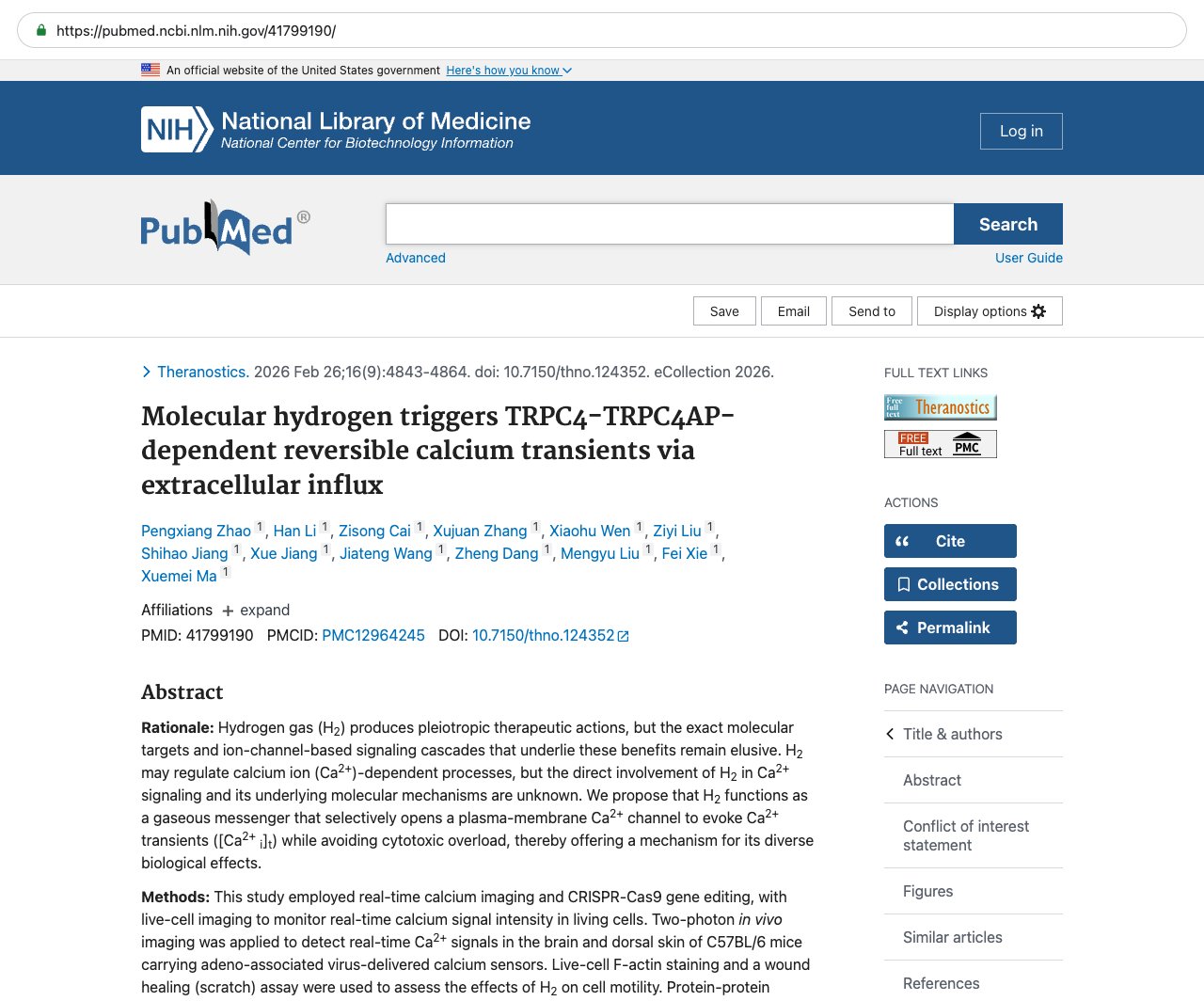
This page mirrors the published abstract (© the authors / publisher) for reference and citation. The canonical source is the PubMed record linked above. This is not medical advice.