2022 · Ge — Microbial hydrogen economy alleviates colitis by reprogramming colonocyte metabolism and reinforcing intestinal barrier
Super-Abstract
In mice with experimentally induced acute colitis, hydrogen-rich saline administration reduced intestinal inflammation, increased beneficial short-chain fatty acid (SCFA)-producing bacteria, and strengthened the gut barrier. The proposed mechanism centers on the H₂–gut microbiota–SCFA axis and modulation of specific bacteria that degrade the protective mucus layer. This is an animal study; results cannot be directly transferred to humans. (Gut Microbes, 2022.)
Commentary
The „microbial hydrogen economy“ refers to the balance between H₂-producing (hydrogenogenic) and H₂-consuming (hydrogenotrophic) microbes in the gut — a balance that appears critical for colonic health. This study uses dextran sulfate sodium (DSS)-induced colitis in mice as its experimental model, which is a standard but imperfect proxy for human inflammatory bowel disease. Hydrogen-rich saline (HS) was administered either by inhalation or intraperitoneal injection. The most mechanistically interesting finding is that HS increased the abundance of SCFA-producing bacteria and, consequently, SCFA levels. SCFAs — particularly butyrate — activate the peroxisome proliferator-activated receptor γ (PPARγ) pathway in colonocytes, which normally suppresses Nos2 (inducible nitric oxide synthase) and thereby maintains the anaerobic environment essential for healthy gut bacteria. A secondary pathway involved reduction of specific mucus-degrading bacteria, preserving the mucus layer and reinforcing tight junction proteins. The paper also notes suppression of opportunistic Escherichia coli expansion. Together, the data paint a picture of H₂ acting indirectly on the gut ecosystem rather than as a direct anti-inflammatory drug.
Key quotes
- „Exogenous H2 reprograms colonocyte metabolism by regulating the H2-gut microbiota-SCFAs axis and strengthens the intestinal barrier by modulating specific mucosa-associated mucolytic bacteria.“ — the two-pathway summary: colonocyte metabolism + barrier integrity
- „HS administration can increase the abundance of intestinal-specific short-chain fatty acid (SCFA)-producing bacteria and SCFA production, thereby activating the intracellular butyrate sensor peroxisome proliferator-activated receptor γ signaling.“ — the core metabolic mechanism via butyrate/PPARγ
- „improved microbial hydrogen economy alleviates colitis.“ — the overarching conclusion linking H₂ to microbiome balance
Our assessment
A mechanistically rich preclinical animal study that provides a multi-pathway explanation for H₂'s anti-colitis effects. The DSS model is widely used but does not fully replicate human IBD. All results are from mice, and direct human relevance requires clinical confirmation. The microbiota–SCFA–PPARγ axis is a compelling and scientifically plausible pathway, making this paper a useful reference for hypothesis-building. The two delivery routes (inhalation and intraperitoneal saline injection) also help distinguish H₂-specific effects from saline effects.
Study design
- Type: preclinical animal study (in-vivo) · Model: DSS-induced acute colitis in mice · H₂ delivery: hydrogen-rich saline (HS) by inhalation or intraperitoneal injection
- Result: HS ameliorated colitis; increased SCFA-producing bacteria and SCFA levels; activated PPARγ, decreased Nos2 expression; reduced mucolytic bacteria; enhanced tight junction proteins; decreased intestinal permeability; suppressed pathogenic E. coli expansion
Abstract
With the rapid development and high therapeutic efficiency and biosafety of gas-involving theranostics, hydrogen medicine has been particularly outstanding because hydrogen gas (H2), a microbial-derived gas, has potent anti-oxidative, anti-apoptotic, and anti-inflammatory activities in many disease models. Studies have suggested that H2-enriched saline/water alleviates colitis in murine models; however, the underlying mechanism remains poorly understood. Despite evidence demonstrating the importance of the microbial hydrogen economy, which reflects the balance between H2-producing (hydrogenogenic) and H2-utilizing (hydrogenotrophic) microbes in maintaining colonic mucosal ecosystems, minimal efforts have been exerted to manipulate relevant H2-microbe interactions for colonic health. Consistent with previous studies, we found that administration of hydrogen-rich saline (HS) ameliorated dextran sulfate sodium-induced acute colitis in a mouse model. Furthermore, we demonstrated that HS administration can increase the abundance of intestinal-specific short-chain fatty acid (SCFA)-producing bacteria and SCFA production, thereby activating the intracellular butyrate sensor peroxisome proliferator-activated receptor γ signaling and decreasing the epithelial expression of Nos2, consequently promoting the recovery of the colonic anaerobic environment. Our results also indicated that HS administration ameliorated disrupted intestinal barrier functions by modulating specific mucosa-associated mucolytic bacteria, leading to substantial inhibition of opportunistic pathogenic Escherichia coli expansion as well as a significant increase in the expression of interepithelial tight junction proteins and a decrease in intestinal barrier permeability in mice with colitis. Exogenous H2 reprograms colonocyte metabolism by regulating the H2-gut microbiota-SCFAs axis and strengthens the intestinal barrier by modulating specific mucosa-associated mucolytic bacteria, wherein improved microbial hydrogen economy alleviates colitis.
Source & links
Screenshot of the PubMed page
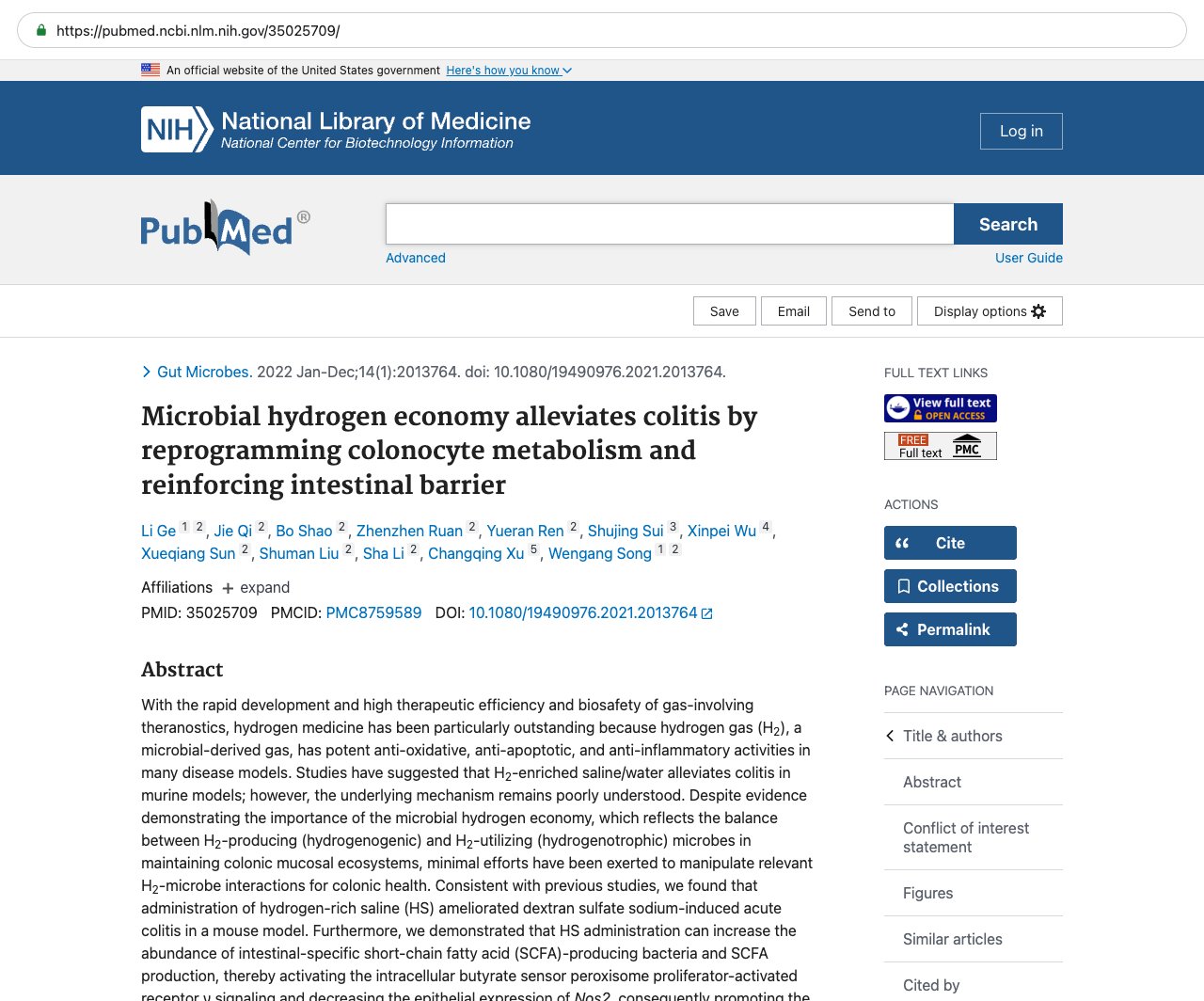
This page mirrors the published abstract (© the authors / publisher) for reference and citation. The canonical source is the PubMed record linked above. This is not medical advice.