2025 · Moriya et al. — Hydrogen Inhalation Is Associated With a Transient Rightward Shift in Prefrontal Oxyhemoglobin Asymmetry and Autonomic Modulation
Super-Abstract
A single 30-minute session of pure hydrogen gas inhalation (99.9 % H₂, 300 mL/min via nasal cannula) transiently increased oxygenation in the right prefrontal cortex and simultaneously altered heart-rate variability in healthy adults — findings consistent with a brief, coordinated neurovascular-autonomic response. Both effects normalised within 90 minutes of stopping inhalation. (Scientific Reports, 2025.)
Commentary
This study asks a question that has received surprisingly little direct attention: what does H₂ actually do to the brain and autonomic nervous system in real time, in healthy humans? The methodology is solid for an exploratory study — time-domain near-infrared spectroscopy for prefrontal oxygenation combined with continuous ECG-derived heart-rate variability provides simultaneous central and autonomic readouts. The rightward shift in prefrontal oxy-Hb asymmetry is an intriguing finding: right-dominant PFC activation is associated in neuroscience with certain stress responses, withdrawal behaviour, and negative affect — but the clinical meaning here is unclear and should not be over-interpreted. The autonomic sequence (sympathetic activation during inhalation → parasympathetic recovery afterwards) is physiologically plausible and consistent with a mild, transient stress-like response. Critically, all effects were transient and resolved within 90 minutes. Using 99.9 % pure hydrogen via nasal cannula is also not a clinically deployed protocol — most therapeutic approaches use 2–4 % H₂ — making direct clinical translation uncertain.
Key quotes
- „Hydrogen inhalation elicited robust, transient increases in the right-PFC asymmetry of the oxy-Hb concentration.“ — the main cerebral finding — transient and lateralised
- „the LF/HF ratio increased during inhalation, indicating sympathetic activation, followed by decreases in the heart rate after inhalation, consistent with parasympathetic recovery.“ — the autonomic sequence: sympathetic activation then parasympathetic rebound
- „acute hydrogen inhalation transiently modulates PFC oxygenation lateralization and autonomic tone, suggesting potential relevance to cognitive and cardiovascular regulation.“ — the authors' cautious interpretation of clinical relevance
Our assessment
A well-designed exploratory physiology study in healthy adults. Its value lies in documenting acute neurovascular and autonomic responses to H₂ inhalation — territory largely unexplored in humans. Limitations: small sample (n not specified in abstract), healthy volunteers only, high-concentration H₂ protocol (99.9 %) not representative of therapeutic use, no cognitive performance outcomes measured, unclear whether the right-PFC shift has any beneficial or adverse clinical meaning. The transient nature of all effects reinforces the need for repeated-dose or longer-exposure trials before drawing conclusions about cognitive or cardiovascular benefit.
Study design
- Type: acute crossover physiology study in healthy adults · H₂ delivery: 99.9 % H₂ gas via nasal cannula, 300 mL/min, single 30-minute session
- Cerebral outcome: transient increase in right-PFC oxyhemoglobin asymmetry index (TD-NIRS), returning to baseline by 90 min post-inhalation
- Autonomic outcome: increased LF/HF ratio (sympathetic activation) during inhalation; decreased heart rate post-inhalation (parasympathetic recovery)
Abstract
Molecular hydrogen (H2) has selective antioxidant and anti-inflammatory properties, yet its immediate effects on human cerebral oxygenation and autonomic function remain unclear. In this study, we evaluated acute central and autonomic responses to a single 30-minute session of hydrogen inhalation in healthy adults, using 99.9% hydrogen delivered via nasal cannula at a fixed flow rate of 300 mL/min. Cerebral oxygenation was assessed using time-domain near-infrared spectroscopy (TD-NIRS) to quantify the concentrations of oxyhemoglobin (oxy-Hb) and deoxyhemoglobin (deoxy-Hb) in the bilateral prefrontal cortex (PFC), and to calculate interhemispheric asymmetry indices before hydrogen inhalation, immediately after the end of inhalation, and at 30 and 90 min thereafter. Autonomic activity was assessed via continuous electrocardiography (ECG) to derive heart rate, R-R interval, and frequency-domain heart rate variability metrics (low-frequency (LF), high-frequency (HF) and LF/HF ratio). Hydrogen inhalation elicited robust, transient increases in the right-PFC asymmetry of the oxy-Hb concentration. Concurrently, the LF/HF ratio increased during inhalation, indicating sympathetic activation, followed by decreases in the heart rate after inhalation, consistent with parasympathetic recovery. These parallel cerebral and autonomic responses suggest a coordinated neurovascular-autonomic coupling in response to hydrogen inhalation. Our findings show that acute hydrogen inhalation transiently modulates PFC oxygenation lateralization and autonomic tone, suggesting potential relevance to cognitive and cardiovascular regulation.
Source & links
Screenshot of the PubMed page
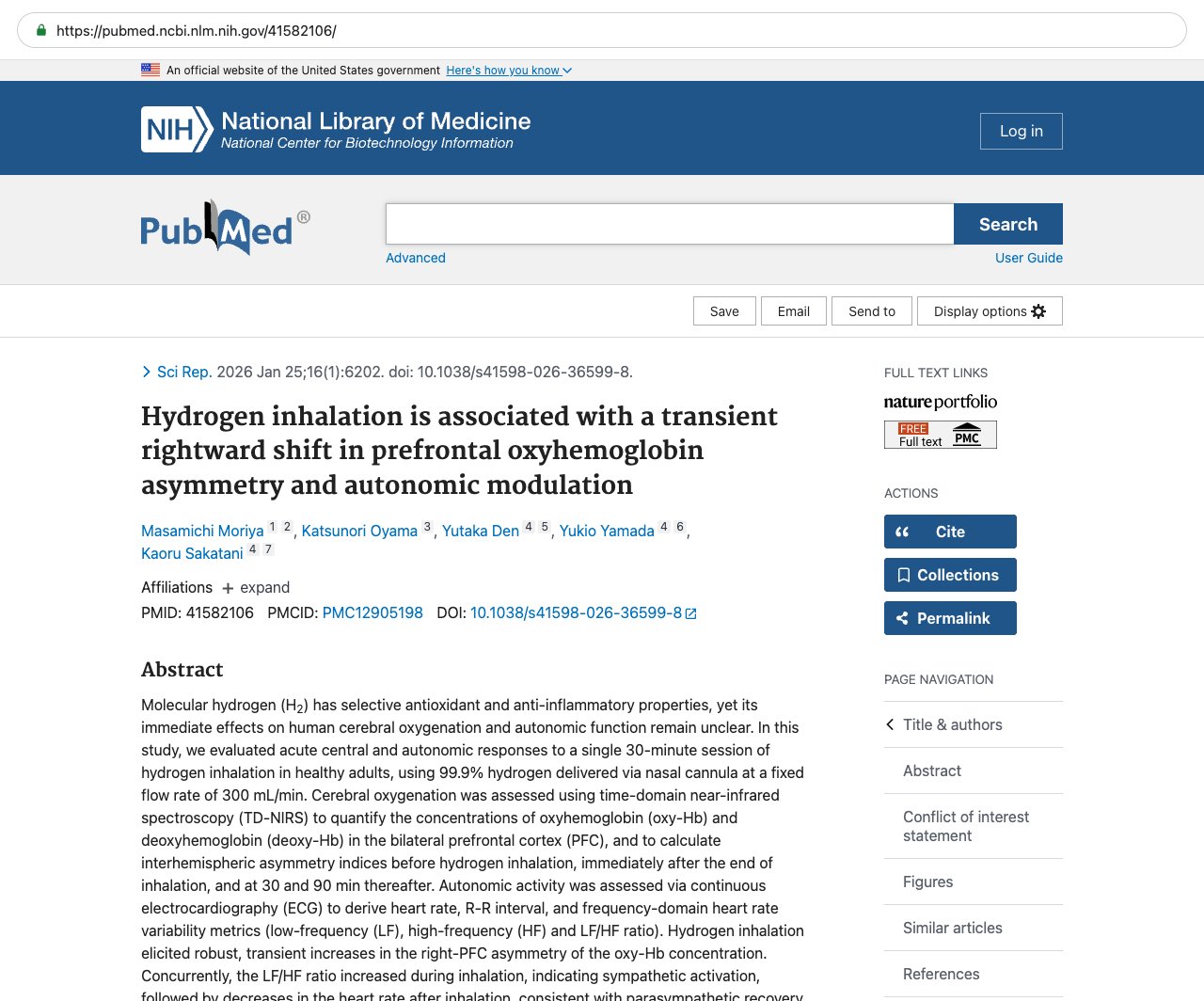
This page mirrors the published abstract (© the authors / publisher) for reference and citation. The canonical source is the PubMed record linked above. This is not medical advice.