2016 · Iuchi — Molecular Hydrogen Regulates Gene Expression by Modifying the Free Radical Chain Reaction-Dependent Generation of Oxidized Phospholipid Mediators
Super-Abstract
Molecular hydrogen (H₂) may regulate gene expression not by directly targeting DNA or transcription factors, but by modifying how oxidized phospholipids are produced through free radical chain reactions. This in-vitro study suggests H₂ attenuates lipid peroxidation and thereby shapes calcium-dependent signaling and downstream gene activity. It is a cell and chemical study, not a human trial. (Scientific Reports, 2016.)
Commentary
One outstanding question in hydrogen biology is: if H₂ selectively scavenges only the most reactive radicals, how does it influence such a wide range of gene expression changes seen in experiments? Iuchi et al. propose a secondary mechanism: H₂ does not directly touch genes or transcription factors — instead it modifies the chemical profile of oxidized phospholipid species generated by free radical chain reactions (autoxidation). These oxidized phospholipids are known signaling mediators that influence calcium (Ca²⁺) ion fluxes, which in turn regulate many genes. In a pure chemical system, ~1 % H₂ gas suppressed linoleic acid autoxidation. In cell-culture experiments, the H₂-altered phospholipid mix reduced Ca²⁺ signaling and changed the expression of numerous genes detectable by microarray. The study fills an important gap in the mechanistic understanding of H₂ biology but is entirely cell/chemical-based — no organism-level or human data.
Key quotes
- „H2 suppressed free radical chain reaction-dependent peroxidation and recovered the increased cellular Ca(2+), resulting in the regulation of Ca(2+)-dependent gene expression.“ — the proposed signaling chain: H₂ → less lipid peroxidation → less Ca²⁺ rise → altered gene expression
- „H2 modified the chemical production of the autoxidized phospholipid species in the cell-free system.“ — H₂ acts upstream at the chemistry level, not directly on genes
- „H2 might regulate gene expression via the Ca(2+) signal transduction pathway by modifying the free radical-dependent generation of oxidized phospholipid mediators.“ — the authors' proposed mechanistic model
Our assessment
This is an in-vitro and cell-free chemistry study — not a clinical or animal study. It makes a mechanistically plausible and novel proposal: H₂ shapes gene expression indirectly by altering the oxidized phospholipid landscape, which then modulates Ca²⁺ signaling. The chemical evidence (linoleic acid autoxidation suppression) is solid. The cell microarray data is consistent but requires careful interpretation — hundreds of gene-expression changes from a complex phospholipid mix may reflect non-specific effects. The key limitation is that concentrations and conditions in cell culture systems rarely mirror in-vivo physiology. No human data; no clinical relevance can be drawn directly. Scientifically, this is valuable mechanistic groundwork.
Study design
- Type: in-vitro and cell-free chemistry study · Model: linoleic acid and PAPC phospholipid autoxidation in chemical system; cultured cells exposed to H₂-modified phospholipid species · H₂ delivery: ~1 % H₂ gas (v/v) in chemical system; H₂-treated phospholipids applied to cells
- Result: H₂ suppressed linoleic acid autoxidation; altered oxidized phospholipid species profile; reduced Ca²⁺ signal transduction in cells; regulated expression of multiple genes by microarray — all in cell-free or cell-culture systems, no in-vivo or human data
Abstract
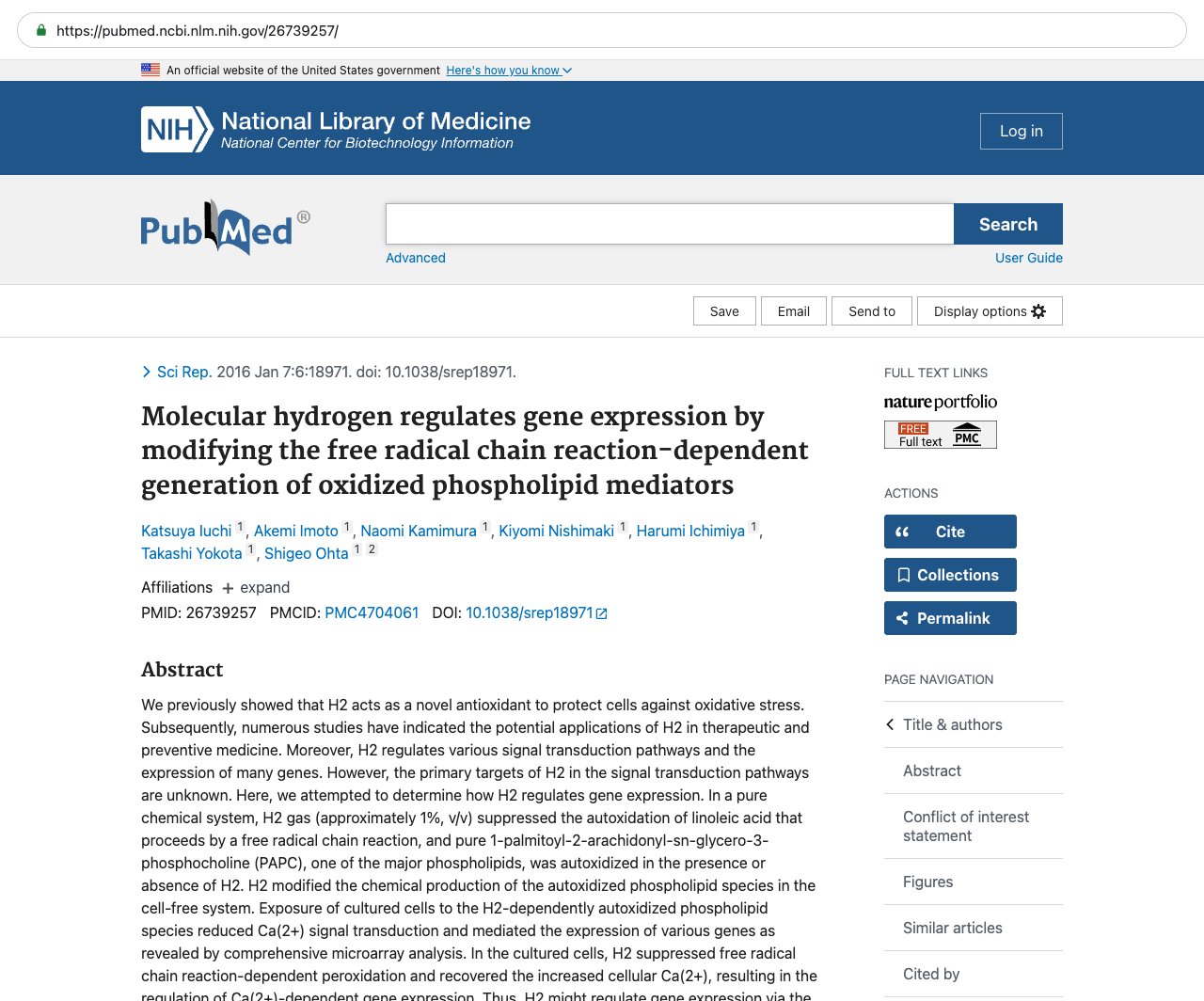
We previously showed that H2 acts as a novel antioxidant to protect cells against oxidative stress. Subsequently, numerous studies have indicated the potential applications of H2 in therapeutic and preventive medicine. Moreover, H2 regulates various signal transduction pathways and the expression of many genes. However, the primary targets of H2 in the signal transduction pathways are unknown. Here, we attempted to determine how H2 regulates gene expression. In a pure chemical system, H2 gas (approximately 1%, v/v) suppressed the autoxidation of linoleic acid that proceeds by a free radical chain reaction, and pure 1-palmitoyl-2-arachidonyl-sn-glycero-3-phosphocholine (PAPC), one of the major phospholipids, was autoxidized in the presence or absence of H2. H2 modified the chemical production of the autoxidized phospholipid species in the cell-free system. Exposure of cultured cells to the H2-dependently autoxidized phospholipid species reduced Ca(2+) signal transduction and mediated the expression of various genes as revealed by comprehensive microarray analysis. In the cultured cells, H2 suppressed free radical chain reaction-dependent peroxidation and recovered the increased cellular Ca(2+), resulting in the regulation of Ca(2+)-dependent gene expression. Thus, H2 might regulate gene expression via the Ca(2+) signal transduction pathway by modifying the free radical-dependent generation of oxidized phospholipid mediators.
Source & links
Screenshot of the PubMed page
This page mirrors the published abstract (© the authors / publisher) for reference and citation. The canonical source is the PubMed record linked above. This is not medical advice.