2025 · Tian — Molecular hydrogen attenuates cisplatin-induced nephrotoxicity by modulating β-hydroxybutyrate metabolism
Super-Abstract
Hydrogen (H₂) protects the kidney against chemotherapy damage: In a mouse model, inhaled H₂ markedly mitigated the kidney injury caused by the cancer drug cisplatin — via a newly discovered metabolic pathway: H₂ boosts the formation of the ketone body β-hydroxybutyrate, thereby dampening inflammation and cell death in kidney tissue. (Molecular Biology Reports, 2025.)
Commentary
Cisplatin is one of the most effective chemotherapeutics there is — but its biggest problem is that it damages the kidneys and therefore cannot be dosed arbitrarily high. This is exactly where this preclinical study comes in: Tian's team established a mouse model of cisplatin-induced acute kidney injury (AKI) and additionally treated some of the animals with inhaled hydrogen gas. The result: H₂ inhalation markedly reduced kidney injury, measured by less inflammation and less programmed cell death (apoptosis, demonstrated via TUNEL staining, ELISA and immunohistochemistry). The discovered mechanism is intriguing: through RNA sequencing, the team found that H₂ upregulates ketone body metabolism — specifically the enzyme HMGCS2, which drives the formation of β-hydroxybutyrate (β-HOB). This β-HOB appears to be an important mediator of the kidney-protective effect. This extends the classic picture of H₂ as a mere radical scavenger by a genuine metabolic component. One must stay honest about the scope: this is an animal and cell study — direct evidence in humans is lacking, and whether this translates to real chemotherapy patients must first be shown by clinical trials.
Key quotes
- „H2 inhalation significantly attenuated cisplatin-induced kidney injury by reducing inflammation and apoptosis in renal tissue.“ — the core finding: less kidney damage through H₂ inhalation
- „Transcriptomic analysis revealed that H2 upregulated the ketone body metabolic pathway, particularly enhancing β-hydroxybutyrate (β-HOB) synthesis via increased expression of the ketogenic enzyme 3-hydroxy-3-methylglutaryl-CoA synthase 2 (HMGCS2).“ — the newly discovered metabolic mechanism
- „Molecular hydrogen confers protection against cisplatin-induced nephrotoxicity by modulating β-HOB metabolism through upregulation of HMGCS2, thereby suppressing renal inflammation and apoptosis.“ — the authors' overall conclusion
Our assessment
The study is relevant for H₂ research because it goes beyond the known radical-scavenger effect and points to a concrete metabolic pathway (ketone bodies/β-HOB) — that is mechanistically novel and well documented. It fits into the line of tissue-protection studies, but is not evidence for consuming H₂ water: H₂ was delivered here by inhalation, not via drinking water. Limitations, stated honestly: purely preclinical (mouse + cells), no human data; the transfer to patients is open; and the topic of „protection against chemo side effects“ is medically sensitive — no healing promises may be derived from it. Furthermore: the dataset listed a DOI that does not match the journal/year (Hindawi prefix + an embedded year 2019 for a 2025 paper) — it was omitted as probably incorrect; the canonical reference is the PubMed link.
Study design
- Type: preclinical (mouse model + in-vitro validation) · n: not stated in the abstract · Duration: not stated · H₂ delivery: inhalation of H₂ gas
- Result metrics: significant reduction of cisplatin-related kidney injury (less inflammation and apoptosis); upregulation of HMGCS2 and β-hydroxybutyrate (β-HOB) as the mediating mechanism (concrete values/p-values not reported in the abstract)
Abstract
Nephrotoxicity is a common adverse effect of many chemotherapeutic agents and represents a major dose-limiting factor in cancer treatment. Therefore, developing effective renoprotective strategies is urgently needed. Molecular hydrogen (H2) has emerged as a therapeutic agent with potent antioxidant and anti-inflammatory properties, selectively scavenging hydroxyl radicals and alleviating tissue injury. However, the protective effects and underlying mechanisms of H2 in chemotherapy-induced acute kidney injury (AKI) remain poorly understood. A cisplatin-induced AKI mouse model was established with or without H₂ administration. Kidney injury biomarkers were evaluated, and levels of inflammation and apoptosis were assessed using TUNEL staining, ELISA, and immunohistochemistry. To investigate the underlying mechanisms, RNA sequencing was performed, followed by heatmap, Venn diagram, and volcano plot analyses to identify differentially expressed genes. KEGG pathway enrichment analysis was used to explore metabolic alterations upon H2 treatment in cisplatin-induced nephrotoxicity. Subsequently, metabolic alterations were validated through a series of in vivo and in vitro experiments, including ELISA, flow cytometry, qRT-PCR, western blotting, and immunohistochemistry. H2 inhalation significantly attenuated cisplatin-induced kidney injury by reducing inflammation and apoptosis in renal tissue. Transcriptomic analysis revealed that H2 upregulated the ketone body metabolic pathway, particularly enhancing β-hydroxybutyrate (β-HOB) synthesis via increased expression of the ketogenic enzyme 3-hydroxy-3-methylglutaryl-CoA synthase 2 (HMGCS2). Functional assays confirmed that H2-mediated upregulation of HMGCS2 and β-HOB contributed to its renoprotective effects. Molecular hydrogen confers protection against cisplatin-induced nephrotoxicity by modulating β-HOB metabolism through upregulation of HMGCS2, thereby suppressing renal inflammation and apoptosis. These findings provide new insights into the metabolic mechanism underlying H2's tissue-protective effects and offer a theoretical foundation for its potential clinical application in mitigating chemotherapy-induced kidney injury.
Source & links
Screenshot of the PubMed page
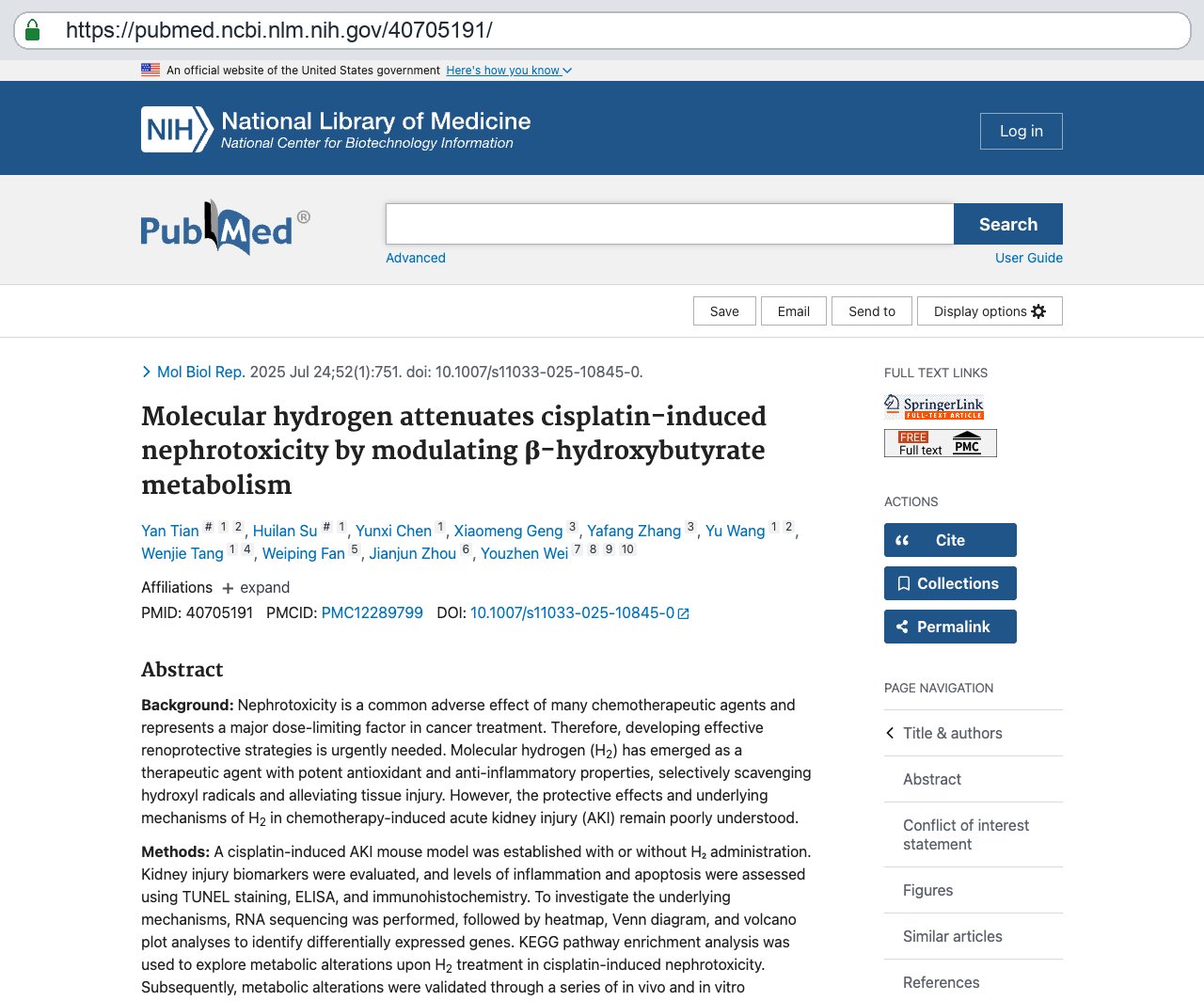
This page mirrors the published abstract (© the authors / publisher) for reference and citation. The canonical source is the PubMed record linked above. This is not medical advice.