2025 · Zhang — Hydrogen attenuates the senescence of adipose-derived stem cells and enhances their myogenic differentiation via modulation of the PRDX6/SIRT1/PGC-1α signaling pathway.
Super-Abstract
Stem cells derived from fat tissue age over time, limiting their potential for regenerative therapies — and hydrogen gas treatment can slow this ageing while simultaneously improving the cells' ability to differentiate into muscle tissue. The study identifies the PRDX6/SIRT1/PGC-1α molecular pathway as a key mediator of hydrogen's protective effect. This is a cell-culture and animal study; no human data are available. (Human & Experimental Toxicology, 2025.)
Commentary
Adipose-derived mesenchymal stem cells (ADSCs) are of practical interest in regenerative medicine because they are readily accessible and multipotent. A recurring clinical problem is that these cells age — both in culture and in older donors — reducing their therapeutic utility. This paper reports that H₂ gas treatment reduces markers of cellular senescence (β-galactosidase positivity, mitochondrial oxidative stress) and enhances myogenic markers (MyHC, myogenin, MYOD) in ADSC cultures. The identified pathway — PRDX6 → SIRT1 → PGC-1α — is a plausible antioxidant/mitochondrial signalling axis, and the pharmacological inhibition experiment (blocking PRDX6 abolished H₂ benefits) provides causal evidence. However, all work is in cell culture with some animal-level validation; there is no clinical data on whether H₂ treatment of donor cells or patients improves stem cell quality or regenerative outcomes in humans.
Key quotes
- „Hydrogen treatment reduced senescence and increased differentiation capacity, as evidenced by higher proportions of MyHC-positive cells, increased myogenin levels, and decreased Muscle RING finger protein1 (MuRF1) expression.“ — key cellular outcomes: less ageing, more muscle differentiation potential
- „Molecular investigations revealed activation of the PRDX6/SIRT1/PGC-1α axis, accompanied by elevated NQO-1 expression.“ — the identified signalling pathway — antioxidant and mitochondrial protection
- „Pharmacological inhibition of PRDX6 largely eliminated the protective effects of hydrogen on cellular aging, disrupted differentiation, and caused mitochondrial dysfunction.“ — causal proof: blocking PRDX6 removes the H₂ benefit — confirming the pathway
Our assessment
A mechanistically well-executed cell/animal study on hydrogen's protective role against stem cell senescence. The pathway identification (PRDX6/SIRT1/PGC-1α) and the inhibition experiment provide genuine scientific value. Critical limitation: this is preclinical research — these are cell-culture and animal findings, not human evidence. The clinical potential for stem-cell-based regenerative therapies is real, but requires human studies to confirm whether H₂ pretreatment of ADSCs or systemic H₂ application improves patient outcomes. No human data exist. Results are promising as a mechanistic foundation, not as a treatment recommendation.
Study design
- Type: in-vitro / animal study (preclinical) · Model: adipose-derived mesenchymal stem cells (ADSCs) treated with hydrogen gas · H₂ delivery: hydrogen gas exposure to cell cultures
- Endpoints: β-galactosidase staining (senescence), MyHC immunofluorescence, MYOD/myogenin expression (myogenic differentiation), mitochondrial oxidative stress markers
- Result: reduced senescence markers; enhanced myogenic differentiation capacity; activation of PRDX6/SIRT1/PGC-1α axis confirmed; PRDX6 pharmacological inhibition abolished H₂ benefits (causal evidence)
Abstract
IntroductionAdipose-derived mesenchymal stem cells (ADSCs) are promising candidates for regenerative therapies, but their clinical application is limited by cellular aging. This study investigated the effects of hydrogen on ADSC senescence and myogenic differentiation, along with the underlying molecular mechanisms.MethodsADSCs were treated with hydrogen gas. Senescence was assessed using β-galactosidase staining, proliferation assays, measurements of mitochondrial oxidative stress, and protein expression analysis. Differentiation capacity was evaluated through MyHC immunofluorescence, MYOD expression profiling, and quantification of myogenic regulatory factors. Additionally, the key molecular pathway of hydrogen's action was investigated by pharmacologically inhibiting PRDX6.ResultsThe findings showed that hydrogen treatment reduced senescence and increased differentiation capacity, as evidenced by higher proportions of MyHC-positive cells, increased myogenin levels, and decreased Muscle RING finger protein1 (MuRF1) expression. Molecular investigations revealed activation of the PRDX6/SIRT1/PGC-1α axis, accompanied by elevated NQO-1 expression. Importantly, pharmacological inhibition of PRDX6 largely eliminated the protective effects of hydrogen on cellular aging, disrupted differentiation, and caused mitochondrial dysfunction.DiscussionThese results suggest that hydrogen can regulate ADSC behavior via PRDX6-driven activation of SIRT1/PGC-1α signaling, offering potential approaches to improve stem cell quality for regenerative medicine.
Source & links
Screenshot of the PubMed page
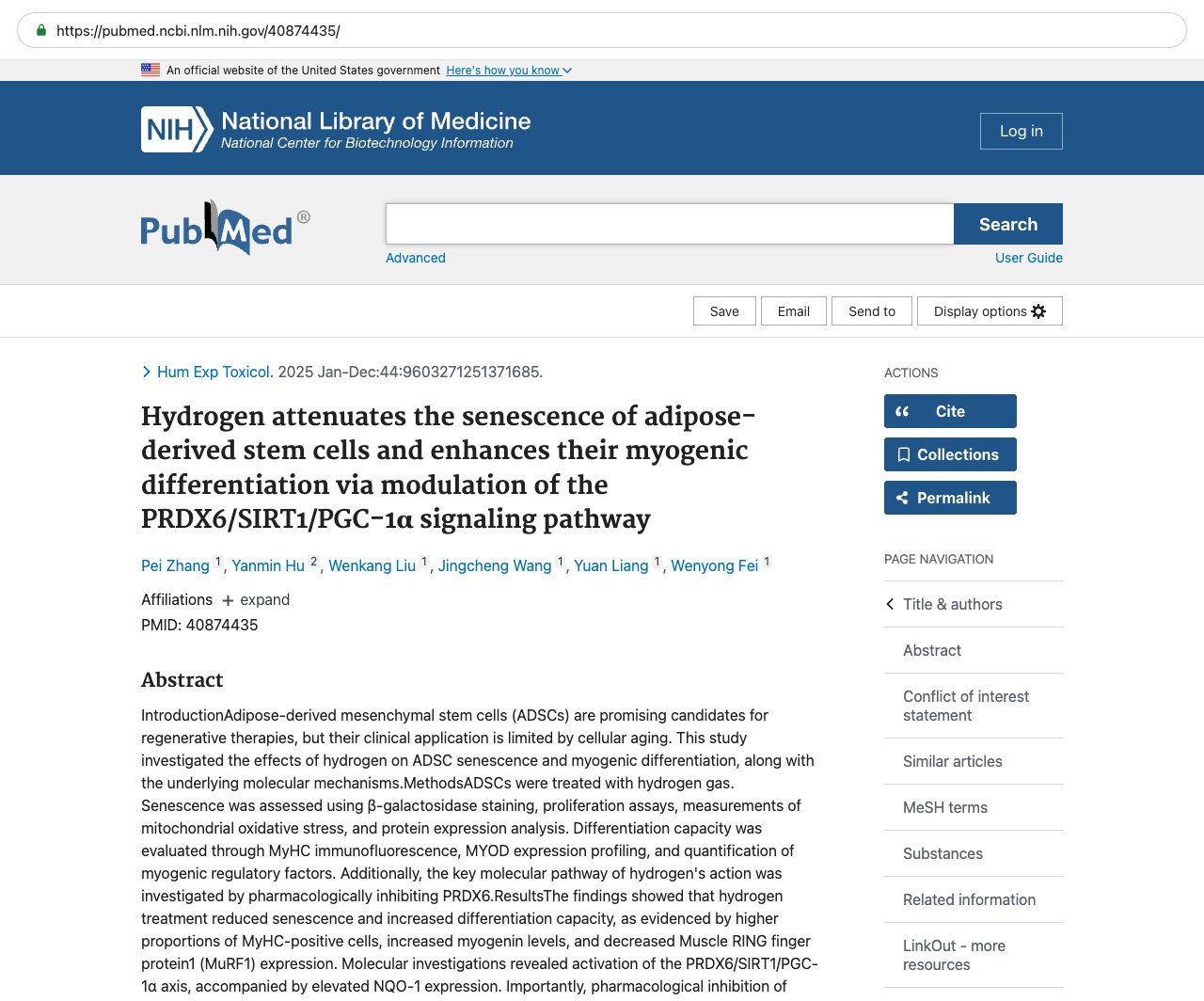
This page mirrors the published abstract (© the authors / publisher) for reference and citation. The canonical source is the PubMed record linked above. This is not medical advice.