2018 · Jiang — Therapeutic efficacy of hydrogen-rich saline alone and in combination with PI3K inhibitor in non-small cell lung cancer
Super-Abstract
In cultured human lung cancer cells (A549 line), hydrogen-rich saline reduced proliferation and promoted apoptosis; combining it with the PI3K inhibitor LY294002 enhanced these effects further by suppressing the PI3K/Akt signalling pathway. This is an in-vitro cell study — no evidence exists that this translates to human cancer patients. (Molecular Medicine Reports, 2018.)
Commentary
This study addressed a well-known challenge in oncology: cancer cells often exploit the PI3K/Akt pathway to sustain growth and evade apoptosis. The authors tested whether hydrogen-rich saline — on its own and combined with a PI3K inhibitor — could counteract this in A549 non-small cell lung cancer (NSCLC) cells. The combination reduced malondialdehyde (oxidative damage marker), raised superoxide dismutase activity, suppressed phospho-Akt, and downregulated both heme oxygenase-1 and NF-κB p65. The results suggest an additive or synergistic anti-tumour effect at the cellular level. However, this is a single cell-line experiment in culture conditions that differ greatly from a tumour microenvironment in the body. PI3K inhibitors are known to have significant toxicity in vivo, and how hydrogen interacts with them systemically is entirely unexplored. This paper is mechanistically interesting but far from any clinical application.
Key quotes
- „This combination therapy may be more effective than separate drug treatment; it decreased the malondialdehyde level and increased the superoxide dismutase activity.“ — additive antioxidant benefit of combining hydrogen with PI3K inhibitor
- „the results of the present study demonstrated that administration of the two agents in combination may inhibit phospho-Akt activity, and reduce expression of heme oxygenase-1 and nuclear factor-κB p65.“ — molecular mechanism: combined suppression of the PI3K/Akt/NF-κB axis
- „the present study provided evidence that combined therapy may be a novel therapeutic option for patients with NSCLC.“ — the authors' cautious forward-looking claim — based solely on cell culture data
Our assessment
This is an in-vitro study on a single cancer cell line. Results are mechanistically plausible and internally consistent, but cell culture findings in oncology routinely fail to translate to animal models, let alone humans. No animal experiments, toxicology data, or pharmacokinetic information are provided. The claim that this „may be a novel therapeutic option for patients“ is speculative at this stage. Until confirmed in rigorous preclinical models and eventually clinical trials, these findings should be understood as hypothesis-generating only.
Study design
- Type: in-vitro cell study · Model: A549 NSCLC human cell line · Groups: control / hydrogen-rich saline / LY294002 (PI3K inhibitor) / combination
- H₂ delivery: hydrogen-rich saline · Endpoints: cell proliferation, apoptosis, MDA, SOD activity, phospho-Akt, HO-1, NF-κB p65 expression
- Result: combination therapy showed greater anti-proliferative and pro-apoptotic effects than either agent alone; PI3K/Akt/NF-κB pathway suppressed more strongly in the combination group
Abstract
The aim of the present study was to investigate the effects of combination therapy of LY294002, a specific inhibitor of phosphatidylinositol 3‑kinase (PI3K), with hydrogen‑rich saline on the proliferation and apoptosis of the non‑small cell lung cancer (NSCLC) A549 cell line and the mechanisms underpinning this. Excessive production of reactive oxygen species (ROS) may induce DNA mutations, DNA damage, genomic instability and cell proliferation, and ROS are involved in several types of cancer, particularly lung cancer. In a previous study, hydrogen was recognized as an antioxidant in preventive and therapeutic applications. The PI3K/protein kinase B (Akt) pathway is an important signaling pathway that may activate downstream of a series of extracellular signals and impact on cellular processes including cell proliferation, apoptosis and survival. To date, the PI3K/Akt signaling pathway has been indicated as a feasible target for novel antineoplastic drugs. Different strategies combining the two treatment modalities have been used in cancer therapy in order to achieve an improved therapeutic response and longer control of tumor modalities control. The present study investigated the effect of hydrogen‑rich saline alone and in combination with the PI3K inhibitor, LY294002, on the proliferation, oxidative stress and apoptosis of NSCLC A549 cells. This combination therapy may be more effective than separate drug treatment; it decreased the malondialdehyde level and increased the superoxide dismutase activity. The combination therapy also enhanced the efficacy of anti‑proliferation and apoptosis. Similarly, the results of the present study demonstrated that administration of the two agents in combination may inhibit phospho‑Akt activity, and reduce expression of heme oxygenase‑1 and nuclear factor‑κB p65. The results further suggested that the combination therapy may reduce cell proliferation and promote cell apoptosis by downregulating Akt phosphorylation and inhibiting the PI3K pathway in NSCLC cell lines. Therefore, the present study provided evidence that combined therapy may be a novel therapeutic option for patients with NSCLC.
Source & links
Screenshot of the PubMed page
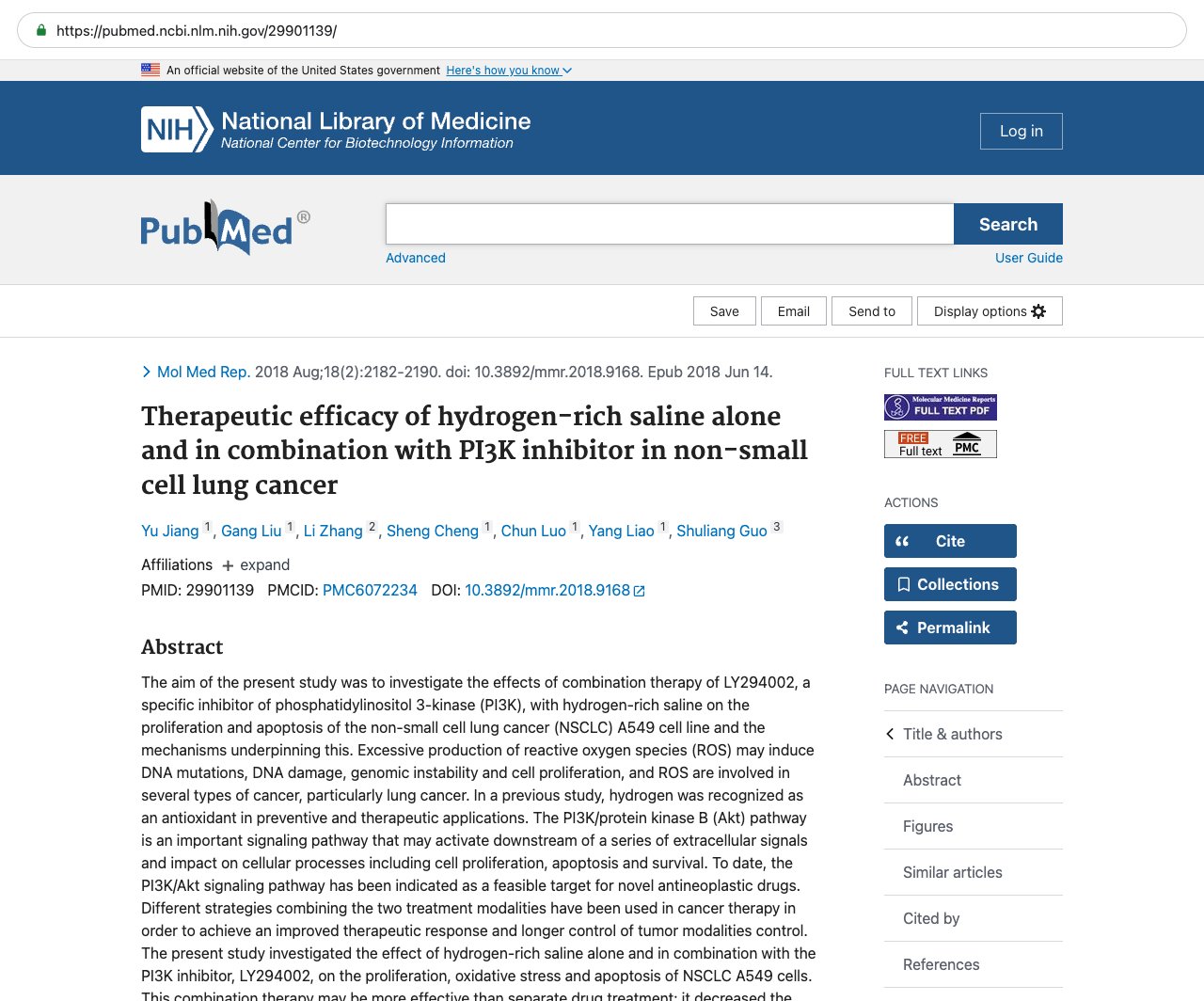
This page mirrors the published abstract (© the authors / publisher) for reference and citation. The canonical source is the PubMed record linked above. This is not medical advice.