2012 Medical science monitor : international medical journal of experimental and clinical research Mechanism / Preclinical Saline / IV
2012 · Yang et al. — Hydrogen-rich saline protects immunocytes from radiation-induced apoptosis.
Super-Abstract
Ionizing radiation depletes the immune system by triggering apoptosis (programmed cell death) in immune cells — a major problem in radiation therapy and radiological accidents. This animal and cell study found that hydrogen-rich saline (H₂ dissolved in physiological saline) significantly reduced radiation-induced cell death in immune cells, attenuated the activation of apoptosis enzymes, and helped maintain white blood cell and platelet counts in irradiated mice. These are preclinical findings in mice and cell cultures — not human data.
Commentary
This study is notable for combining in-vitro experiments (human AHH-1 lymphocyte cells) with in-vivo experiments (irradiated mice), giving a more complete mechanistic picture than cell studies alone. The key finding — that H₂-rich saline reduces hydroxyl radical (•OH) levels and downstream apoptosis in immune cells — fits well with H₂'s established mechanism as a selective •OH scavenger. The hematological data (preservation of white blood cells and platelets) are clinically meaningful markers, though the model is mouse-based. The practical question of how these results would translate to human radiation patients remains open. H₂ saline was produced in-house, which is typical for research but introduces questions about standardization.
Key quotes
- „H2-rich medium pretreatment reduced •OH level in AHH-1 cells.“ — the core antioxidant mechanism demonstrated in human lymphocyte cells
- „H2 reduced radiation-induced apoptosis in thymocytes and splenocytes in living mice.“ — the radioprotective effect confirmed in the animal model
- „H2 rescued the radiation-caused depletion of white blood cells (WBC) and platelets (PLT).“ — the hematologically relevant outcome — immune cell preservation
Our assessment
This is a preclinical study in mice and human cell lines — no human clinical data. The results are mechanistically plausible and consistent with H₂'s known radical-scavenging properties. The combination of in-vitro and in-vivo data strengthens the findings within the preclinical context. However, extrapolation to human radiation therapy patients requires clinical trials, which were not done here. The study is a useful stepping stone for further research on H₂ as a radioprotective agent.
Study design
- Type: preclinical study (in-vitro + animal) · n: AHH-1 human lymphocyte cell line + mice (number not specified in abstract) · H₂ delivery: H₂-rich saline (intravenous equivalent / cell medium)
- Result: H₂ reduced intracellular hydroxyl radicals in cells; reduced apoptosis in mouse thymocytes and splenocytes; attenuated caspase-3 activation; preserved WBC and platelet counts in irradiated mice
Abstract
BACKGROUND: Radiation often causes depletion of immunocytes in tissues and blood, which results in immunosuppression. Molecular hydrogen (H2) has been shown in recent studies to have potential as a safe and effective radioprotective agent through scavenging free radicals. This study was designed to test the hypothesis that H2 could protect immunocytes from ionizing radiation (IR). MATERIAL/METHODS: H2 was dissolved in physiological saline or medium using an apparatus produced by our department. A 2-[6-(4'-hydroxy) phenoxy-3H-xanthen-3-on-9-yl] benzoate (HPF) probe was used to detect intracellular hydroxyl radicals (•OH). Cell apoptosis was evaluated by annexin V-FITC and Propidium iodide (PI) staining as well as the caspase 3 activity. Finally, we examined the hematological changes using an automatic Sysmex XE 2100 hematology analyzer. RESULTS: We demonstrated H2-rich medium pretreatment reduced •OH level in AHH-1 cells. We also showed H2 reduced radiation-induced apoptosis in thymocytes and splenocytes in living mice. Radiation-induced caspase 3 activation was also attenuated by H2 treatment. Finally, we found that H2 rescued the radiation-caused depletion of white blood cells (WBC) and platelets (PLT). CONCLUSIONS: This study suggests that H2 protected the immune system and alleviated the hematological injury induced by IR.
Source & links
Screenshot of the PubMed page
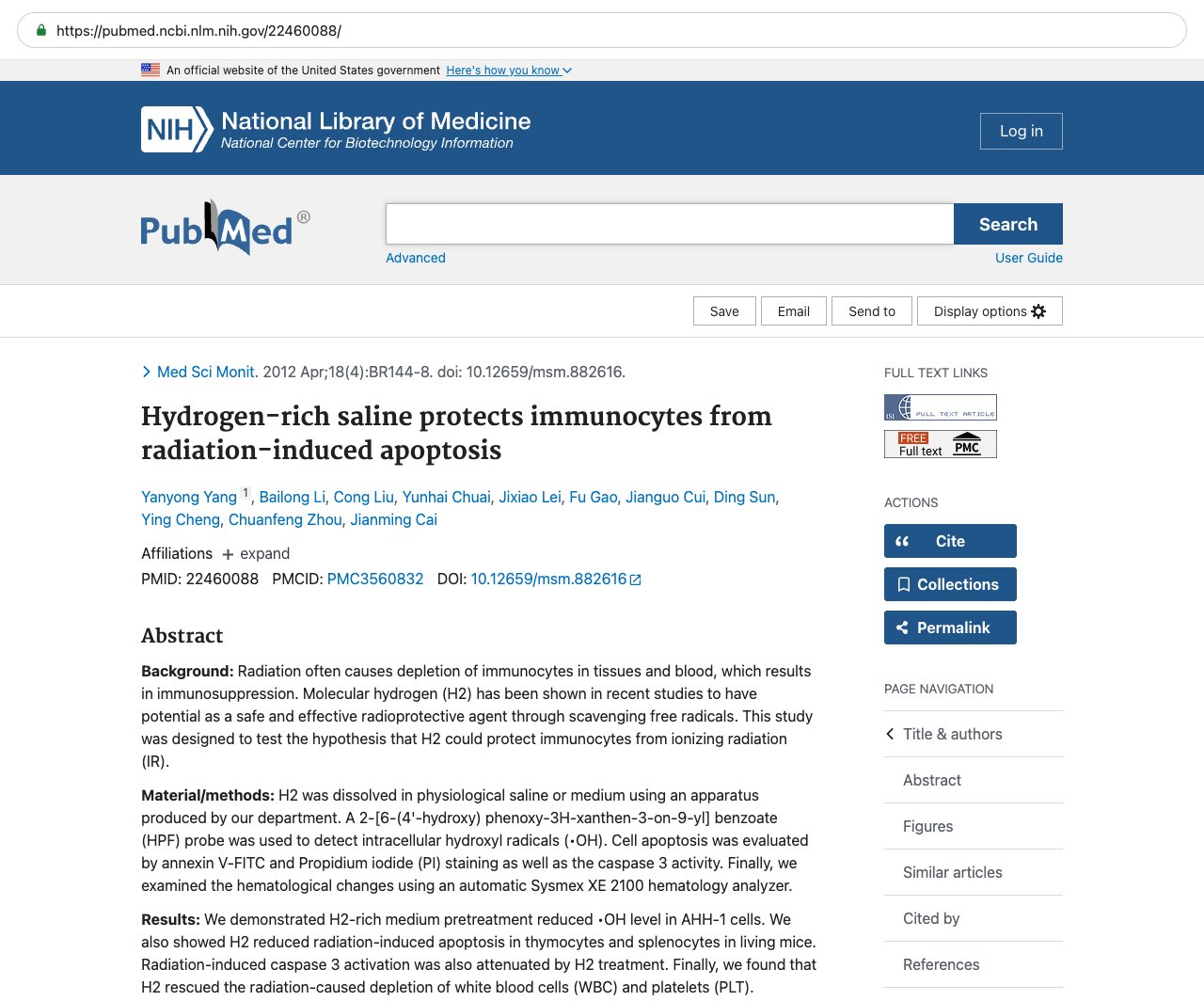
This page mirrors the published abstract (© the authors / publisher) for reference and citation. The canonical source is the PubMed record linked above. This is not medical advice.