2021 · Sano et al. — Hydrogen Gas Therapy: From Preclinical Studies to Clinical Trials.
Super-Abstract
Hydrogen gas (H₂) has demonstrated broad therapeutic potential in preclinical and early clinical studies — from ischaemia-reperfusion injury to organ transplantation and emergency medicine — and appears safe, inexpensive, and easy to administer. This review by Sano and colleagues highlights key findings and describes a novel field delivery system for organ preservation. (Current Pharmaceutical Design, 2021.)
Commentary
Sano and colleagues bring together evidence from preclinical models and clinical studies focusing on H₂ in emergency medicine — cardiac arrest, haemorrhagic shock, myocardial infarction — and organ transplantation. Notable is their comparison with targeted temperature management (TTM/hypothermia), an established neuroprotective intervention, positioning H₂ as a potential adjunct or alternative. The suppression of TNF-α-mediated endothelial glycocalyx degradation is highlighted as a newly identified mechanism. The group also describes a practical innovation: a method to easily transport H₂ gas to emergency settings and dissolve it in organ preservation solutions on-site. This is a clinical-leaning review from an active research group.
Key quotes
- „H2 reduces the organ damage caused by ischemia-reperfusion.“ — the central preclinical/clinical finding across emergency indications
- „H2 is an easily administered, inexpensive and well-tolerated agent that is highly effective for a wide range of conditions in emergency medicine, as well as for preserving donated organs.“ — the authors' summary conclusion — confident but still based on early-phase evidence
- „We have also outlined the critical role this effect plays in a variety of medical emergencies, including myocardial infarction, hemorrhagic shock, and out-of-hospital cardiac arrest, as well as in organ transplantation.“ — scope of emergency medicine indications reviewed
Our assessment
This review comes from a research group with direct clinical trial experience in H₂ (Sano et al. have published phase 1/2 data on H₂ inhalation after cardiac arrest). The optimistic framing reflects genuine clinical experience, not just wishful thinking. Honest note: the conclusion that H₂ is „highly effective for a wide range of conditions“ is stronger than the current evidence level fully supports — several cited trials are phase 1/2 or small-scale. The novel organ preservation delivery method is an interesting applied contribution. This review is a useful clinical perspective but should be read alongside more conservative systematic reviews.
Study design
- Type: narrative review with own methodological contribution (H₂ delivery for organ preservation) · n: n/a (literature synthesis + method description) · H₂ delivery: inhalation and IV saline (across cited studies)
- Result: narrative synthesis of preclinical and early clinical evidence for H₂ in ischaemia-reperfusion and emergency medicine; practical delivery innovation for organ preservation described; large-scale RCT evidence still lacking
Abstract
BACKGROUND: Mounting evidence indicates that hydrogen gas (H2) is a versatile therapeutic agent, even at very low, non-combustible concentrations. The Chinese National Health and Medical Commission recently recommended the use of inhaled H2 in addition to O2 therapy in the treatment of COVID-19-associated pneumonia, and its effects extend to anti-tumor, anti-inflammatory and antioxidant actions. SUMMARY: In this review, we have highlighted key findings from preclinical research and recent clinical studies demonstrating that H2 reduces the organ damage caused by ischemia-reperfusion. We have also outlined the critical role this effect plays in a variety of medical emergencies, including myocardial infarction, hemorrhagic shock, and out-of-hospital cardiac arrest, as well as in organ transplantation. H2 is compared with established treatments such as targeted temperature management, and we have also discussed its possible mechanisms of action, including the recently identified suppression of TNF-α-mediated endothelial glycocalyx degradation by inhaled H2. In addition, our new method that enables H2 gas to be easily transported to emergency settings and quickly injected into an organ preservation solution at the site of donor organ procurement have been described. CONCLUSION: H2 is an easily administered, inexpensive and well-tolerated agent that is highly effective for a wide range of conditions in emergency medicine, as well as for preserving donated organs.
Source & links
Screenshot of the PubMed page
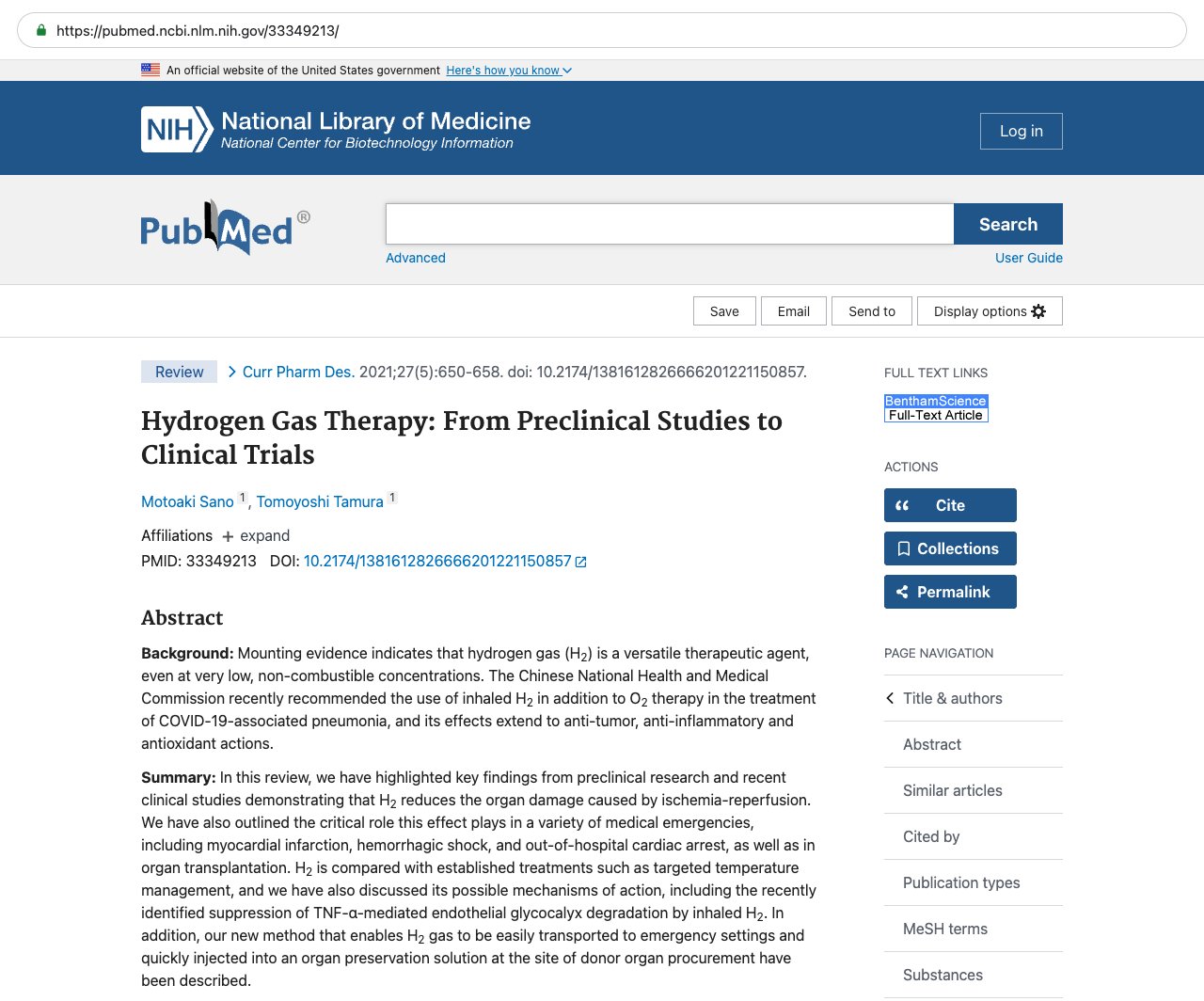
This page mirrors the published abstract (© the authors / publisher) for reference and citation. The canonical source is the PubMed record linked above. This is not medical advice.