2015 · Hattori et al. — Maternal molecular hydrogen treatment attenuates lipopolysaccharide-induced rat fetal lung injury.
Super-Abstract
Drinking hydrogen-rich water (HRW) before lipopolysaccharide (LPS) injection significantly reduced inflammation, oxidative damage, and cell death in fetal rat lungs — suggesting that maternal H₂ intake could protect premature infants from inflammation-driven lung disease. Both cell-culture (A549 line) and pregnant rat experiments were used. These are preclinical results and cannot be directly applied to human pregnancy.
Commentary
Maternal inflammation — for example from infection — is a known trigger for preterm birth and neonatal respiratory impairment. This study tests whether H₂ given to pregnant rats via drinking water could reduce LPS-induced injury to fetal lung tissue. In the A549 human lung epithelial cell line, H₂-rich medium significantly suppressed LPS-induced ROS and IL-6 production and preserved cell viability. In pregnant rats, pre-treatment with HRW for 24 hours before intraperitoneal LPS injection on gestational day 19 significantly reduced fetal lung levels of apoptosis marker (cleaved caspase-3), oxidative DNA damage (8-OHdG), IL-6, and VEGF. The mechanistic logic is plausible: H₂ selectively scavenges the most cytotoxic reactive oxygen species (hydroxyl radical, peroxynitrite) without disrupting normal redox signalling. The animal model is relevant — LPS-induced preterm inflammation mimics clinical scenarios — but direct extrapolation to human antenatal therapy requires clinical trials.
Key quotes
- „The number of apoptotic cells, and levels of ROS and IL-6 were significantly increased by LPS treatment, and repressed following cultured with HM in A549 cells.“ — in-vitro result: H₂-rich medium reverses LPS-induced cell damage
- „the population positive for cleaved caspase-3, 8-hydroxy-2'-deoxyguanosine, IL-6, and VEGF was significantly increased in the LPS group compared with that observed in the Control group and significantly decreased in the HW + LPS group.“ — in-vivo result: H₂ water pre-treatment reduced all four damage markers in fetal lungs
- „Antenatal H2 administration may decrease the pulmonary mobility associated with inflammation in premature infants.“ — the authors' cautious clinical hypothesis — still requires human evidence
Our assessment
A well-designed preclinical study with both in-vitro and in-vivo components. The consistent reduction of inflammatory and oxidative markers across both models strengthens the biological plausibility of H₂'s protective effect on fetal lungs. However, these are animal and cell results — no human data exist for antenatal H₂ administration. The jump from pregnant rat to pregnant woman is large: pharmacokinetics of H₂ transfer across the placenta, safety in first-trimester human pregnancy, and optimal dosing are entirely untested in humans. The findings are promising for basic research but cannot support clinical recommendations.
Study design
- Type: preclinical animal + in-vitro study · Model: pregnant Sprague-Dawley rats (gestational day 19, LPS-induced inflammation) + A549 human lung epithelial cells · H₂ delivery: H₂-rich water (ad libitum, 24 h pre-LPS) in vivo; H₂-rich medium in vitro
- Key endpoints: fetal lung apoptosis (cleaved caspase-3), oxidative DNA damage (8-OHdG), IL-6, VEGF (immunohistochemistry); in vitro: cell viability, ROS, IL-6 · Result: all damage markers significantly reduced in HW + LPS group vs. LPS-only group
Abstract
Maternal inflammation is associated with spontaneous preterm birth and respiratory impairment among premature infants. Recently, molecular hydrogen (H2) has been reported to have a suppressive effect on oxidative stress and inflammation. The aim of this study was to evaluate the effects of H2 on fetal lung injury caused by maternal inflammation. Cell viability and the production of interleukin-6 (IL-6) and reactive oxygen species (ROS) were examined by treatment with lipopolysaccharide (LPS) contained in ordinal or H2-rich medium (HM) using a human lung epithelial cell line, A549. Pregnant Sprague Dawley rats were divided into three groups: Control, LPS, and HW + LPS groups. Rats were injected with phosphate-buffered saline (Control) or LPS intraperitoneally (LPS) on gestational day 19 and provided H2 water (HW) ad libitum for 24 h before LPS injection (HW + LPS). Fetal lung samples were collected on day 20, and the levels of apoptosis, oxidative damage, IL-6, and vascular endothelial growth factor (VEGF) were evaluated using immunohistochemistry. The number of apoptotic cells, and levels of ROS and IL-6 were significantly increased by LPS treatment, and repressed following cultured with HM in A549 cells. In the rat models, the population positive for cleaved caspase-3, 8-hydroxy-2'-deoxyguanosine, IL-6, and VEGF was significantly increased in the LPS group compared with that observed in the Control group and significantly decreased in the HW + LPS group. In this study, LPS administration induced apoptosis and oxidative damage in fetal lung cells that was ameliorated by maternal H2 intake. Antenatal H2 administration may decrease the pulmonary mobility associated with inflammation in premature infants.
Source & links
Screenshot of the PubMed page
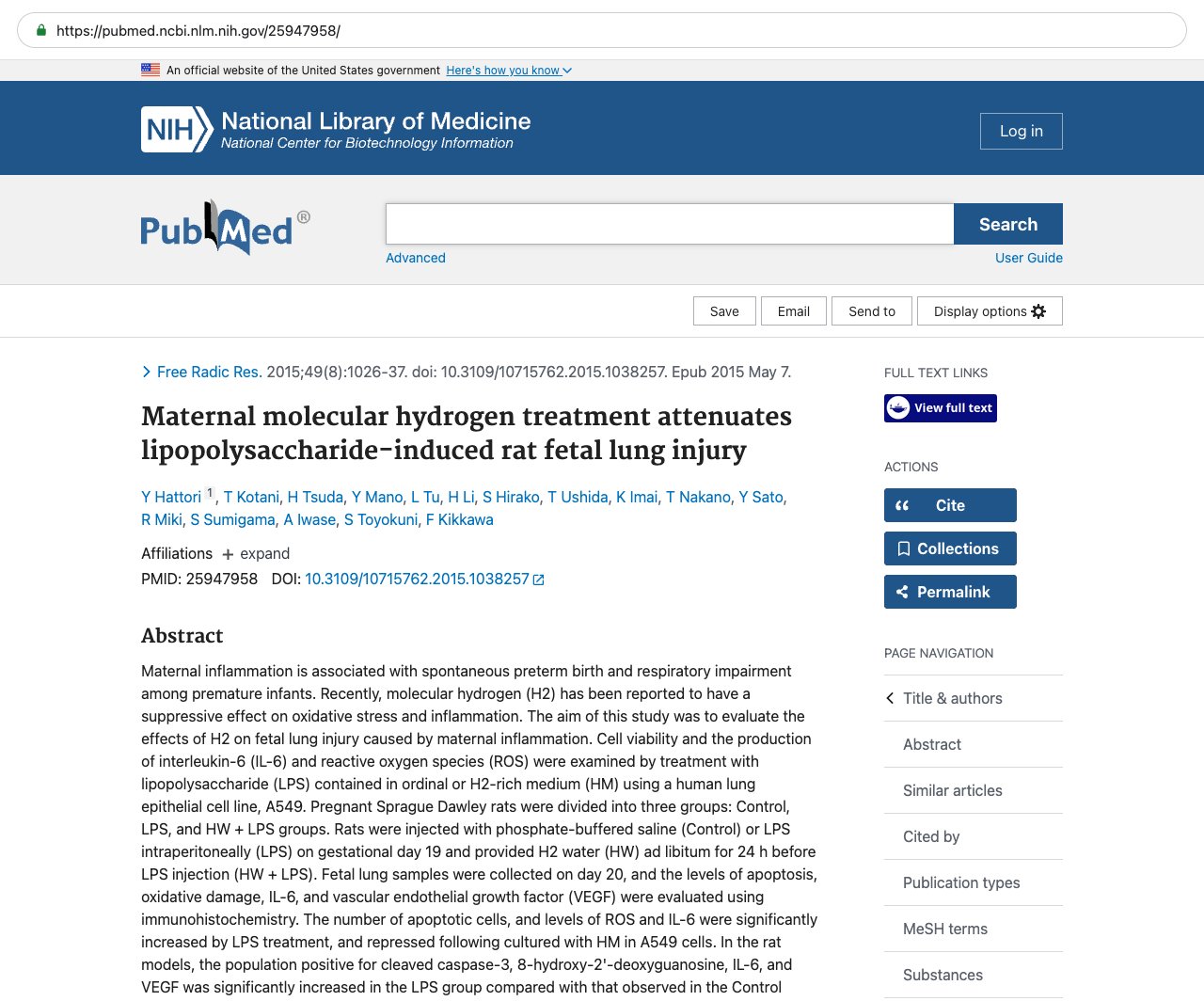
This page mirrors the published abstract (© the authors / publisher) for reference and citation. The canonical source is the PubMed record linked above. This is not medical advice.