2009 · Kajiya — Hydrogen mediates suppression of colon inflammation induced by dextran sodium sulfate.
Super-Abstract
In a mouse model of inflammatory bowel disease, adding molecular hydrogen (H₂) to drinking water significantly suppressed colon inflammation induced by dextran sodium sulfate (DSS). H₂ reduced weight loss, colitis scores, colon shortening, and pro-inflammatory cytokines (IL-12, TNF-α, IL-1β), and histologically reduced tissue destruction and macrophage infiltration. (Biochemical and Biophysical Research Communications, 2009.)
Commentary
This is an early animal study exploring H₂'s anti-inflammatory potential in a well-established rodent model of IBD. The DSS-colitis mouse model is widely used because it mimics key features of human inflammatory bowel disease, particularly ulcerative colitis. The results are promising: H₂ water not only reduced inflammatory markers but also visibly protected tissue integrity. However, as a mouse study, it cannot be directly applied to human IBD patients. Mouse DSS-colitis has different kinetics and immune architecture compared to human disease. No human clinical trials on H₂ and IBD had been conducted at the time. The study is an important preclinical building block — not a treatment recommendation.
Key quotes
- „DSS-induced pathogenic outcomes including, loss of body weight, increase of colitis score, pathogenic shortening of colon length, elevated level of IL-12, TNF-alpha and IL-1beta in colon lesion, were significantly suppressed by the addition of H2 to DSS solution.“ — the main anti-inflammatory findings in the mouse colitis model
- „the DSS-mediated colonic tissue destruction accompanied by macrophage infiltration was remarkably suppressed by H2.“ — histological finding: H₂ protected colon tissue from immune cell infiltration
- „the present study indicated that H2 can prevent the development of DSS-induced colitis in mice.“ — conclusion — explicitly limited to the mouse model
Our assessment
This is a preclinical animal study — results cannot be directly transferred to humans. The DSS mouse model is a reasonable proxy for aspects of ulcerative colitis, and the findings (cytokine reduction, tissue protection) are biologically coherent with H₂'s known antioxidant and anti-inflammatory properties. However, mouse studies routinely overestimate effects seen in humans, and IBD has complex immunological and environmental components that a single-agent intervention may not address. This paper is a useful early signal; clinical evidence in humans with IBD would be needed before any conclusions about therapeutic use.
Study design
- Type: animal study (in vivo, mouse) · Model: DSS-induced colitis in mice · H₂ delivery: H₂-dissolved drinking water, ad libitum for 7 days
- Outcome: significant reduction in colitis score, body weight loss, colon shortening, IL-12/TNF-α/IL-1β levels, and macrophage infiltration compared to DSS-only group
Abstract
By its antioxidant effect, molecular hydrogen gas (H2) was reported to protect organs from tissue damage induced by ischemia reperfusion. To evaluate its anti-inflammatory effects, we established a mouse model of human inflammatory bowel disease (IBD) by supplying mice with water containing (1) dextran sodium sulfate (DSS) (5%), (2) DSS (5%) and H2, or (3) H2 only ad libitum up to 7 days. At day-7, DSS-induced pathogenic outcomes including, loss of body weight, increase of colitis score, pathogenic shortening of colon length, elevated level of IL-12, TNF-alpha and IL-1beta in colon lesion, were significantly suppressed by the addition of H2 to DSS solution. Histological analysis also revealed that the DSS-mediated colonic tissue destruction accompanied by macrophage infiltration was remarkably suppressed by H2. Therefore, the present study indicated that H2 can prevent the development of DSS-induced colitis in mice.
Source & links
Screenshot of the PubMed page
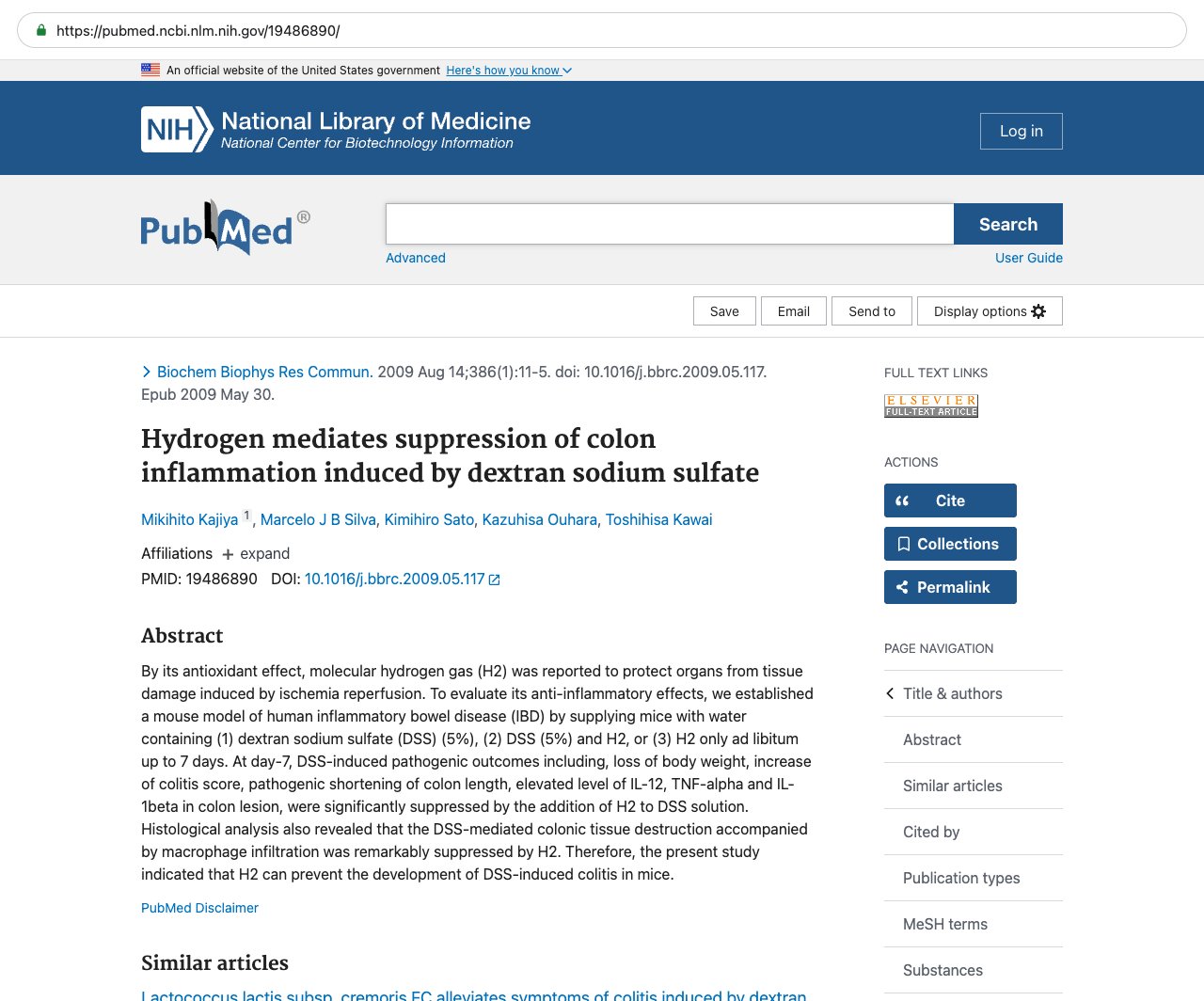
This page mirrors the published abstract (© the authors / publisher) for reference and citation. The canonical source is the PubMed record linked above. This is not medical advice.