2022 · Adzavon — Long-term and daily use of molecular hydrogen induces reprogramming of liver metabolism in rats by modulating NADP/NADPH redox pathways
Super-Abstract
Rats exposed to molecular hydrogen for six months — either by drinking hydrogen-rich water or inhaling 4 % H₂ gas — showed reduced fat accumulation in the liver, lower blood lipid levels, and broad metabolic changes driven by the NADP/NADPH redox system. This is the first study to combine transcriptomics and metabolomics to map the molecular targets of long-term H₂ exposure. This is an animal study; no human data are available. (Scientific Reports, 2022.)
Commentary
Most hydrogen research uses short-term interventions; this study stands out by tracking metabolic changes over six months — equivalent to a substantial portion of a rat's lifespan. Two administration routes were compared head-to-head: drinking hydrogen-rich water (HRW) and inhaling 4 % H₂ gas for 2 hours daily. Both routes produced broadly similar liver effects, which is an important internal validation: the effects are attributable to H₂ itself rather than to route-specific factors. The key mechanistic finding is that NADP (the oxidized form of the NADP⁺/NADPH redox couple) emerged as the central regulatory node linking H₂-induced changes across lipid metabolism, amino acid metabolism, purine nucleotide biosynthesis, and carbohydrate pathways. Reduced lipogenesis and increased lipolysis correlated with visible loss of visceral fat and brown adipose tissue as observed by micro-CT. A secondary observation was modulation of immune response genes. The authors themselves caution that molecular data supporting H₂'s therapeutic functions „remain elusive“ and that this work aims to fill that gap. No functional disease endpoints were measured; the study is mechanistic baseline work in healthy rats.
Key quotes
- „NADP is the central regulator of H2 induced metabolic alterations in the liver, which was further confirmed by an increase in the level of components of metabolic pathways that require NADP as substrate.“ — the core mechanistic finding: NADP/NADPH redox as the hub
- „Rats exposed 2 h daily to H2 either by drinking HRW or by breathing 4% H2 gas showed reduced lipogenesis and enhanced lipolysis in the liver.“ — the main metabolic outcome across both delivery routes
- „This work is the first to provide metabolomic and transcriptomic data to uncover molecular targets for the effect of prolonged molecular hydrogen treatment on liver metabolism.“ — novelty claim — filling a mechanistic data gap
Our assessment
A first-of-its-kind mechanistic animal study providing multi-omics evidence for long-term H₂ effects on liver metabolism. The dual-route design (inhalation vs. HRW) and six-month duration make it methodologically stronger than typical short-term rodent studies. However, this is purely preclinical research in healthy rats. The NADP/NADPH findings are mechanistic hypothesis-generators — not proof that H₂ improves liver disease outcomes in humans. Translation to human metabolic or liver disease remains to be demonstrated.
Study design
- Type: preclinical animal study (in-vivo) · Model: rats, 6 months, daily 2 h exposure · H₂ delivery: two routes — drinking hydrogen-rich water (HRW) vs. inhalation of 4 % H₂ gas
- Outcome measures: transcriptomics, metabolomics, biochemistry, micro-CT · Result: reduced liver lipogenesis, enhanced lipolysis, decreased serum lipids, visceral fat loss; NADP identified as central redox regulator; immune pathway modulation observed
Abstract
Molecular hydrogen (H2) has emerged as a new therapeutic option in several diseases and is widely adopted by healthy people. However, molecular data to support therapeutic functions attributed to the biological activities of H2 remain elusive. Here, using transcriptomic and metabolomic approaches coupled with biochemistry and micro-CT technics, we evaluated the effect of long-term (6 months) and daily use of H2 on liver function. Rats exposed 2 h daily to H2 either by drinking HRW (H2 dissolved in H2O) or by breathing 4% H2 gas showed reduced lipogenesis and enhanced lipolysis in the liver, which was associated with apparent loss of visceral fat and brown adipose tissue together with a reduced level of serum lipids. Both transcripts and metabolites enriched in H2-treated rats revealed alteration of amino acid metabolism pathways and activation of purine nucleotides and carbohydrate biosynthesis pathways. Analysis of the interaction network of genes and metabolites and correlation tests revealed that NADP is the central regulator of H2 induced metabolic alterations in the liver, which was further confirmed by an increase in the level of components of metabolic pathways that require NADP as substrate. Evidence of immune response regulation activity was also observed in response to exposure to H2. This work is the first to provide metabolomic and transcriptomic data to uncover molecular targets for the effect of prolonged molecular hydrogen treatment on liver metabolism.
Source & links
Screenshot of the PubMed page
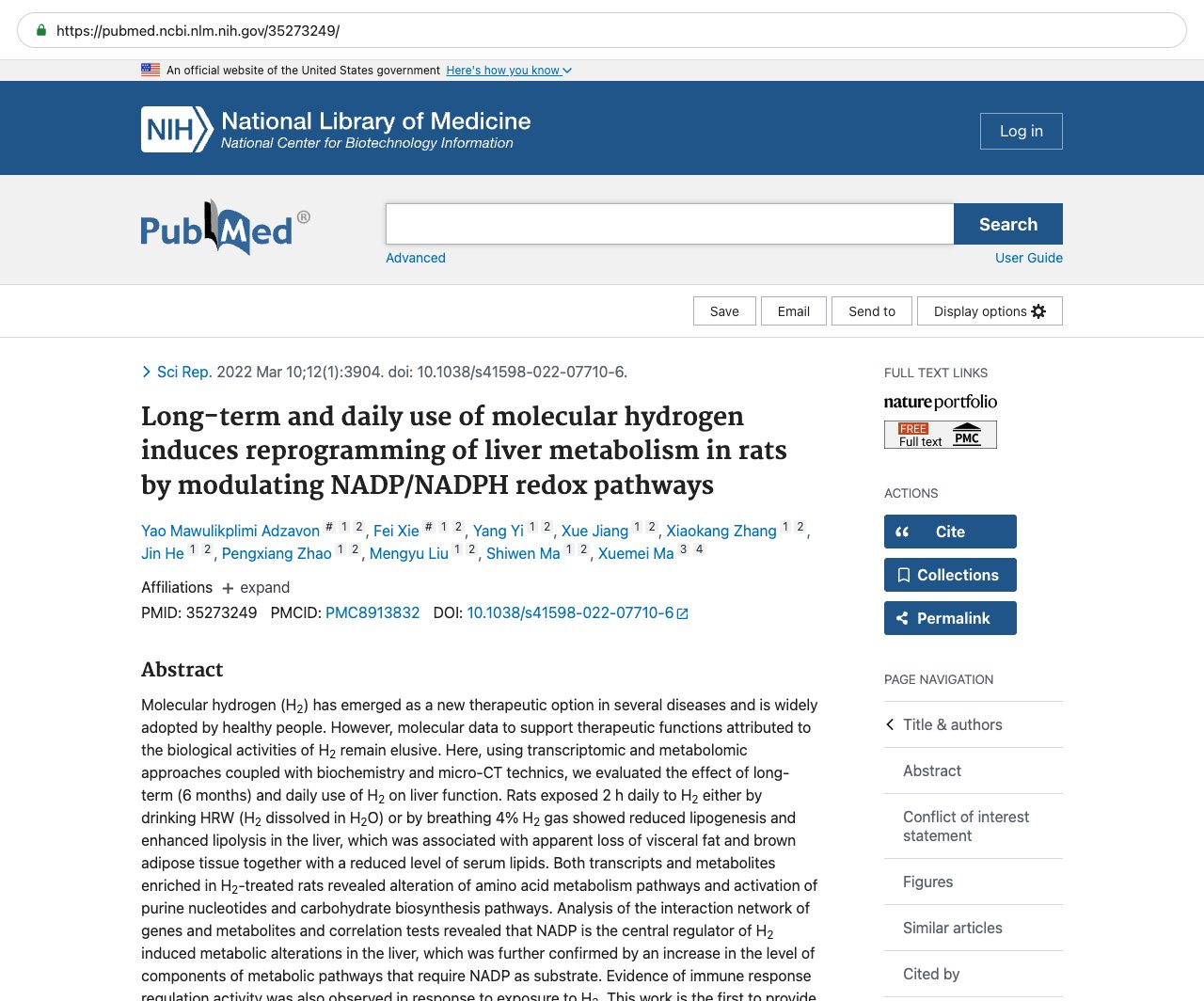
This page mirrors the published abstract (© the authors / publisher) for reference and citation. The canonical source is the PubMed record linked above. This is not medical advice.