2008 · Kajiyama — Supplementation of hydrogen-rich water improves lipid and glucose metabolism in patients with type 2 diabetes or impaired glucose tolerance
Super-Abstract
Hydrogen-rich water lowers oxidative stress in diabetics. In a randomized double-blind crossover (36 patients, 900 ml/day, 8 weeks), harmfully modified LDL cholesterol fell by 15.5 %; in 4 of 6 prediabetics the glucose tolerance test normalized. (Nutrition Research, 2008 — one of the first clinical H₂ studies with a rigorous design.)
Commentary
This is clinical evidence at a high level: a <strong>randomized, double-blind, placebo-controlled crossover design</strong> — the gold standard — with 30 type-2 diabetics and 6 people with impaired glucose tolerance. Over 8 weeks the participants drank either 900 ml of hydrogen-rich water or visually identical placebo water, then (after a washout) the other. The results are concrete and statistically significant: modified LDL −15.5 %, small dense LDL −5.7 %, the oxidative-stress marker 8-isoprostane in urine −6.6 %. In addition, trends in the right direction — oxidized LDL and free fatty acids down, the „good“ hormone adiponectin and the protective enzyme EC-SOD up. Perhaps the most striking finding: in 4 of 6 prediabetics, the oral glucose tolerance test normalized completely. Honestly: the sample is small — but the design is strong.
Key quotes
- „Intake of hydrogen-rich water was associated with significant decreases in the levels of modified low-density lipoprotein (LDL) cholesterol ... and urinary 8-isoprostanes by 15.5% (P < .01), 5.7% (P < .05), and 6.6% (P < .05), respectively.“ — the significant core findings with p-values
- „In 4 of 6 patients with IGT, intake of hydrogen-rich water normalized the oral glucose tolerance test.“ — the strongest single finding: normalized oGTT in prediabetes
- „these results suggest that supplementation with hydrogen-rich water may have a beneficial role in prevention of T2DM and insulin resistance.“ — the authors' conclusion
Our assessment
Directly relevant to glucose and lipid metabolism in type-2 diabetes and a strong piece of evidence, because the study design (double-blind, placebo-controlled, crossover) largely rules out chance and placebo effects. The study translates the mechanism of Ohsawa 2007 for the first time into measurable clinical benefit in a common disease. Limitation, stated honestly: small sample (n=36), surrogate markers instead of hard endpoints (no statement on downstream disease), and 8 weeks is short.
Study design
- Type: RCT, randomized/double-blind/placebo-controlled/crossover · n: 36 (30 T2DM + 6 IGT) · Duration: 8 weeks (+12 weeks washout) · H₂ delivery: 900 ml/day H₂ water
- Result metrics: modified LDL −15.5 % (p<0.01); small dense LDL −5.7 % (p<0.05); urinary 8-isoprostanes −6.6 % (p<0.05); 4/6 IGT with normalized oGTT
Abstract
Oxidative stress is recognized widely as being associated with various disorders including diabetes, hypertension, and atherosclerosis. It is well established that hydrogen has a reducing action. We therefore investigated the effects of hydrogen-rich water intake on lipid and glucose metabolism in patients with either type 2 diabetes mellitus (T2DM) or impaired glucose tolerance (IGT). We performed a randomized, double-blind, placebo-controlled, crossover study in 30 patients with T2DM controlled by diet and exercise therapy and 6 patients with IGT. The patients consumed either 900 mL/d of hydrogen-rich pure water or 900 mL of placebo pure water for 8 weeks, with a 12-week washout period. Several biomarkers of oxidative stress, insulin resistance, and glucose metabolism, assessed by an oral glucose tolerance test, were evaluated at baseline and at 8 weeks. Intake of hydrogen-rich water was associated with significant decreases in the levels of modified low-density lipoprotein (LDL) cholesterol (ie, modifications that increase the net negative charge of LDL), small dense LDL, and urinary 8-isoprostanes by 15.5% (P < .01), 5.7% (P < .05), and 6.6% (P < .05), respectively. Hydrogen-rich water intake was also associated with a trend of decreased serum concentrations of oxidized LDL and free fatty acids, and increased plasma levels of adiponectin and extracellular-superoxide dismutase. In 4 of 6 patients with IGT, intake of hydrogen-rich water normalized the oral glucose tolerance test. In conclusion, these results suggest that supplementation with hydrogen-rich water may have a beneficial role in prevention of T2DM and insulin resistance.
Source & links
Screenshot of the PubMed page
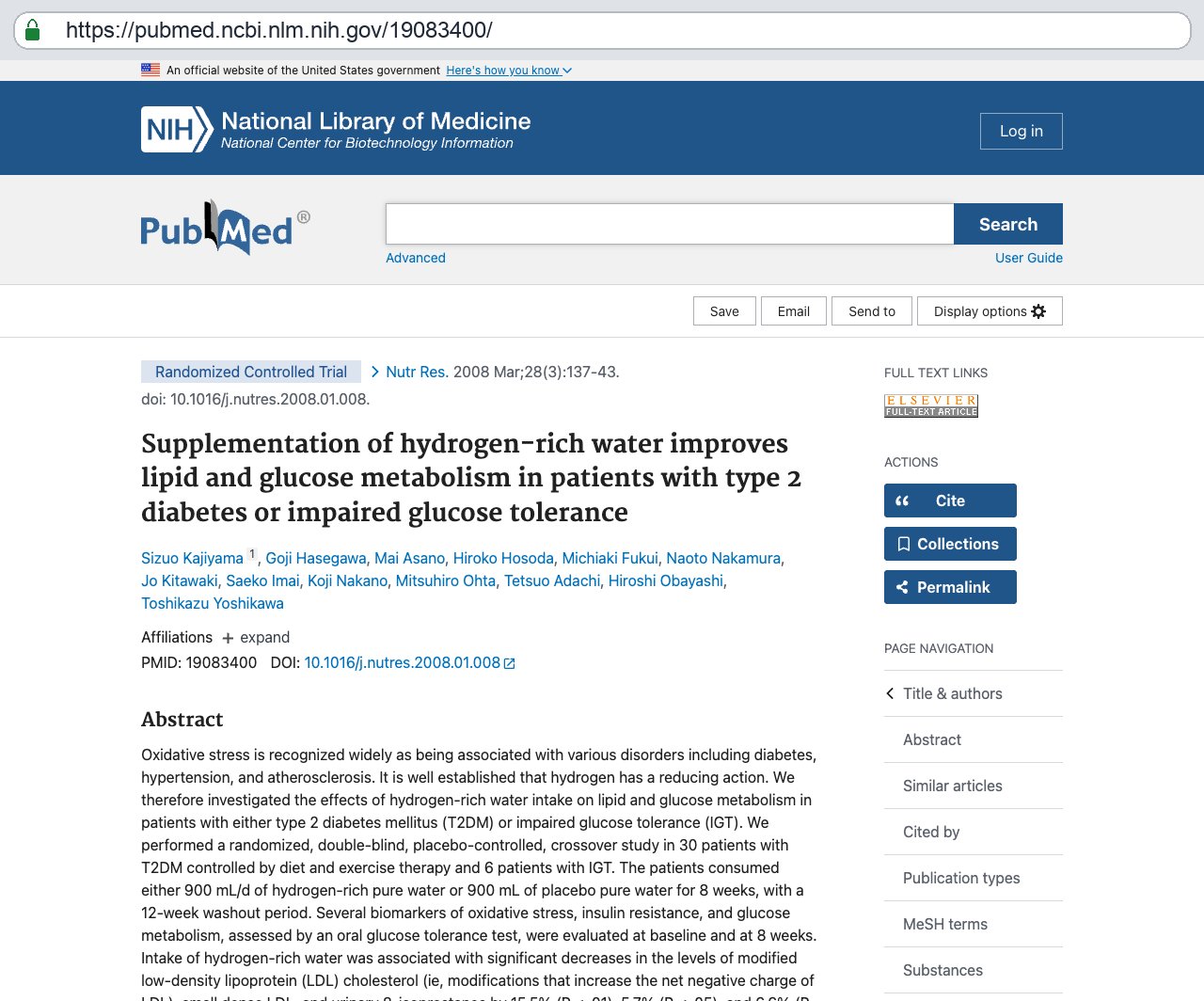
This page mirrors the published abstract (© the authors / publisher) for reference and citation. The canonical source is the PubMed record linked above. This is not medical advice.