2013 · Song et al. — Hydrogen-rich water decreases serum LDL-cholesterol levels and improves HDL function in patients with potential metabolic syndrome.
Super-Abstract
In 20 patients with potential metabolic syndrome, drinking 0.9–1.0 L/day of H₂-rich water for 10 weeks reduced total cholesterol, LDL-cholesterol, and apolipoprotein B100/E, while significantly improving four distinct functional properties of HDL — including anti-oxidative protection of LDL and inhibition of inflammatory monocyte adhesion. Antioxidant enzyme SOD increased and lipid peroxidation markers fell. (Journal of Lipid Research, 2013.)
Commentary
Most cardiovascular risk reduction strategies focus on lowering LDL cholesterol — but HDL function (not merely HDL quantity) is increasingly recognized as equally important. This study is notable for going beyond simple lipid measurements and characterizing four distinct functional improvements in HDL: (1) better protection of LDL against oxidation, (2) reduced ability of inflammatory signals to recruit monocytes to vessel walls, (3) improved cholesterol efflux from foam cells, and (4) protection of endothelial cells from TNF-α-induced apoptosis. These are mechanistically coherent with H₂'s antioxidant and anti-inflammatory profile. The significant LDL reduction and the marked decrease in apoB100/E (atherogenic lipoproteins) add to the cardiovascular relevance. However, the study has a major limitation: no placebo control and only 20 subjects. Without a control arm, natural variation and regression to the mean cannot be excluded.
Key quotes
- „consumption of H2-rich water for 10 weeks resulted in decreased serum total-cholesterol (TC) and LDL-cholesterol (LDL-C) levels.“ — the lipid-lowering signal
- „we found H2 significantly improved HDL functionality assessed in four independent ways, namely, i) protection against LDL oxidation, ii) inhibition of tumor necrosis factor (TNF)-α-induced monocyte adhesion to endothelial cells, iii) stimulation of cholesterol efflux from macrophage foam cells, and iv) protection of endothelial cells from TNF-α-induced apoptosis.“ — comprehensive HDL functional improvement across four independent assays
- „supplementation with H2-rich water seems to decrease serum LDL-C and apoB levels, improve dyslipidemia-injured HDL functions, and reduce oxidative stress, and it may have a beneficial role in prevention of potential metabolic syndrome.“ — authors' summary: promising but speculative without a control arm
Our assessment
Scientifically rich findings with a significant methodological flaw: no placebo control group. Without a parallel control arm, the LDL and HDL changes could reflect spontaneous variation, dietary changes, or regression to the mean over 10 weeks. The four-functional-assay approach to HDL is a genuine strength and rarely seen in H₂ trials. The oxidative stress reductions (SOD increase, TBARS decrease) are internally consistent with the proposed H₂ mechanism. Limitations: no randomization, no control arm, small n (20), metabolic syndrome as an indication is multifactorial (diet, lifestyle confounders uncontrolled). Results are hypothesis-generating, not confirmatory.
Study design
- Type: uncontrolled intervention study (no placebo arm) · n: 20 patients with potential metabolic syndrome · H₂ delivery: 0.9–1.0 L/day H₂-rich water orally for 10 weeks
- Outcomes: serum lipids (TC, LDL-C, HDL-C, TG), apolipoproteins B100/E, HDL functionality (4 assays), SOD activity, TBARS (lipid peroxidation)
- Result: TC and LDL-C decreased; apoB100/E decreased; HDL function improved on all 4 assays; SOD increased; TBARS decreased — all without a control group
Abstract
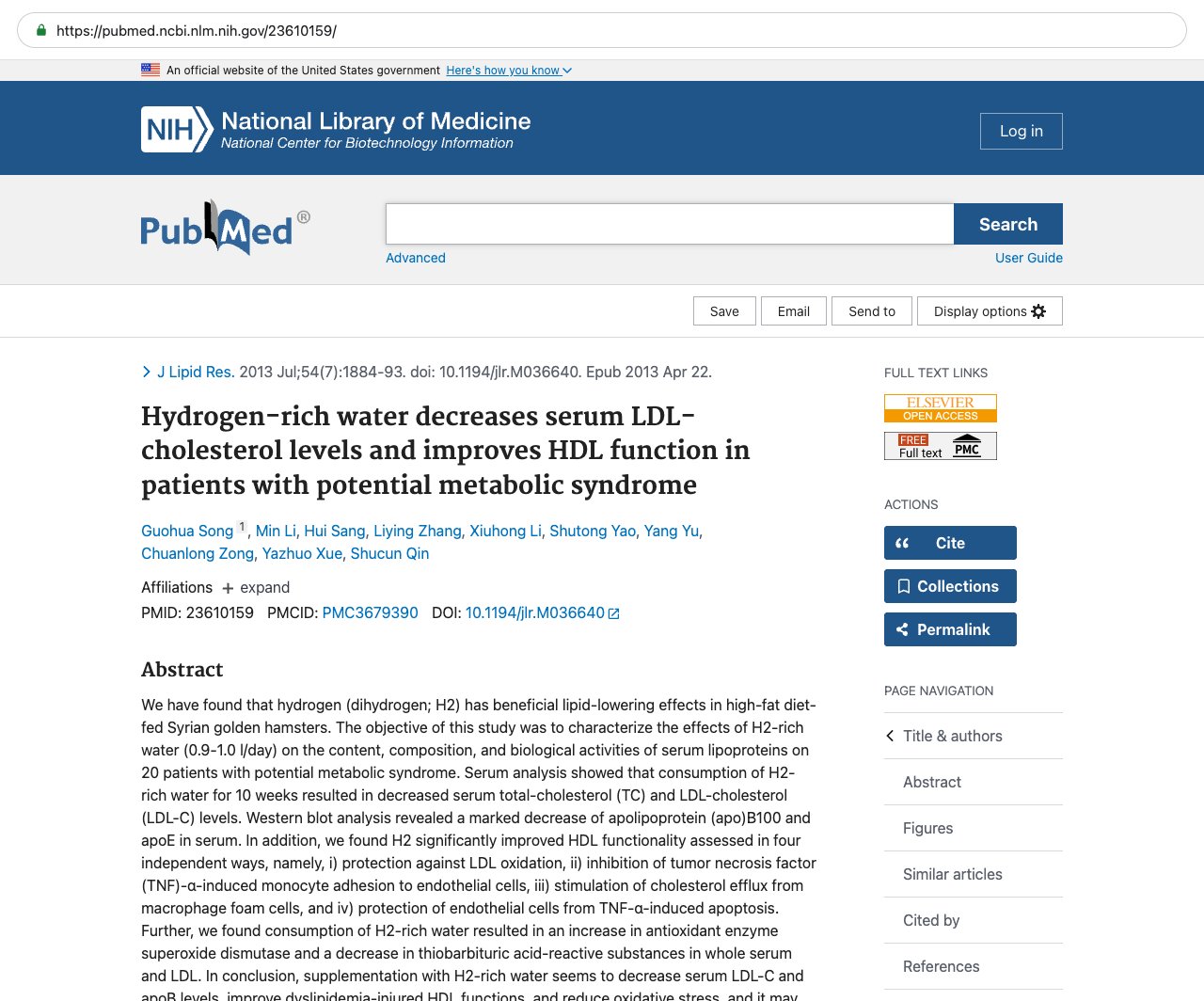
We have found that hydrogen (dihydrogen; H2) has beneficial lipid-lowering effects in high-fat diet-fed Syrian golden hamsters. The objective of this study was to characterize the effects of H2-rich water (0.9-1.0 l/day) on the content, composition, and biological activities of serum lipoproteins on 20 patients with potential metabolic syndrome. Serum analysis showed that consumption of H2-rich water for 10 weeks resulted in decreased serum total-cholesterol (TC) and LDL-cholesterol (LDL-C) levels. Western blot analysis revealed a marked decrease of apolipoprotein (apo)B100 and apoE in serum. In addition, we found H2 significantly improved HDL functionality assessed in four independent ways, namely, i) protection against LDL oxidation, ii) inhibition of tumor necrosis factor (TNF)-α-induced monocyte adhesion to endothelial cells, iii) stimulation of cholesterol efflux from macrophage foam cells, and iv) protection of endothelial cells from TNF-α-induced apoptosis. Further, we found consumption of H2-rich water resulted in an increase in antioxidant enzyme superoxide dismutase and a decrease in thiobarbituric acid-reactive substances in whole serum and LDL. In conclusion, supplementation with H2-rich water seems to decrease serum LDL-C and apoB levels, improve dyslipidemia-injured HDL functions, and reduce oxidative stress, and it may have a beneficial role in prevention of potential metabolic syndrome.
Source & links
Screenshot of the PubMed page
This page mirrors the published abstract (© the authors / publisher) for reference and citation. The canonical source is the PubMed record linked above. This is not medical advice.