2012 · Ohno et al. — Molecular hydrogen as an emerging therapeutic medical gas for neurodegenerative and other diseases.
Super-Abstract
This review surveys the research on molecular hydrogen (H₂) across 63 disease models and human diseases documented in the four and a half years after the landmark 2007 Nature Medicine paper. Most evidence comes from rodent studies; six human diseases have been studied including type 2 diabetes, metabolic syndrome, and hemodialysis. The review honestly notes two unresolved puzzles: the absence of a dose-response relationship and the paradoxical efficacy of tiny amounts of H₂ against a large background of gut-derived H₂.
Commentary
Written by the Ohno group at Nagoya University Graduate School of Medicine, this is a landmark summary piece covering the first wave of H₂ medical research. It catalogues effects across oxidative-stress-mediated diseases — neonatal cerebral hypoxia, Parkinson's disease, ischaemia-reperfusion injuries of heart, lung, liver, kidney, and intestine, and organ transplantation — most demonstrated in rodent models. The inclusion of six human disease studies (diabetes mellitus type 2, metabolic syndrome, haemodialysis, inflammatory and mitochondrial myopathies, brainstem infarction, radiation-induced adverse effects) gives it more translational weight than purely preclinical reviews. However, the authors themselves flag two important mechanistic mysteries: (1) no dose-response effect has been observed — animals and humans taking small amounts of H₂-rich water show marked effects comparable to higher doses; (2) intestinal bacteria already produce large amounts of H₂, yet adding a small exogenous amount produces additional marked effects. These unresolved paradoxes mean the mechanism of H₂'s biological action remains incompletely understood, making clinical dose optimisation difficult.
Key quotes
- „Effects of molecular hydrogen on various diseases have been documented for 63 disease models and human diseases in the past four and a half years.“ — scope of the review: rapid field growth across many disease areas
- „no dose-response effect is observed. Rodents and humans are able to take a small amount of hydrogen by drinking hydrogen-rich water, but marked effects are observed.“ — first unresolved puzzle: efficacy without classical dose-response
- „intestinal bacteria in humans and rodents produce a large amount of hydrogen, but an addition of a small amount of hydrogen exhibits marked effects.“ — second unresolved puzzle: small exogenous dose active despite large endogenous baseline
Our assessment
A key review paper for anyone entering the H₂ medical field — it provides both an honest breadth survey and intellectual honesty about unresolved mechanistic questions. The 63 disease models catalogued are predominantly rodent studies, and the human evidence (6 diseases) is preliminary in size and scope. Important limitations: as a review, it does not produce new effect estimates; the mechanistic paradoxes it names (no dose-response, efficacy vs. endogenous H₂ background) remain open questions even today. The review comes from Japan, where the H₂ research field was most active, and should be read with awareness that the field had a positive-publication bias at this stage.
Study design
- Type: narrative review · Scope: 63 disease models and human diseases; evidence from rodent (majority) and human studies (6 diseases) · H₂ delivery methods covered: inhalation, H₂-rich water, H₂ saline i.v., H₂ bath
- Human diseases covered: type 2 diabetes mellitus, metabolic syndrome, haemodialysis, inflammatory and mitochondrial myopathies, brainstem infarction, radiation-induced adverse effects
- Key open questions named by authors: absence of classical dose-response; paradox of small exogenous H₂ dose efficacy vs. large endogenous gut H₂ production
Abstract
Effects of molecular hydrogen on various diseases have been documented for 63 disease models and human diseases in the past four and a half years. Most studies have been performed on rodents including two models of Parkinson's disease and three models of Alzheimer's disease. Prominent effects are observed especially in oxidative stress-mediated diseases including neonatal cerebral hypoxia; Parkinson's disease; ischemia/reperfusion of spinal cord, heart, lung, liver, kidney, and intestine; transplantation of lung, heart, kidney, and intestine. Six human diseases have been studied to date: diabetes mellitus type 2, metabolic syndrome, hemodialysis, inflammatory and mitochondrial myopathies, brain stem infarction, and radiation-induced adverse effects. Two enigmas, however, remain to be solved. First, no dose-response effect is observed. Rodents and humans are able to take a small amount of hydrogen by drinking hydrogen-rich water, but marked effects are observed. Second, intestinal bacteria in humans and rodents produce a large amount of hydrogen, but an addition of a small amount of hydrogen exhibits marked effects. Further studies are required to elucidate molecular bases of prominent hydrogen effects and to determine the optimal frequency, amount, and method of hydrogen administration for each human disease.
Source & links
Screenshot of the PubMed page
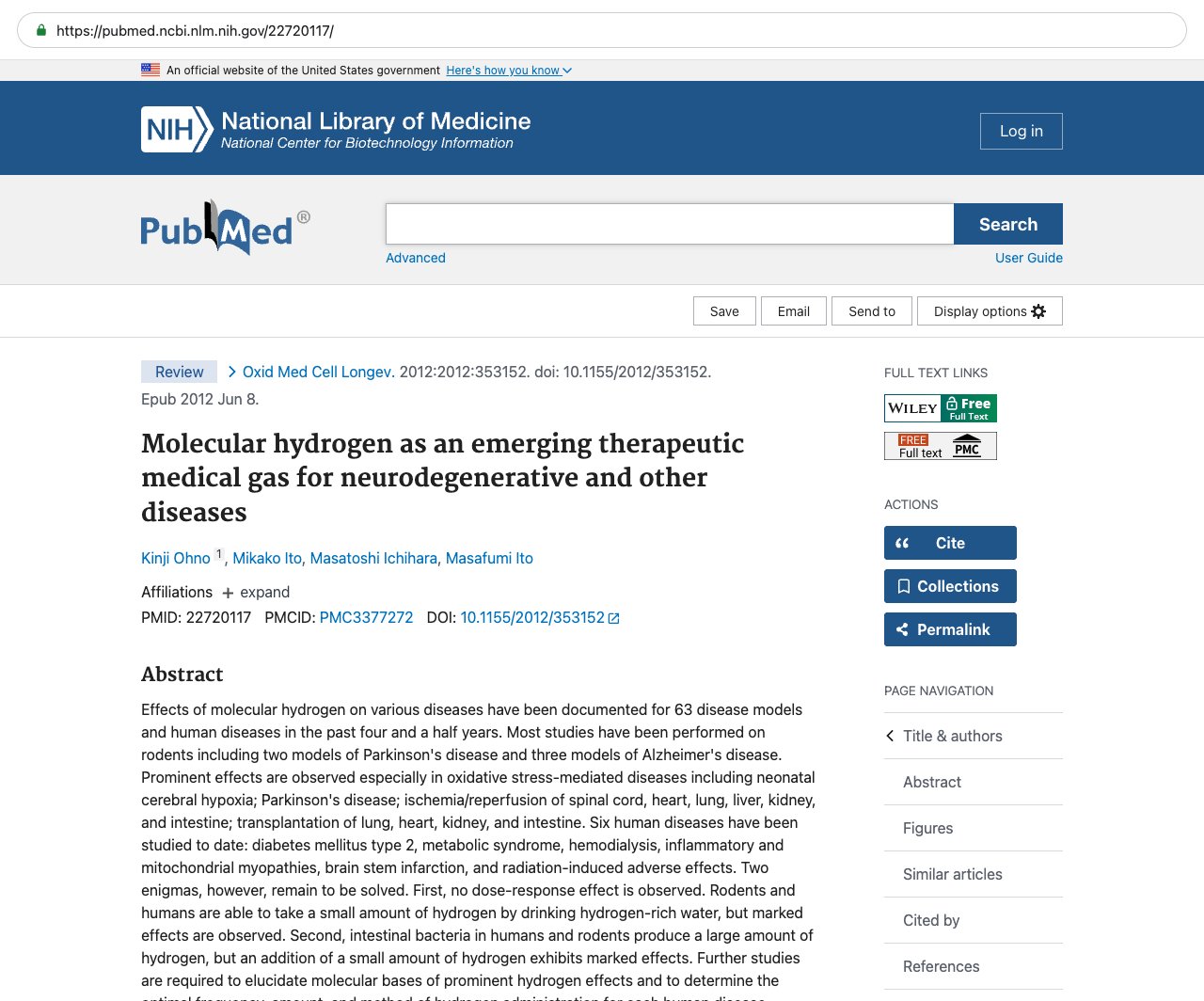
This page mirrors the published abstract (© the authors / publisher) for reference and citation. The canonical source is the PubMed record linked above. This is not medical advice.