2021 Experimental biology and medicine (Maywood, N.J.) Pilot / Observational Human H₂ therapy Drinking (HRW)
2021 · Si — Effects of hydrogen as adjuvant treatment for unstable angina
Super-Abstract
In 40 patients with unstable angina, adding hydrogen-rich water to standard drug therapy for three months reduced angina symptoms and produced greater reductions in total cholesterol, LDL-cholesterol, and apolipoprotein B compared to standard treatment alone. In-vitro work showed H₂ also suppresses the inflammatory pathway driving atherosclerosis. (Experimental Biology and Medicine, 2021.)
Commentary
Unstable angina sits at the dangerous end of the cardiovascular spectrum — a condition of inadequate coronary perfusion closely linked to oxidative stress and inflammation driving atherosclerosis. This study combines a mechanistic in-vitro component (H₂ suppressing ox-LDL-induced oxidative stress via LOX-1/NF-κB pathway inhibition in endothelial cells) with a clinical component (40 hospitalised patients consuming 1,000–1,200 mL/day HRW or placebo water for 3 months, all on standard medication). The clinical findings are meaningful: reduced angina symptoms, lower total cholesterol (not just LDL), lower LDL-cholesterol, and lower apolipoprotein B in the HRW group. Apolipoprotein B is a particularly strong cardiovascular risk marker. The study is not powered as a large outcomes trial, and 40 patients over 3 months cannot establish long-term cardiovascular event reduction. But as an adjuvant therapy signal — in already-treated patients — the lipid improvements are clinically plausible and internally consistent.
Key quotes
- „Hydrogen-rich water intake relieved angina symptoms in unstable angina patients.“ — the primary clinical finding: symptom improvement in an already-treated population
- „Hydrogen-rich water addition resulted in more effective reductions of total-cholesterol, low-density lipoprotein-cholesterol, and apolipoprotein B levels compared with conventional treatment.“ — the lipid profile improvement — additive to standard medication
- „Hydrogen inhibited ox-LDL-induced oxidative stress and inflammatory response by down-regulating LOX-1/NF-kB signaling pathway.“ — the in-vitro mechanistic explanation: H₂ acts on a key atherosclerosis-driving inflammatory axis
Our assessment
A well-structured combined mechanistic and clinical study, though modest in size. The in-vitro/in-vivo pairing strengthens mechanistic plausibility. The clinical findings are consistent with H₂'s known antioxidant and anti-inflammatory properties. Limitations: n=40 (20/20 allocation implied) is underpowered for hard cardiovascular endpoints; the study period is 3 months — too short to observe event-level outcomes; blinding quality of the HRW vs. placebo water is not explicitly described; the journal is of moderate impact. Angina symptom rating is subjective. The lipid reductions are the most objective and convincing finding.
Study design
- Type: in-vitro mechanistic study + clinical controlled trial · n: 40 hospitalised unstable angina patients · H₂ delivery: hydrogen-rich water 1,000–1,200 mL/day, 3 months (plus standard medications in both groups)
- In-vitro model: ox-LDL-induced injury in human umbilical vein endothelial cells — LOX-1/NF-κB pathway
- Result: HRW group: ↓ angina symptoms, ↓ total cholesterol, ↓ LDL-cholesterol, ↓ apolipoprotein B vs. conventional treatment alone; in vitro: H₂ inhibits LOX-1/NF-κB-driven oxidative stress and inflammation
Abstract
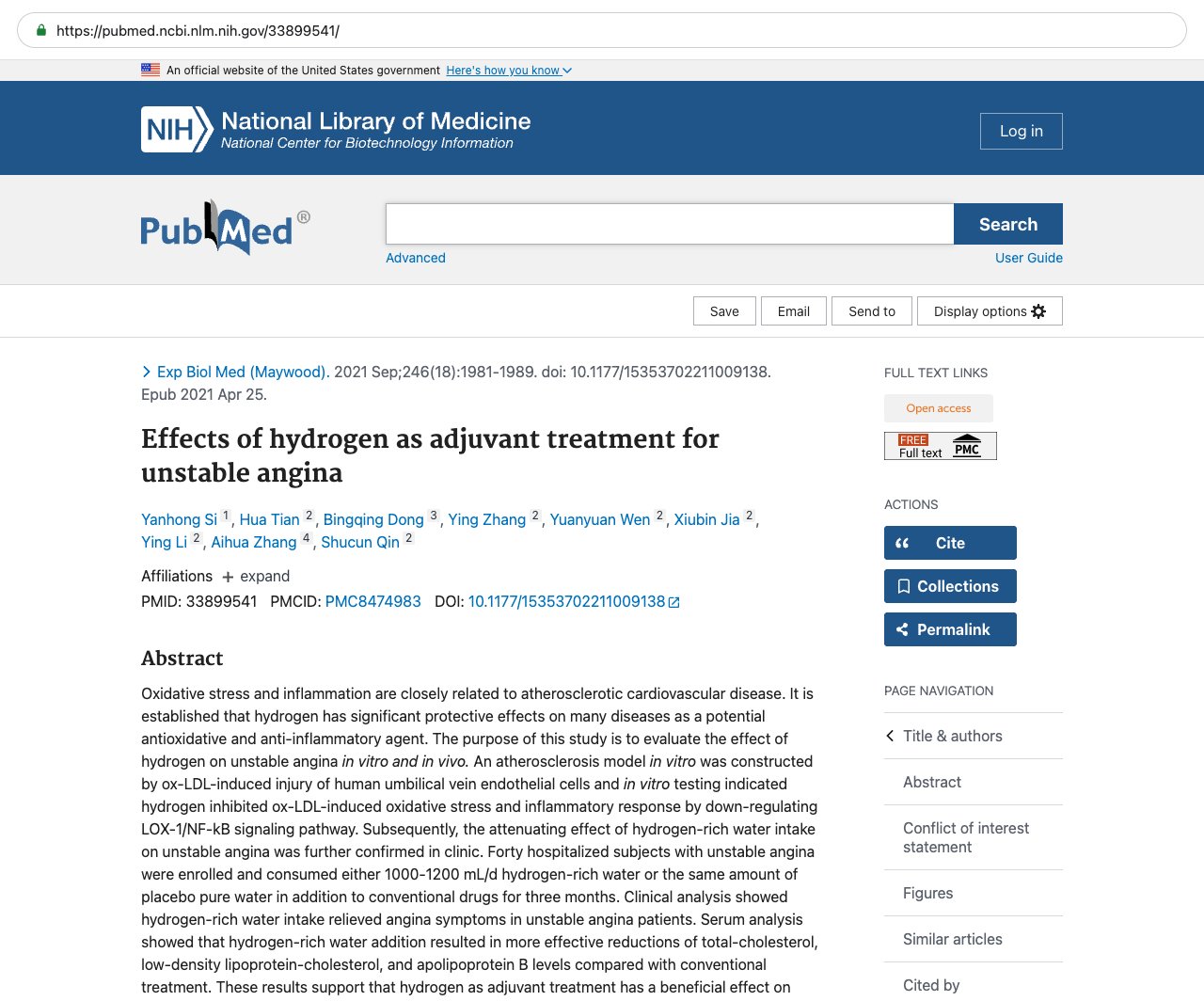
Oxidative stress and inflammation are closely related to atherosclerotic cardiovascular disease. It is established that hydrogen has significant protective effects on many diseases as a potential antioxidative and anti-inflammatory agent. The purpose of this study is to evaluate the effect of hydrogen on unstable angina in vitro and in vivo. An atherosclerosis model in vitro was constructed by ox-LDL-induced injury of human umbilical vein endothelial cells and in vitro testing indicated hydrogen inhibited ox-LDL-induced oxidative stress and inflammatory response by down-regulating LOX-1/NF-kB signaling pathway. Subsequently, the attenuating effect of hydrogen-rich water intake on unstable angina was further confirmed in clinic. Forty hospitalized subjects with unstable angina were enrolled and consumed either 1000-1200 mL/d hydrogen-rich water or the same amount of placebo pure water in addition to conventional drugs for three months. Clinical analysis showed hydrogen-rich water intake relieved angina symptoms in unstable angina patients. Serum analysis showed that hydrogen-rich water addition resulted in more effective reductions of total-cholesterol, low-density lipoprotein-cholesterol, and apolipoprotein B levels compared with conventional treatment. These results support that hydrogen as adjuvant treatment has a beneficial effect on unstable angina.
Source & links
Screenshot of the PubMed page
This page mirrors the published abstract (© the authors / publisher) for reference and citation. The canonical source is the PubMed record linked above. This is not medical advice.