2021 · Li et al. — Hydrogen Commonly Applicable from Medicine to Agriculture: From Molecular Mechanisms to the Field.
Super-Abstract
Beyond its medical applications, molecular hydrogen (H₂) shows substantial promise in agriculture — enhancing plant stress tolerance, improving crop quality and yield, prolonging shelf life, and even strengthening livestock resilience. This review presents H₂ as a bridge between human health research and sustainable food production. (Current Pharmaceutical Design, 2021.)
Commentary
This review takes an unusually broad perspective, extending the hydrogen biology discussion from medicine into plant science and food production. The agricultural applications described — abiotic/biotic stress tolerance, plant growth regulation, improved nutritional values, reduced nitrite accumulation during vegetable storage, and livestock pathogen resistance — are supported by field trial data from China. This is not a clinical or even animal health review in the traditional sense; it is primarily a review of plant and agricultural science. The medical and agricultural mechanisms are presented as sharing a common root: H₂'s ability to modulate oxidative stress and cellular signalling. The low-carbon framing is an additional policy angle.
Key quotes
- „It has been demonstrated that hydrogen gas (H2) may enhance plant tolerance towards abiotic and biotic stresses, regulate plant growth and development, increase nutritional values, prolong the shelf life, and decrease the nitrite accumulation during the storage of vegetables.“ — the range of agricultural benefits described in this review
- „Our field trials show that H2 may have a promising potential to increase yield and improve the quality of agricultural products.“ — field-level evidence from China cited by the authors
- „Hydrogen agriculture belongs to a low carbon economy, and has great potential to provide 'safe, tasty, healthy, and high-yield' agricultural products so that it may improve the sustainability of agriculture.“ — the authors' policy-level framing of H₂ agriculture
Our assessment
This review is notable for its cross-domain scope. For readers interested in H₂ in human health, the medical section serves as background context; the novel contribution is the agricultural application framework. Honest note: the evidence quality for agricultural H₂ is variable — some claims rest on field trial data, others on laboratory experiments. The enthusiasm for „hydrogen agriculture“ as a low-carbon solution carries a promotional tone. This is not a clinical review and contains no human health trial data.
Study design
- Type: narrative review spanning medicine and agriculture · n: n/a (literature synthesis + field trial data from China) · H₂ delivery: inhalation (medical context); various agricultural application methods
- Result: broad narrative synthesis; preclinical and field evidence supports multiple agricultural benefits; human health data are background material rather than primary focus
Abstract
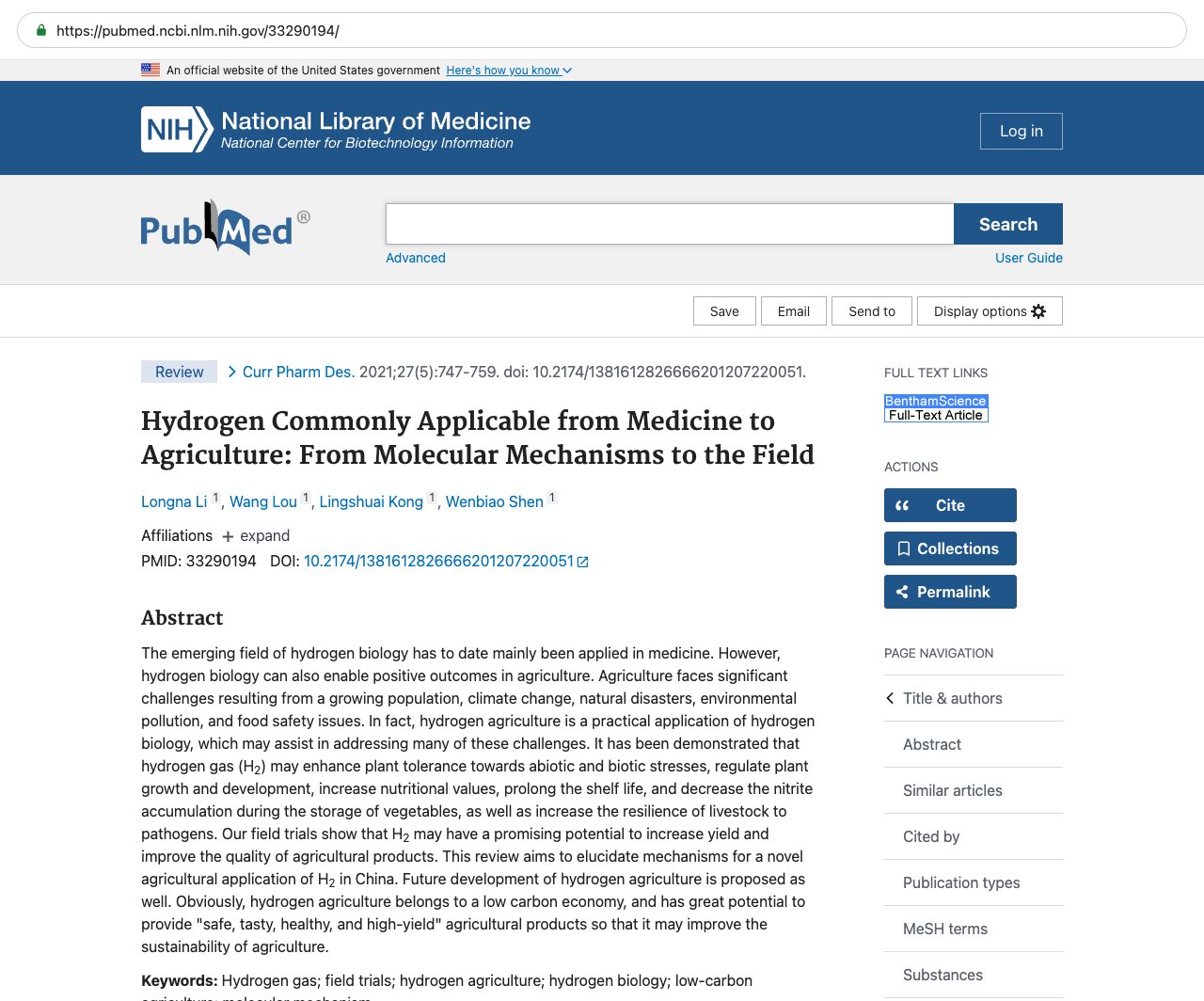
The emerging field of hydrogen biology has to date mainly been applied in medicine. However, hydrogen biology can also enable positive outcomes in agriculture. Agriculture faces significant challenges resulting from a growing population, climate change, natural disasters, environmental pollution, and food safety issues. In fact, hydrogen agriculture is a practical application of hydrogen biology, which may assist in addressing many of these challenges. It has been demonstrated that hydrogen gas (H2) may enhance plant tolerance towards abiotic and biotic stresses, regulate plant growth and development, increase nutritional values, prolong the shelf life, and decrease the nitrite accumulation during the storage of vegetables, as well as increase the resilience of livestock to pathogens. Our field trials show that H2 may have a promising potential to increase yield and improve the quality of agricultural products. This review aims to elucidate mechanisms for a novel agricultural application of H2 in China. Future development of hydrogen agriculture is proposed as well. Obviously, hydrogen agriculture belongs to a low carbon economy, and has great potential to provide "safe, tasty, healthy, and high-yield" agricultural products so that it may improve the sustainability of agriculture.
Source & links
Screenshot of the PubMed page
This page mirrors the published abstract (© the authors / publisher) for reference and citation. The canonical source is the PubMed record linked above. This is not medical advice.