2025 · Zhang — Living Therapeutics for Synergistic Hydrogen-Photothermal Cancer Treatment by Photosynthetic Bacteria.
Super-Abstract
Living photosynthetic bacteria (Rhodobacter sphaeroides) were used as a self-powered, targeted platform that simultaneously generates hydrogen gas and converts near-infrared light into heat inside tumours. In animal experiments, this dual hydrogen-plus-photothermal approach killed tumour cells more effectively than either therapy alone, while sparing surrounding healthy tissue. (Advanced Science, 2025.)
Commentary
This is a preclinical animal study. The approach is conceptually innovative: rather than engineering a synthetic nanoparticle, it exploits the natural hydrogen-producing and light-absorbing capabilities of a bacterium. Rhodobacter sphaeroides produces H₂ metabolically and absorbs strongly in the near-infrared (NIR) spectrum, making it both a hydrogen source and a photothermal agent. The dual modality creates a synergy: H₂ exerts its antioxidant and metabolic-disruption effects while local heating amplifies tumour cell death. The targeted induction minimises collateral damage to healthy tissue — a key advantage over systemic H₂ delivery. Limitations: bacterial safety in immunocompromised patients, immune responses to bacterial antigens, stability and shelf life of living therapeutics, and regulatory pathways for living microbial cancer therapies are all substantial open questions.
Key quotes
- „Living R. sphaeroides exhibits strong absorption in the NIR spectrum, effectively converting light energy into thermal energy while concurrently generating H2.“ — dual functionality of the photosynthetic bacterium as therapeutic agent
- „This dual functionality facilitates the targeted induction of tumor cell death and substantially reduces collateral damage to adjacent normal tissues.“ — therapeutic advantage of the combined approach
- „Integrating hydrogen therapy with photothermal effects, mediated through photosynthetic bacteria, provides a robust, dual-modality approach that enhances the overall efficacy of tumor treatments.“ — authors' summary of the combined strategy
Our assessment
This is a preclinical animal study — results cannot be directly transferred to humans. The living-therapeutic concept is inventive and leverages natural biology elegantly, but the translation challenges are considerable: bacterial immunogenicity, infection risk, consistency of H₂ production in vivo, light penetration depth for NIR photothermal therapy in deep tumours, and the complex regulatory landscape for live microbial therapeutics. No human data exist for this approach, and clinical translation is still at a very early conceptual stage.
Study design
- Type: preclinical animal study · Model: mouse subcutaneous tumour model · H₂ delivery: metabolic H₂ production by living Rhodobacter sphaeroides bacteria injected into tumour
- Co-modality: NIR photothermal therapy (bacteria as light-absorber) · Endpoints: tumour volume, cell death/apoptosis, normal-tissue damage markers · Result: superior tumour cell kill vs. H₂ alone or photothermal alone; reduced healthy-tissue damage
Abstract
Hydrogen gas (H2) therapy, recognized for its inherent biosafety, holds significant promise as an anti-cancer strategy. However, the efficacy of H2 treatment modalities is compromised by their reliance on systemic gas administration or chemical reactions generation, which suffers from low efficiency, poor targeting, and suboptimal utilization. In this study, living therapeutics are employed using photosynthetic bacteria Rhodobacter sphaeroides for in situ H2 production combined with near-infrared (NIR) mediated photothermal therapy. Living R. sphaeroides exhibits strong absorption in the NIR spectrum, effectively converting light energy into thermal energy while concurrently generating H2. This dual functionality facilitates the targeted induction of tumor cell death and substantially reduces collateral damage to adjacent normal tissues. The findings reveal that integrating hydrogen therapy with photothermal effects, mediated through photosynthetic bacteria, provides a robust, dual-modality approach that enhances the overall efficacy of tumor treatments. This living therapeutic strategy not only leverages the therapeutic potential of both hydrogen and photothermal therapeutic modalities but also protects healthy tissues, marking a significant advancement in cancer therapy techniques.
Source & links
Screenshot of the PubMed page
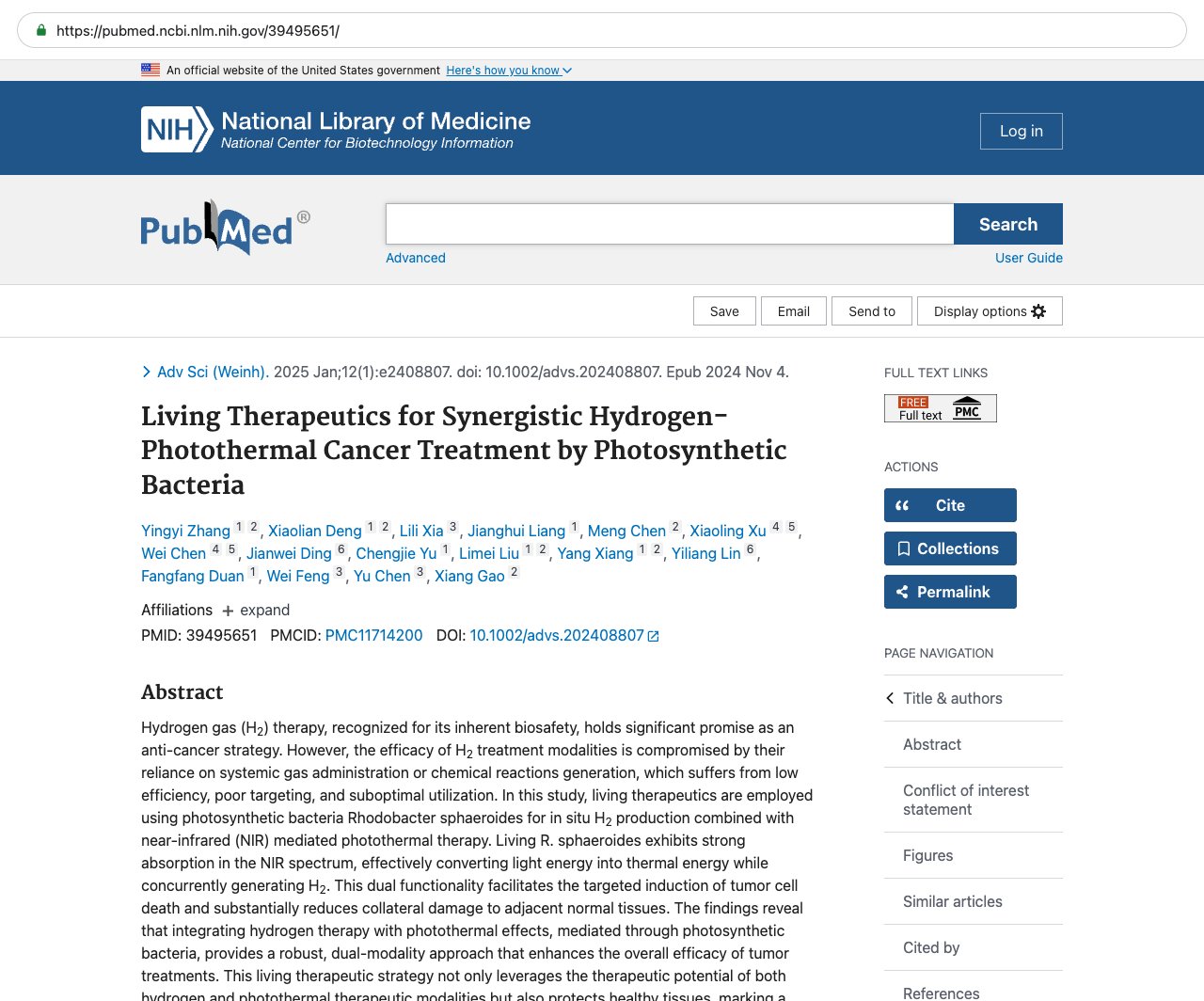
This page mirrors the published abstract (© the authors / publisher) for reference and citation. The canonical source is the PubMed record linked above. This is not medical advice.