2018 · Wan — An In Situ Depot for Continuous Evolution of Gaseous H₂ Mediated by a Magnesium Passivation/Activation Cycle for Treating Osteoarthritis
Super-Abstract
This mouse study tested intra-muscular injection of magnesium-containing microparticles (Mg@PLGA) as a local H₂ delivery system for osteoarthritis (OA). The Mg particles continuously release H₂ in body fluids via a passivation/activation cycle, sustained over time. Biochemical and histological analyses showed reduced joint inflammation and cartilage destruction in the OA mouse model. This is an animal study; no human data exist yet. (Angewandte Chemie, 2018.)
Commentary
A key challenge for H₂ therapy is that directly inhaled or ingested H₂ is cleared from tissue rapidly — bioavailability at the target site is poor. Wan and colleagues address this with an elegant materials science solution: PLGA microparticles loaded with magnesium powder. When injected near the OA joint, Mg reacts slowly with water (passivation layer forms, then breaks down cyclically) to generate H₂ continuously at the local site, sustaining concentrations above a therapeutic threshold. This avoids systemic delivery issues. The biological results — reduced inflammatory markers, preserved cartilage histology — are consistent with H₂'s known anti-inflammatory properties. However, the OA mouse model is inbred and relatively mild; human OA involves years of joint degeneration, immune dysregulation, and mechanical loading that this model does not capture.
Key quotes
- „Mg@PLGA MPs that are intra-muscularly injected close to the OA knee in a mouse model can act as an in situ depot that can evolve gaseous H2 continuously, mediated by the cycle of passivation/activation of Mg in body fluids, at a concentration that exceeds its therapeutic threshold.“ — the core innovation: sustained local H₂ release above the therapeutic threshold
- „The analytical data that are obtained in the biochemical and histological studies indicate that the proposed Mg@PLGA MPs can effectively mitigate tissue inflammation and prevent cartilage from destruction, arresting the progression of OA changes.“ — biological efficacy in the mouse OA model
- „Inflammation is involved in many human pathologies, including osteoarthritis. Hydrogen (H2) is known to have anti-inflammatory effects; however, the bioavailability of directly administered H2 gas is typically poor.“ — the problem this study addresses — H₂ bioavailability
Our assessment
A creative preclinical materials science and pharmacology study with well-conceived design. The continuous-release Mg@PLGA depot concept addresses a real limitation of conventional H₂ delivery. Limitations: mouse OA model — not equivalent to human disease progression; no long-term safety data for Mg/PLGA in joints (corrosion products, inflammatory response to particles); no dose-optimisation data; no human trials. The concept is scientifically interesting and the results are encouraging, but the gap between a mouse knee injection and a human clinical application remains large. This should be considered early-stage proof-of-concept, not clinical evidence.
Study design
- Type: controlled animal experiment · Model: mouse OA model (intra-articular injection), intra-muscular injection of Mg@PLGA microparticles near OA knee
- H₂ delivery: sustained local release from Mg@PLGA microparticles (Mg passivation/activation cycle in body fluids) · Endpoints: biochemical markers of inflammation, histological assessment of cartilage
- Result: continuous H₂ evolution above therapeutic threshold; reduced tissue inflammation and cartilage destruction vs. controls in mouse OA model
Abstract
Inflammation is involved in many human pathologies, including osteoarthritis (OA). Hydrogen (H2 ) is known to have anti-inflammatory effects; however, the bioavailability of directly administered H2 gas is typically poor. Herein, a local delivery system that can provide a high therapeutic concentration of gaseous H2 at inflamed tissues is proposed. The delivery system comprises poly(lactic-co-glycolic acid) microparticles that contain magnesium powder (Mg@PLGA MPs). Mg@PLGA MPs that are intra-muscularly injected close to the OA knee in a mouse model can act as an in situ depot that can evolve gaseous H2 continuously, mediated by the cycle of passivation/activation of Mg in body fluids, at a concentration that exceeds its therapeutic threshold. The analytical data that are obtained in the biochemical and histological studies indicate that the proposed Mg@PLGA MPs can effectively mitigate tissue inflammation and prevent cartilage from destruction, arresting the progression of OA changes.
Source & links
Screenshot of the PubMed page
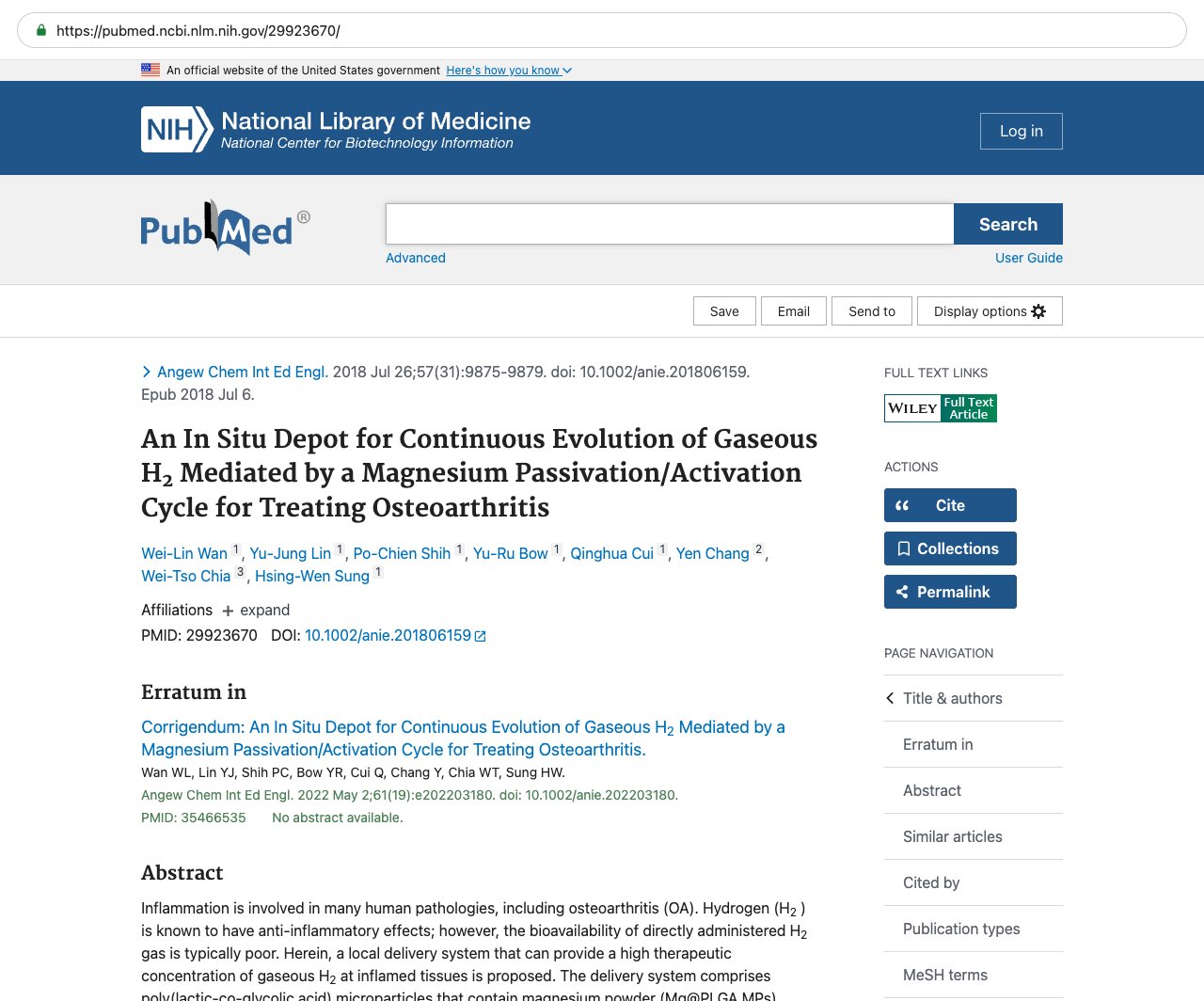
This page mirrors the published abstract (© the authors / publisher) for reference and citation. The canonical source is the PubMed record linked above. This is not medical advice.