2023 · Son — PdO-Nanoparticle-Embedded Carbon Nanotube Yarns for Wearable Hydrogen Gas Sensing Platforms with Fast and Sensitive Responses
Super-Abstract
Researchers developed a flexible yarn-type sensor that detects explosive hydrogen concentrations within two seconds — opening a path toward wearable H₂ safety monitors. The sensor uses palladium oxide nanoparticles embedded in carbon nanotube yarn to sense H₂ with extraordinary sensitivity (1198%) and speed, even when bent around joints. This is a materials-science and safety study, not a biomedical therapy study.
Commentary
This in-vitro engineering study addresses a practical safety problem: H₂ becomes flammable above 4 vol%, and wearable monitoring is currently limited. The biscrolling fabrication technique — rolling palladium oxide nanoparticles into carbon nanotube buckypapers to form a flexible yarn — is the central innovation. The 2-second response time and high sensitivity are notable benchmarks. However, this work is fundamentally a sensor-materials study: it has no connection to H₂ inhalation therapy, H₂ water, or any biomedical application. Its relevance to H₂ medicine lies in safety infrastructure — enabling real-time leak detection in clinical or home settings where H₂ is administered.
Key quotes
- „when exposed to a flammable H2 concentration (4 vol %), the biscrolled HGSP yarn exhibits a short response time of 2 s, with a high sensitivity of 1198%“ — the headline sensor performance figures
- „the fabricated HGSP yarn could be applied to a wearable gas monitoring platform for real-time detection of H2 gas leakage even over the bends of joints“ — the proposed application: a wearable, flexible H₂ safety sensor
- „Because of the high loading of H2-active PdO NPs (up to 97.7 wt %), when exposed to a flammable H2 concentration (4 vol %), the biscrolled HGSP yarn exhibits a short response time of 2 s“ — how high PdO loading drives the fast response
Our assessment
This is a materials engineering study, not a clinical or therapeutic investigation. Its value lies entirely in the safety domain: it demonstrates that a flexible, body-conforming H₂ sensor with fast response and high sensitivity is technically feasible. No claims about H₂ health effects are made or should be inferred. For the H₂ medicine context, the work is relevant only as proof-of-concept for wearable leak monitoring — not as evidence of therapeutic benefit. The in-vitro character of the work means all results are lab-bench measurements; real-world wearable performance under sweat, body movement, and varying humidity has not yet been validated.
Study design
- Type: in-vitro materials/engineering study · n: n/a (sensor characterisation) · H₂ delivery: controlled gas-phase H₂ exposure of sensor yarn in lab
- Result: 2 s response time at 4 vol% H₂; sensitivity 1198% (ΔG/G₀ × 100%); yarn shows mechanical flexibility suitable for joint-mounted wearable use
Abstract
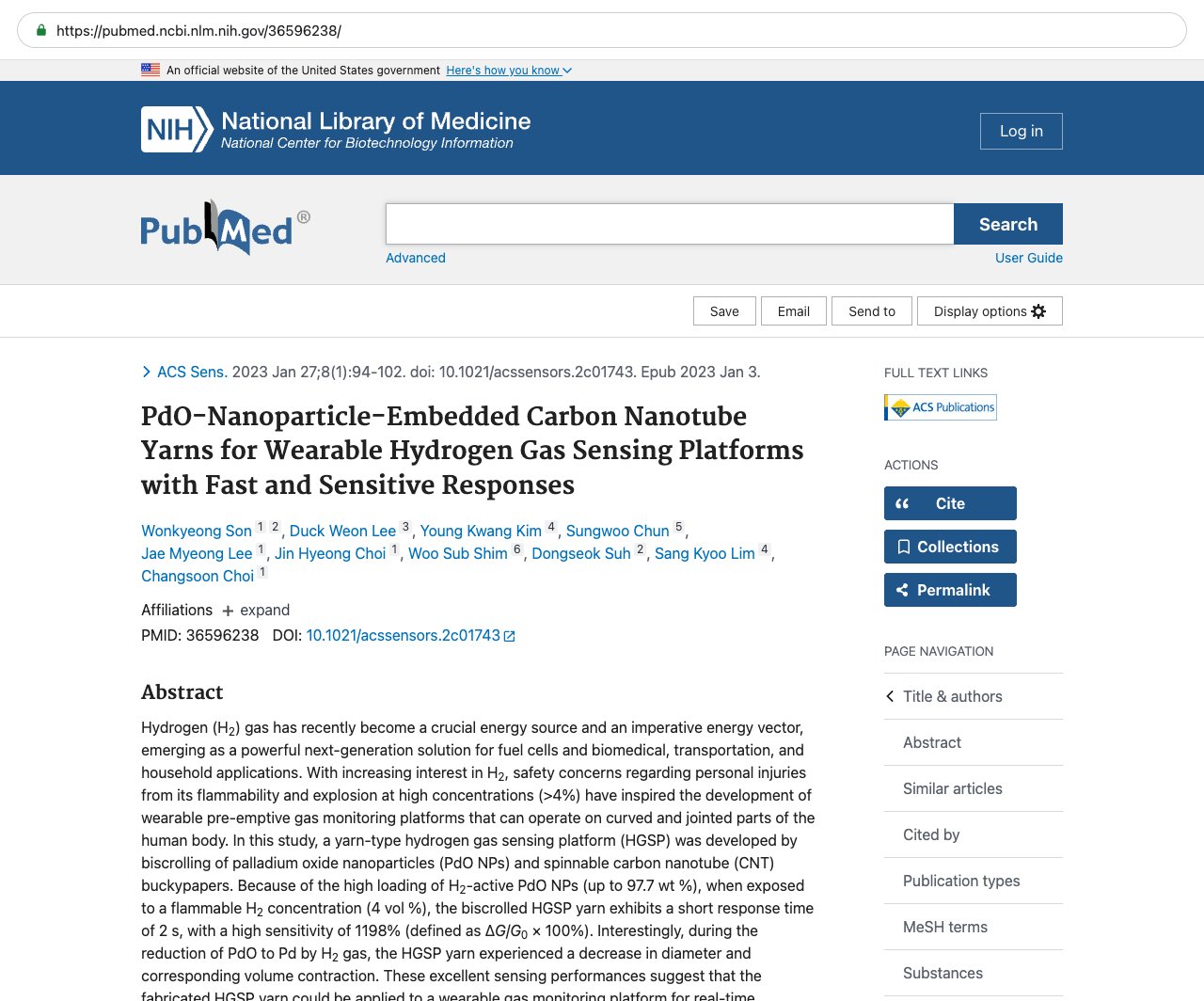
Hydrogen (H2) gas has recently become a crucial energy source and an imperative energy vector, emerging as a powerful next-generation solution for fuel cells and biomedical, transportation, and household applications. With increasing interest in H2, safety concerns regarding personal injuries from its flammability and explosion at high concentrations (>4%) have inspired the development of wearable pre-emptive gas monitoring platforms that can operate on curved and jointed parts of the human body. In this study, a yarn-type hydrogen gas sensing platform (HGSP) was developed by biscrolling of palladium oxide nanoparticles (PdO NPs) and spinnable carbon nanotube (CNT) buckypapers. Because of the high loading of H2-active PdO NPs (up to 97.7 wt %), when exposed to a flammable H2 concentration (4 vol %), the biscrolled HGSP yarn exhibits a short response time of 2 s, with a high sensitivity of 1198% (defined as ΔG/G0 × 100%). Interestingly, during the reduction of PdO to Pd by H2 gas, the HGSP yarn experienced a decrease in diameter and corresponding volume contraction. These excellent sensing performances suggest that the fabricated HGSP yarn could be applied to a wearable gas monitoring platform for real-time detection of H2 gas leakage even over the bends of joints.
Source & links
Screenshot of the PubMed page
This page mirrors the published abstract (© the authors / publisher) for reference and citation. The canonical source is the PubMed record linked above. This is not medical advice.