2023 · Lin — Hydrogen Gas Treatment Improves Postoperative Delirium and Cognitive Dysfunction in Elderly Noncardiac Patients
Super-Abstract
Prophylactic hydrogen inhalation nearly halves postoperative delirium in elderly patients. In a randomized design (184 patients ≥ 65 years), delirium occurred in 24 % of the control group but only 12 % of the hydrogen group — with a simultaneously significantly lower inflammatory marker CRP. (Journal of Personalized Medicine, 2023.)
Commentary
Postoperative delirium is an acute brain dysfunction that affects millions of elderly patients each year — and has hardly any effective prophylaxis. This randomized controlled study tested exactly that: 184 patients aged 65 and over before elective surgery were randomized into a control group or a hydrogen-inhalation group. The result is clinically tangible: in the control group, 17 of 70 patients (24 %) developed delirium, in the hydrogen group only 10 of 83 (12 %) — almost a halving. Consistent with this, postoperative C-reactive protein (CRP), an inflammatory marker, was significantly lower in the hydrogen group; the authors therefore interpret the effect via a dampened inflammatory response. To be honest: hospital length of stay and sleep quality did not differ, and on the first day the pain scores in the hydrogen group were even minimally higher (4.08 vs. 3.54; a clinically small difference). Blinding is not explicitly mentioned in the abstract — that is a methodological weakness.
Key quotes
- „Postoperative delirium occurred in 17 (24%) of 70 patients without hydrogen inhalation and in 10 (12%) of 83 patients after hydrogen inhalation.“ — the core finding: halving of the delirium rate
- „The postoperative C-reactive protein level was significantly lower in the hydrogen group than the control group.“ — indication of a dampened inflammatory response as the mechanism
- „This study suggests that hydrogen inhalation can prevent postoperative delirium in elderly noncardiac patients by reducing the inflammatory response.“ — the authors' conclusion
Our assessment
Relevant for H₂ inhalation applications because a hard clinical endpoint (occurrence/non-occurrence of delirium) is measured here instead of a surrogate marker — and that in a relevant risk population (elderly surgical patients) with a decent sample size (n = 184). The CRP finding provides a plausible inflammatory mechanism. Limitation, stated honestly: the abstract says „randomized“ but mentions no explicit blinding or placebo inhalation — for a subjectively co-assessed endpoint (CAM delirium screening) that is a serious weakness. Length of stay and sleep quality remained unaffected, and pain scores were initially slightly higher. Note on the year: first PubMed listing 2022 (Epub), formal publication volume JPM Vol. 13 = 2023.
Study design
- Type: randomized controlled study (blinding not specified in the abstract) · n: 184 enrolled (analysis: 70 control / 83 hydrogen) · Duration: perioperative, follow-up 1–7 days post-op · H₂ delivery: prophylactic hydrogen gas inhalation
- Result: delirium 24 % (control) vs. 12 % (hydrogen); postoperative CRP significantly lower in the hydrogen group; NRS pain day 1: 4.08 vs. 3.54 (p < 0.05); no difference in hospital length of stay and sleep quality (day 1/3/7)
Abstract
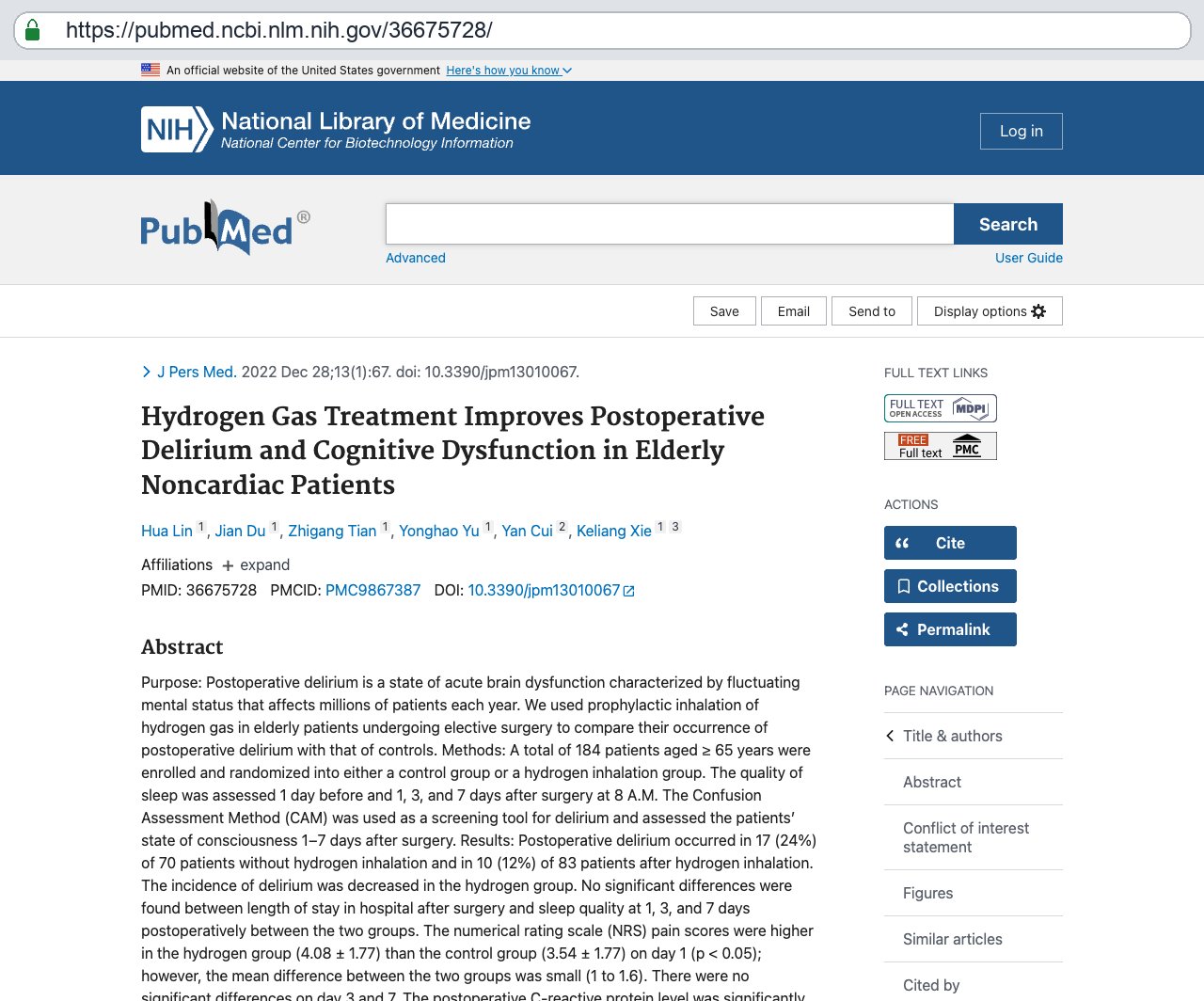
Purpose: Postoperative delirium is a state of acute brain dysfunction characterized by fluctuating mental status that affects millions of patients each year. We used prophylactic inhalation of hydrogen gas in elderly patients undergoing elective surgery to compare their occurrence of postoperative delirium with that of controls. Methods: A total of 184 patients aged ≥ 65 years were enrolled and randomized into either a control group or a hydrogen inhalation group. The quality of sleep was assessed 1 day before and 1, 3, and 7 days after surgery at 8 A.M. The Confusion Assessment Method (CAM) was used as a screening tool for delirium and assessed the patients' state of consciousness 1−7 days after surgery. Results: Postoperative delirium occurred in 17 (24%) of 70 patients without hydrogen inhalation and in 10 (12%) of 83 patients after hydrogen inhalation. The incidence of delirium was decreased in the hydrogen group. No significant differences were found between length of stay in hospital after surgery and sleep quality at 1, 3, and 7 days postoperatively between the two groups. The numerical rating scale (NRS) pain scores were higher in the hydrogen group (4.08 ± 1.77) than the control group (3.54 ± 1.77) on day 1 (p < 0.05); however, the mean difference between the two groups was small (1 to 1.6). There were no significant differences on day 3 and 7. The postoperative C-reactive protein level was significantly lower in the hydrogen group than the control group. Conclusions: This study suggests that hydrogen inhalation can prevent postoperative delirium in elderly noncardiac patients by reducing the inflammatory response.
Source & links
Screenshot of the PubMed page
This page mirrors the published abstract (© the authors / publisher) for reference and citation. The canonical source is the PubMed record linked above. This is not medical advice.