2025 · Lin et al. — Precision Assessment of Anti-NMDA Receptor Encephalitis: A Case Report on Integrating Clinical Course, Immunophenotyping, and Comprehensive Symptomatology in a Pediatric Patient With Adjunctive Hydrogen Therapy
Super-Abstract
Anti-NMDA receptor encephalitis is the most common form of autoimmune encephalitis — and it is notoriously difficult to treat when first-line therapies fail. This case describes a 14-year-old boy who showed poor response to initial immunotherapy but improved significantly after rituximab — with hydrogen therapy added as an adjunct. Immunophenotyping revealed correlations between treatment outcomes and shifts in B cell subsets, PD-1+ cytotoxic T cells, and regulatory T cell subtypes. (In Vivo, 2025.)
Commentary
Anti-NMDAR encephalitis presents with psychiatric symptoms, seizures, movement disorders, and autonomic instability — and the standard cascade of corticosteroids, IVIG, and plasmapheresis fails a significant minority of patients. Rituximab is then deployed as a second-line agent targeting B cells. In this case, the patient responded to rituximab, and hydrogen therapy (intravenous hydrogen-rich saline) was introduced simultaneously. The immunophenotyping is detailed, tracking B cell subset dynamics, PD-1+ T cell changes, and regulatory T cell shifts — providing a mechanistic snapshot during a complex multimodal treatment course. The challenge is exactly as in every other case report: the rituximab response and H₂ response cannot be disentangled at n=1. The paper's principal scientific contribution is the immunophenotyping framework for anti-NMDAR encephalitis — which may inform future monitoring protocols regardless of H₂. The pediatric setting adds clinical significance as this population has fewer safe treatment options.
Key quotes
- „This case report describes a 14-year-old boy with anti-NMDAR encephalitis who exhibited poor response to initial treatment, but showed significant improvement with rituximab and adjunctive hydrogen therapy.“ — clinical summary: rituximab + H₂ in a treatment-refractory pediatric case
- „Immunophenotyping revealed correlations between treatment outcomes and shifts in B cell subsets, PD-1+ cytotoxic T cells, and regulatory T cell subtypes.“ — detailed immune monitoring as a tool for tracking treatment response in autoimmune encephalitis
- „This case underscores the importance of integration traditional clinical assessments with advanced diagnostics such as flow cytometry-based immunophenotyping.“ — main methodological message: immunophenotyping as a clinical monitoring tool
Our assessment
Single pediatric case report where rituximab (a well-established second-line agent for anti-NMDAR encephalitis) was the primary therapeutic pivot — and H₂ was an add-on. The patient's improvement is most plausibly attributable to rituximab and natural disease remission, which occurs in many anti-NMDAR encephalitis cases over months. The H₂ contribution cannot be assessed at n=1 alongside rituximab. The intravenous H₂-rich saline delivery method is notable — this is a higher-dose, more controlled route than oral methods. The immunophenotyping analysis is the most scientifically valuable component and could serve as a biomarker template for future interventional studies in autoimmune encephalitis.
Study design
- Type: single case report (pediatric) · n: 1 (14-year-old male, anti-NMDAR encephalitis) · H₂ delivery: intravenous hydrogen-rich saline; concurrent rituximab (primary second-line therapy)
- Endpoints: clinical improvement narrative; flow cytometry (B cell subsets, PD-1+ cytotoxic T cells, regulatory T cell subtypes)
- Result: significant clinical improvement with rituximab + H₂; B cell, PD-1+ T cell, and Treg subset shifts correlating with outcome; H₂ contribution cannot be isolated from rituximab
Abstract
BACKGROUND/AIM: Anti-N-methyl-D-aspartate receptor (NMDAR) encephalitis, though rare, is the most common form of autoimmune encephalitis, predominantly affecting young individuals, particularly females. Standard treatments include corticosteroids, intravenous immunoglobulins (IVIG), and plasmapheresis, with rituximab recommended for those unresponsive to first-line therapies. However, reliable biomarkers for clinical assessment remain elusive. This study investigated the efficacy of adjunctive hydrogen therapy in a patient with anti-NMDAR encephalitis. CASE REPORT: This case report describes a 14-year-old boy with anti-NMDAR encephalitis who exhibited poor response to initial treatment, but showed significant improvement with rituximab and adjunctive hydrogen therapy. Immunophenotyping revealed correlations between treatment outcomes and shifts in B cell subsets, PD-1+ cytotoxic T cells, and regulatory T cell subtypes. CONCLUSION: This case underscores the importance of integration traditional clinical assessments with advanced diagnostics such as flow cytometry-based immunophenotyping, and suggests a potential role for hydrogen therapy in modulating immune response in this complex autoimmune condition.
Source & links
Screenshot of the PubMed page
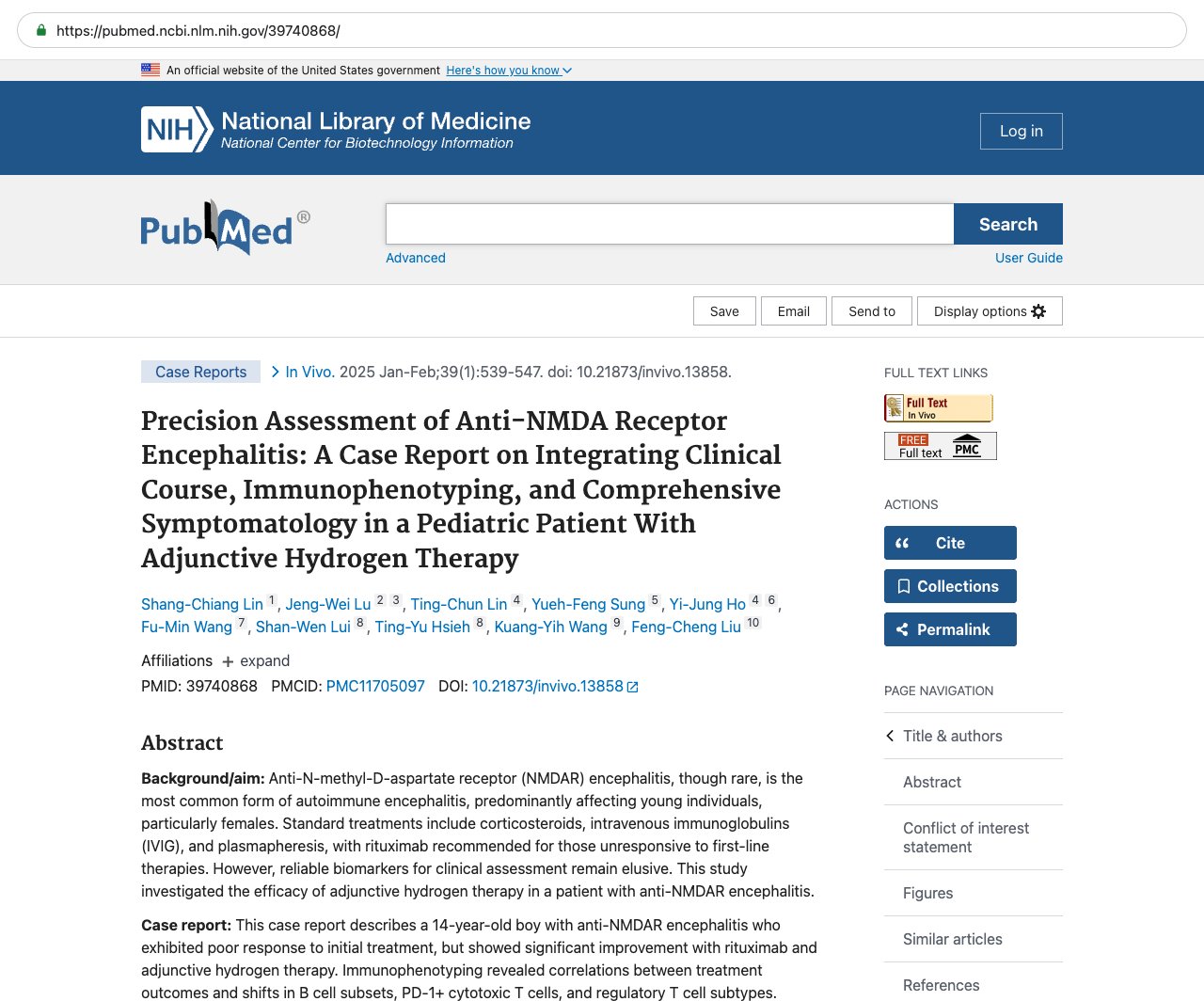
This page mirrors the published abstract (© the authors / publisher) for reference and citation. The canonical source is the PubMed record linked above. This is not medical advice.