2024 · Cui et al. — Molecular Hydrogen Attenuates Sepsis-Induced Cardiomyopathy in Mice by Promoting Autophagy
Super-Abstract
In a mouse model of sepsis-induced cardiomyopathy (SIC), molecular hydrogen inhalation significantly improved 7-day survival, reduced cardiac tissue inflammation, and lowered troponin I levels — effects that operated through promotion of autophagy and mitophagy. When autophagy was pharmacologically blocked, the protective effect of H₂ was reversed, confirming autophagy as a key mechanistic link. This is an animal study; human data are not yet available.
Commentary
Sepsis-induced cardiomyopathy is a serious complication of sepsis, occurring in 40–60% of patients and substantially worsening prognosis. This study uses the well-established cecal ligation and puncture (CLP) mouse model — the gold standard for polymicrobial sepsis — and applies 2% H₂ inhalation as the intervention. The finding that H₂ promotes autophagic flux (removing damaged proteins and organelles) while reducing myocardial troponin I and pathological scores is mechanistically coherent: impaired autophagy in sepsis leads to accumulation of damaged mitochondria (mitophagy deficit), amplifying oxidative stress and cardiomyocyte death. The reversal experiment with bafilomycin A1 (which blocks autophagosome–lysosome fusion) is the methodological strength of this paper — it provides causal evidence rather than correlation. Limitations include the artificial CLP model, male-only mice, and the fact that 2% H₂ inhalation in a controlled experimental environment differs from real-world clinical sepsis management.
Key quotes
- „Hydrogen exerts protective effect against SIC, which may be achieved through the promotion of autophagy and mitophagy.“ — the central mechanistic conclusion of the study
- „The survival rate of septic mice treated with H2 was significantly improved, myocardial tissue inflammation was improved, serum cTnI level was decreased, autophagy flux was increased.“ — the key outcome findings across survival, histology, biomarkers, and mechanism
- „Compared to the CLP + H2 group, the CLP + H2 + BafA1 group showed a decrease in autophagy level and 7-day survival rate … which reversed the protective effect of hydrogen.“ — blocking autophagy abolishes H₂ protection — causal mechanistic evidence
Our assessment
A mechanistically rigorous animal study that identifies autophagy/mitophagy promotion as the likely mechanism by which H₂ protects the heart in sepsis. The reversal experiment with bafilomycin A1 adds meaningful causal weight. Honest limitation: this is an animal study (mice, CLP model) with no human data. CLP models do not fully replicate the heterogeneity of human sepsis. Clinical translation would require safety and efficacy studies in humans. The work is an important step toward understanding H₂'s cardiac protective mechanism, not a clinical recommendation.
Study design
- Type: preclinical animal study · Model: C57BL/6J male mice, cecal ligation and puncture (CLP) sepsis · H₂ delivery: 2% H₂ inhalation + autophagy inhibitor (bafilomycin A1) reversal group
- Groups: Sham / Sham+H₂ / CLP / CLP+H₂ (primary); CLP / CLP+BafA1 / CLP+H₂ / CLP+H₂+BafA1 (mechanistic) · Endpoints: 7-day survival, myocardial histology, serum cTnI, autophagy/mitophagy protein levels
- Result: H₂ significantly improved survival and reduced cardiac injury; autophagy flux increased; these benefits were reversed by BafA1, confirming autophagy as the operative mechanism — all in preclinical models
Abstract
BACKGROUND: Approximately 40 to 60% of patients with sepsis develop sepsis-induced cardiomyopathy (SIC), which is associated with a substantial increase in mortality. We have found that molecular hydrogen (H2) inhalation improved the survival rate and cardiac injury in septic mice. However, the mechanism remains unclear. This study aimed to explore the regulatory mechanism by which hydrogen modulates autophagy and its role in hydrogen protection of SIC. METHODS: Cecal ligation and puncture (CLP) was used to induce sepsis in adult C57BL/6J male mice. The mice were randomly divided into 4 groups: Sham, Sham + 2% hydrogen inhalation (H2), CLP, and CLP + H2 group. The 7-day survival rate was recorded. Myocardial pathological scores were calculated. Myocardial troponin I (cTnI) levels in serum were detected, and the levels of autophagy- and mitophagy-related proteins in myocardial tissue were measured. Another four groups of mice were also studied: CLP, CLP + Bafilomycin A1 (BafA1), CLP + H2, and CLP + H2 + BafA1 group. Mice in the BafA1 group received an intraperitoneal injection of the autophagy inhibitor BafA1 1 mg/kg 1 h after operation. The detection indicators remained the same as before. RESULTS: The survival rate of septic mice treated with H2 was significantly improved, myocardial tissue inflammation was improved, serum cTnI level was decreased, autophagy flux was increased, and mitophagy protein content was decreased (P < 0.05). Compared to the CLP + H2 group, the CLP + H2 + BafA1 group showed a decrease in autophagy level and 7-day survival rate, an increase in myocardial tissue injury and cTnI level, which reversed the protective effect of hydrogen (P < 0.05). CONCLUSION: Hydrogen exerts protective effect against SIC, which may be achieved through the promotion of autophagy and mitophagy.
Source & links
Screenshot of the PubMed page
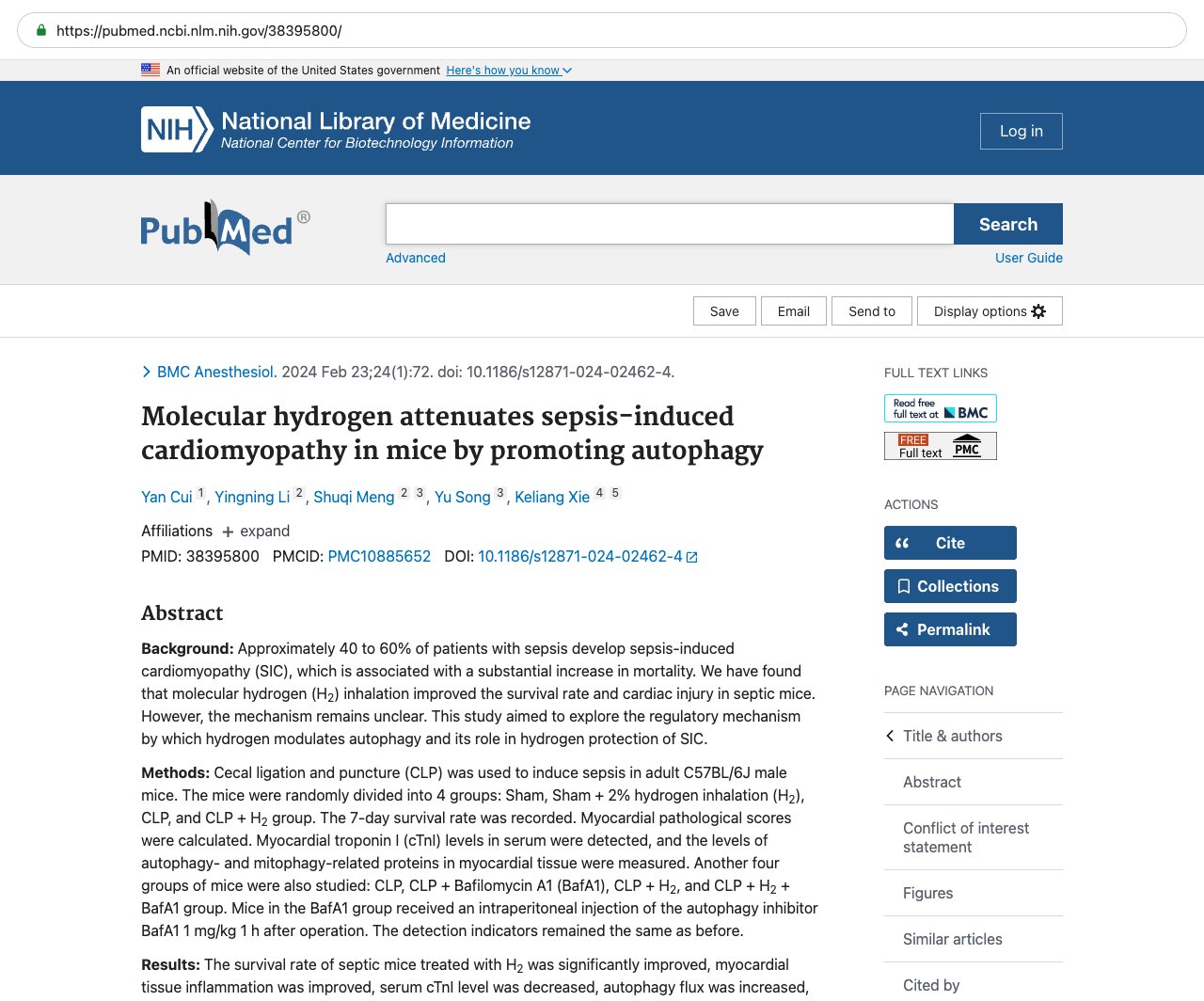
This page mirrors the published abstract (© the authors / publisher) for reference and citation. The canonical source is the PubMed record linked above. This is not medical advice.