2024 · Liu — The Benefit of Hydrogen Gas as an Adjunctive Therapy for Chronic Obstructive Pulmonary Disease.
Super-Abstract
Six COPD patients who added hydrogen gas inhalation (30 min, three times daily for 30 days) to standard treatment showed significant improvements in symptom burden scores (CAT) and dyspnoea scale (mMRC) — but no changes in lung function, sleep quality, inflammation markers, or oxidative stress markers. No adverse effects occurred. (Medicina, 2024.)
Commentary
This is a small pilot study with honest reporting of both positive and null findings. The significant CAT and mMRC improvements (symptom burden and breathlessness) are patient-relevant outcomes, but the lack of effect on lung function (spirometry, DLCO) and the absence of changes in inflammatory or oxidative stress biomarkers is notable and somewhat counterintuitive given the proposed anti-inflammatory mechanism of H₂. One possible interpretation: H₂ improves subjective breathlessness perception or respiratory effort without altering underlying airway pathology — which could reflect central or muscular effects rather than airway anti-inflammation. The unexpected significant change in platelet count (an increase) is unexplained and warrants attention in future studies. With n=6, statistical power is very low and all findings should be considered preliminary.
Key quotes
- „this study revealed significant improvements in CAT [15.5 (10.5-19.75) vs. 8.5 (3-13.5); p = 0.043] and mMRC scores [2.5 (1-4) vs. 2 (0-3.25); p = 0.046] before and after intervention.“ — the significant symptom improvements with their exact values and p-values
- „no significant differences were observed in lung function, DLCO, sleep quality, and 6 MWT before and after hydrogen therapy.“ — the null results: no objective lung function or functional capacity improvement
- „All patients experienced no obvious side-effects.“ — safety observation across all 6 participants
Our assessment
Honest pilot data with important null findings alongside positive symptom scores. The disconnect between subjective symptom improvement and objective function/biomarker measures is clinically important and should not be glossed over. Limitations: n=6 is far too small for reliable statistical inference; no control or placebo group; open-label; unknown if improvements persist beyond 30 days; the platelet count change requires explanation. The study's value is in providing preliminary data and identifying endpoints for a properly powered trial. Cannot support clinical recommendations in isolation.
Study design
- Type: uncontrolled open-label pilot study · n: 6 COPD patients · H₂ delivery: inhalation, 30 min 3×/day for 30 days (add-on to standard COPD treatment)
- Positive results: CAT score improved significantly (15.5→8.5, p=0.043); mMRC dyspnoea scale improved significantly (2.5→2, p=0.046); platelet count increased significantly
- Null results: no significant change in lung function (spirometry), DLCO, sleep quality, 6-minute walk test, inflammatory markers, or oxidative stress markers; no adverse effects
Abstract
Background and Objectives: Recent studies suggest that hydrogen gas possesses anti-inflammatory, antioxidant, and anti-apoptotic properties. This study aimed to explore the therapeutic potential of hydrogen gas and assess its safety and tolerability in individuals with chronic obstructive pulmonary disease (COPD). Materials and Methods: Enrolled COPD patients received standard treatments along with additional hydrogen inhalation for 30 min in the morning, afternoon, and evening over a 30-day period. The assessment included changes in the COPD Assessment Test (CAT), the modified Medical Research Council (mMRC) Dyspnea Scale, lung function, sleep quality, inflammation markers, and oxidative stress markers before and after hydrogen inhalation. Results: Six patients participated in this study. Patients 2, 3, 4, 5, and 6 demonstrated improvements in CAT scores following hydrogen gas intervention, with patients 2, 4, 5, and 6 also showing improvements in mMRC scores. Statistically, this study revealed significant improvements in CAT [15.5 (10.5-19.75) vs. 8.5 (3-13.5); p = 0.043] and mMRC scores [2.5 (1-4) vs. 2 (0-3.25); p = 0.046] before and after intervention, respectively. However, no significant differences were observed in lung function, DLCO, sleep quality, and 6 MWT before and after hydrogen therapy. CBC examination showed a significant difference in platelet count before and after treatment [247 (209.75-298.75) vs. 260 (232.75-314.5); p = 0.043], respectively, while other blood tests, inflammation markers, and oxidative stress markers did not exhibit significant differences before and after hydrogen therapy. All patients experienced no obvious side-effects. Conclusions: Adjuvant therapy with hydrogen gas demonstrated symptom improvements in specific COPD patients, and no significant adverse effects were observed in any of the patients. Hydrogen gas may also exert a modulatory effect on platelet count.
Source & links
Screenshot of the PubMed page
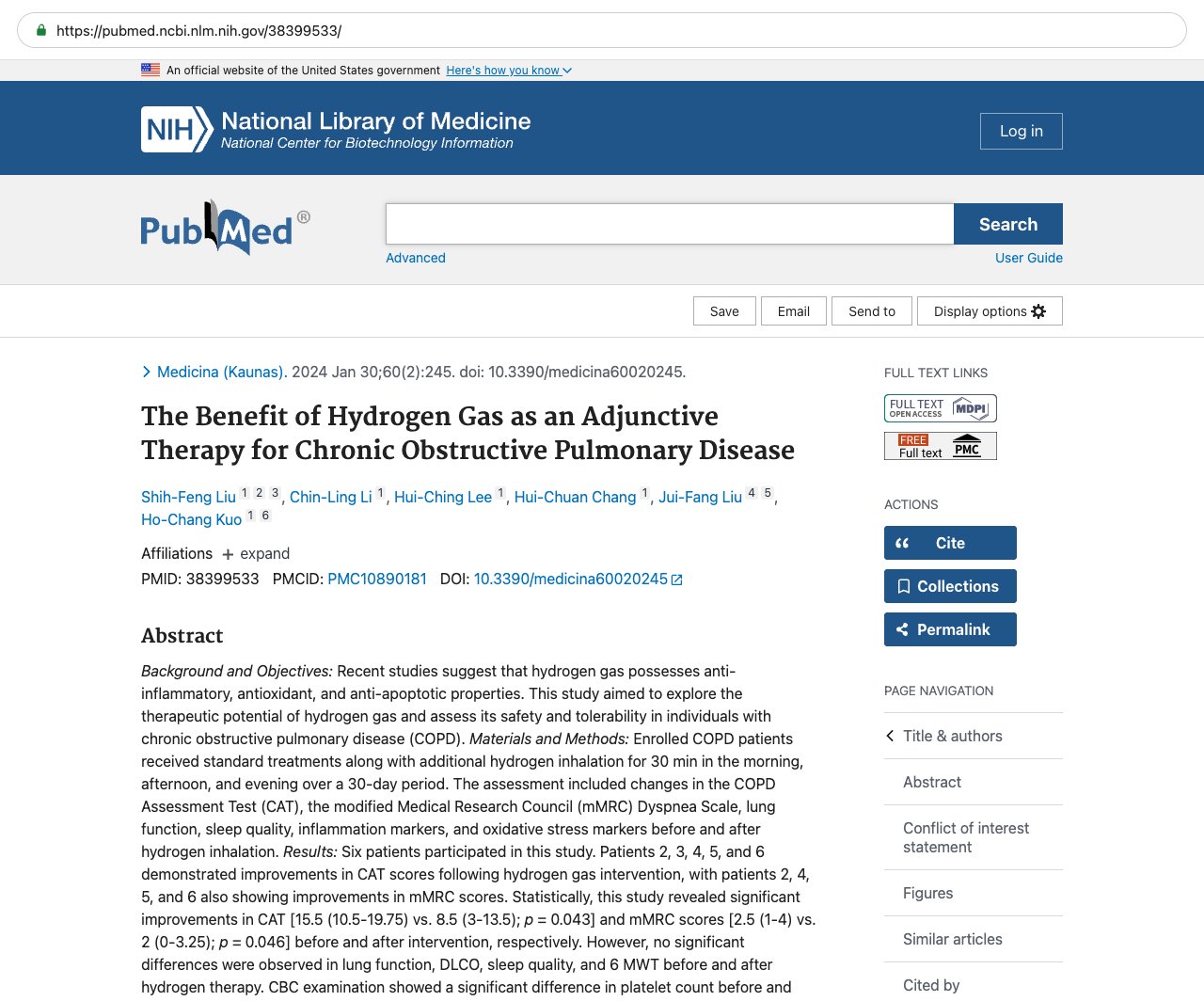
This page mirrors the published abstract (© the authors / publisher) for reference and citation. The canonical source is the PubMed record linked above. This is not medical advice.