2013 · Matsumoto et al. — Effect of supplementation with hydrogen-rich water in patients with interstitial cystitis/painful bladder syndrome.
Super-Abstract
In a double-blind, placebo-controlled RCT in 30 patients with interstitial cystitis/painful bladder syndrome (IC/PBS), hydrogen-rich water did not significantly outperform placebo on any primary symptom endpoint after 8 weeks — though an exceptional responder rate (11%) was noted. The authors do not recommend HRW for IC/PBS based on these results. (Urology, 2013.)
Commentary
Interstitial cystitis/painful bladder syndrome is a chronic, poorly understood condition characterized by bladder pain, urinary urgency and frequency, with no reliable treatment. This is one of the few H₂ trials that reports a clearly negative primary outcome — and it should be highlighted as such. Both the HRW and placebo groups improved their bladder pain scores during the 8 weeks, but the improvement was statistically indistinguishable between groups. The only notable finding was that 11% of HRW patients showed very substantial improvement in bladder pain — a potential outlier signal that could indicate a responder subgroup worth studying, but not a robust finding at n=30. The rigorous design (prospective, double-blind, 2:1 randomization, multiple validated questionnaires, voiding diary) makes this a reliable null result. Honest reporting of negative results like this is essential to the H₂ evidence base.
Key quotes
- „The score of bladder pain was significantly reduced in both groups.“ — both groups improved — suggesting a strong placebo effect or natural disease fluctuation
- „the effect of hydrogen-rich water on symptoms was not significantly different from that of placebo, although supplementation with hydrogen-rich water was extremely effective in improving the bladder pain score in 11% of the patients.“ — core finding: no significant benefit over placebo; potential responder minority noted
- „The results of the present study do not support the use of supplementation with hydrogen-rich water for treating patients with IC/PBS.“ — authors' clear negative conclusion
Our assessment
A well-designed trial with a clearly negative primary result: HRW showed no statistically significant benefit over placebo for IC/PBS symptoms. Both groups improved equally, consistent with a strong placebo effect or natural disease fluctuation. The possible 11% exceptional-responder signal is interesting but not actionable at this sample size. Limitations: small n (28 evaluable), 8-week duration may be short for a chronic condition, single-center, predominantly female population. This honest null result is an important contribution to the evidence base — it rules out a broad, non-specific anti-inflammatory effect of HRW in IC/PBS at standard dosing.
Study design
- Type: prospective, randomized, double-blind, placebo-controlled RCT · n: 30 enrolled (28 evaluable: ~20 HRW, ~8 placebo) with IC/PBS, 2:1 randomization · H₂ delivery: hydrogen-rich water orally for 8 weeks
- Outcomes: Interstitial Cystitis Symptom Index, Interstitial Cystitis Problem Index, Parsons' Pelvic Pain and Urgency/Frequency Scale, VAS bladder pain, 3-day voiding diary
- Result: bladder pain improved in both groups; NO significant between-group difference on any primary endpoint; 11% of HRW patients showed large bladder pain improvement; 2 withdrawals
Abstract
OBJECTIVE: To investigate the efficacy of hydrogen-rich water for the treatment of patients with interstitial cystitis/painful bladder syndrome (IC/PBS). METHODS: We conducted a prospective, randomized, double-blind, placebo-controlled clinical trial of hydrogen-rich water in patients with IC/PBS. Inclusion criteria were stable symptoms of IC/PBS for ≥ 12 weeks after bladder hydrodistension, Interstitial Cystitis Symptom Index score of ≥ 7 and bladder pain (question 4 on Interstitial Cystitis Symptom Index) of ≥ 4. They were randomized by a 2:1 ratio to receive hydrogen-rich water or placebo water for 8 weeks. The symptoms were assessed using the Interstitial Cystitis Symptom Index, Interstitial Cystitis Problem Index, Parsons' Pelvic Pain and Urgency/Frequency Patient Symptom Scale, visual analog scale bladder pain scores, and a standard 3-day voiding diary. The primary outcome was improvement of patient-reported symptoms evaluated after treatment. RESULTS: A total of 30 participants (29 women and 1 man, age 64.0 ± 14.8 years) were enrolled in the present study, and 2 patients (both women) were withdrawn from the study. The score of bladder pain was significantly reduced in both groups. However, the effect of hydrogen-rich water on symptoms was not significantly different from that of placebo, although supplementation with hydrogen-rich water was extremely effective in improving the bladder pain score in 11% of the patients. CONCLUSION: The results of the present study do not support the use of supplementation with hydrogen-rich water for treating patients with IC/PBS.
Source & links
Screenshot of the PubMed page
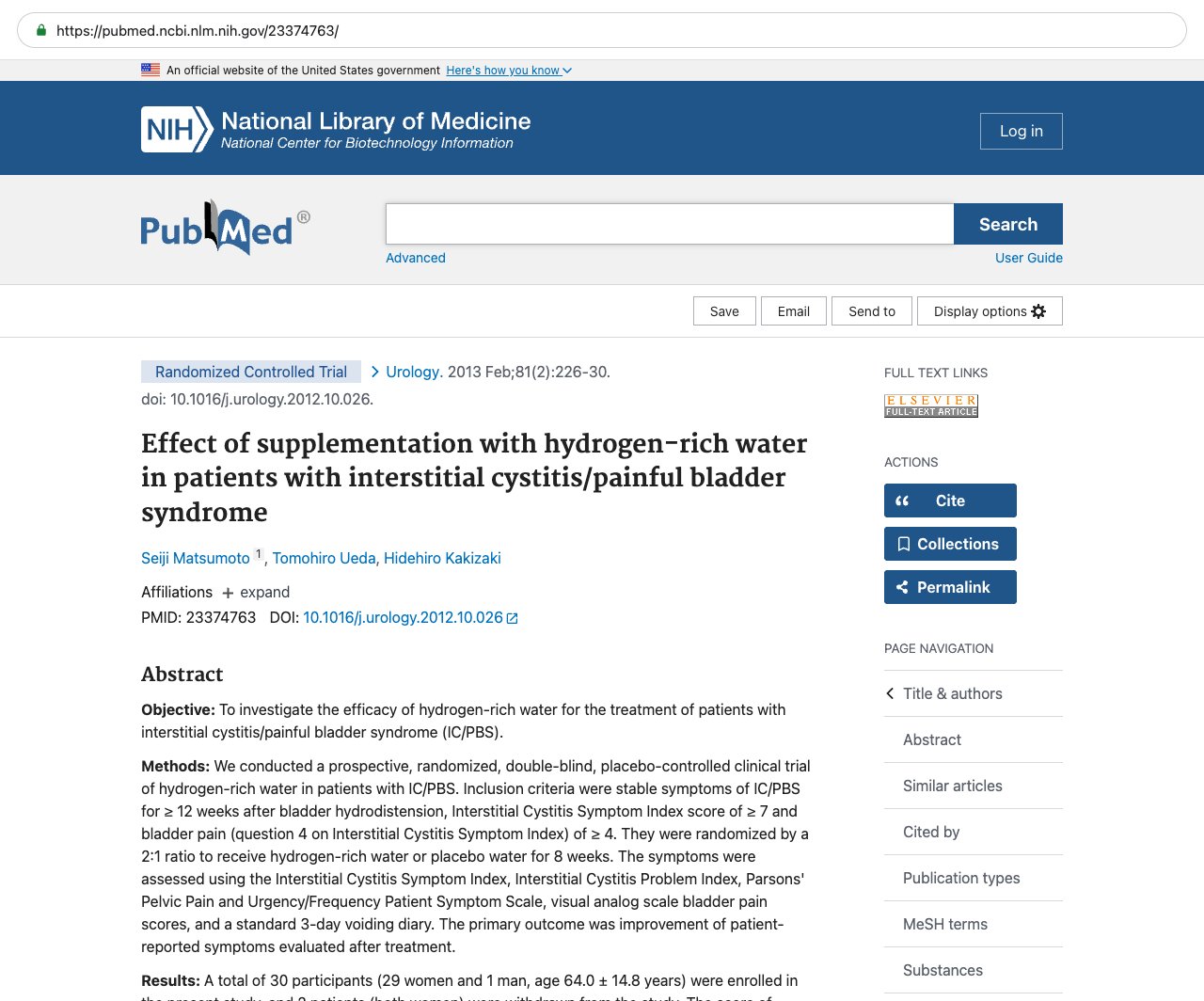
This page mirrors the published abstract (© the authors / publisher) for reference and citation. The canonical source is the PubMed record linked above. This is not medical advice.