2025 · Misnikova et al. — Hydrogen and Methane Detection in Breath in Response to Two Different Types of Dietary Fiber and Its Relationship to Postprandial Glucose Concentration in Obese Patients with Type 2 Diabetes and Normoglycemic Subjects
Super-Abstract
This study reveals a striking difference in gut-produced H₂ between people with type 2 diabetes (T2DM) and metabolically healthy controls. After eating fiber-rich foods, normoglycemic participants produced significantly more exhaled H₂ — and those with higher H₂ showed lower postprandial glucose spikes. Patients with T2DM produced less H₂ but more methane (CH₄), and methane correlated positively with worse glucose control. (Nutrients, 2025.)
Commentary
This paper is about endogenous — not supplemented — H₂: the gas produced by gut bacteria as they ferment dietary fiber (inulin and guar gum). It reframes H₂ as a metabolic readout of gut microbiome function, not a therapeutic supplement. The core finding is an inverse relationship between exhaled H₂ and postprandial glucose in healthy individuals (r = −0.569) — meaning more bacterial H₂ production is associated with better glucose regulation after eating. In T2DM patients, this H₂ response is blunted (odds ratio for normal H₂ response: 0.17), and methane production is elevated instead — with methane correlating with worse postprandial glycemia. This raises a microbiome-metabolic axis hypothesis: H₂-producing bacteria (hydrogenogenic) may protect against postprandial glycemia, while methanogenic bacteria may interfere with it. The design is modest (n=28, crossover with two fiber types) but the findings are biologically coherent.
Key quotes
- „All subjects in the control group had a significant increase in exhaled H2. OR for increased hydrogen production in patients with T2DM was 0.17 (95% CI 0.031-0.93, p = 0.043).“ — T2DM patients are 6x less likely to produce normal H₂ after fiber — blunted microbiome response
- „There was an inverse correlation between maximum glucose rise and maximum H2 in exhaled air after food load in normoglycemic subjects (r = -0.569, p = 0.034).“ — the key metabolic finding: more H₂ = less glucose spike in healthy people
- „The confirmation of a causal relationship between decreased H2 production, increased intestinal CH4 production, and more severe postprandial glycemia may identify new therapeutic targets in the correction of postprandial glycemia in patients with T2DM.“ — authors' hypothesis: H₂/CH₄ ratio as a therapeutic target
Our assessment
This is a small exploratory study (n=28) without intervention — it does not test H₂ supplementation and makes no claims about drinking H₂-enriched water. The correlation between exhaled H₂ and postprandial glycemia is statistically significant but based on a small sample. Causality is not established — lower H₂ in T2DM may be a consequence of altered microbiome composition rather than a driver of glucose dysregulation. The methane-glycemia correlation in T2DM, while intriguing, involves small subgroups. Important framing note: this study is about gut-produced H₂ as a microbiome marker, not about therapeutic H₂ administration. It is nonetheless relevant context for understanding why some individuals may respond differently to H₂ therapy.
Study design
- Type: crossover observational study · n: 14 T2DM + 14 normoglycemic controls (all obese) · H₂ source: endogenous gut fermentation (dietary fiber: inulin and guar gum)
- Endpoints: exhaled H₂ and CH₄ (breath test); postprandial glucose (flash continuous monitoring)
- Result: normoglycemic controls showed significant exhaled H₂ increase after fiber; T2DM patients had blunted H₂ response (OR 0.17) and elevated CH₄; inverse H₂–glucose correlation in healthy subjects (r=−0.57, p=0.034); CH₄ correlated positively with postprandial glycemia in T2DM
Abstract
Background: The aim of this study was to investigate the relationship between postprandial glycemic levels based on flashmonitoring and the production of intestinal hydrogen (H2) and methane (CH4) gases based on the measurement of the amount of these gases in exhaled air. Materials and Methods: We studied 14 subjects with type 2 diabetes mellitus (T2DM) and 14 individuals without diabetes (control) with two food load tests, including two types of dietary fiber (inulin and guar gum), with the simultaneous determination of gases in exhaled air and the assessment of glucose levels. Results: All subjects in the control group had a significant increase in exhaled H2. OR for increased hydrogen production in patients with T2DM was 0.17 (95% CI 0.031-0.93, p = 0.043). The level of H2 in exhaled breath after food load in patients with T2DM was lower than in normoglycemic subjects. There was an inverse correlation between maximum glucose rise and maximum H2 in exhaled air after food load in normoglycemic subjects (r = -0.569, p = 0.034). Patients with T2DM had direct correlations between the level of CH4 in exhaled air and the parameters of postprandial glycemia in the lactulose test (p < 0.05). Conclusions: The confirmation of a causal relationship between decreased H2 production, increased intestinal CH4 production, and more severe postprandial glycemia may identify new therapeutic targets in the correction of postprandial glycemia in patients with T2DM.
Source & links
Screenshot of the PubMed page
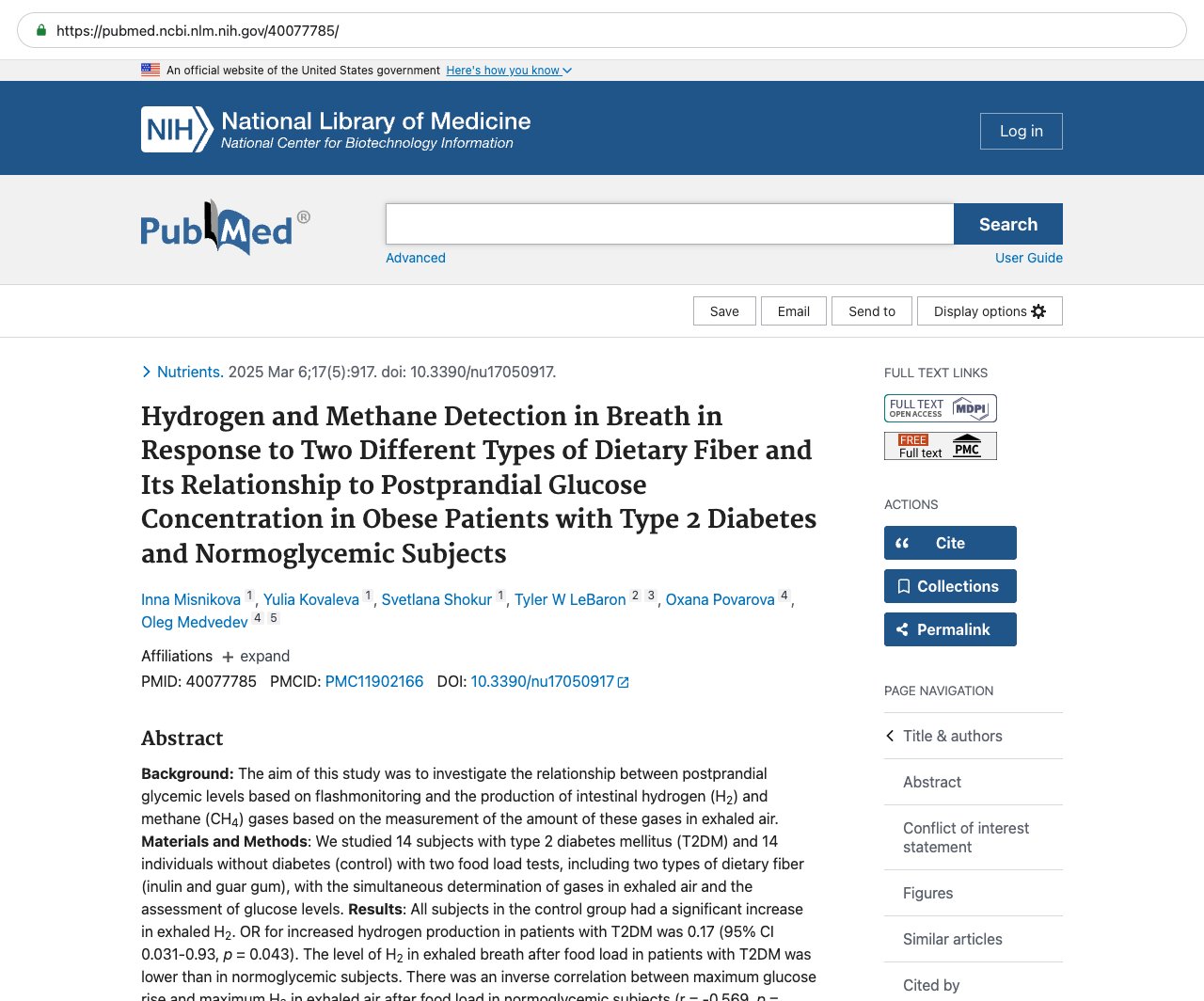
This page mirrors the published abstract (© the authors / publisher) for reference and citation. The canonical source is the PubMed record linked above. This is not medical advice.