2026 · Seneff — The essential role of hydrogen gas recycling by gut microbes in reducing deuterium load in host mitochondria: is trimethylamine oxide a deuterium sensor?
Super-Abstract
This hypothesis paper proposes that the gut microbiome's recycling of molecular hydrogen plays a role in keeping mitochondria supplied with deuterium-depleted water — and that TMAO (a gut-derived metabolite elevated in many chronic diseases) may function as a marker for impaired deuterium management. The idea connects microbiome health, mitochondrial bioenergetics, and dietary choline in a speculative but detailed framework. This is not an interventional study — it is a theoretical hypothesis with no clinical trial data. (Metabolomics, 2026.)
Commentary
Seneff and colleagues construct an ambitious cross-disciplinary hypothesis linking gut microbial H₂ recycling, deuterium metabolism, and TMAO signaling. The paper reinterprets existing observations — notably that synthetic deuterated choline raises TMAO while natural egg-derived choline does not — through a deuterium-management lens. The theory is intellectually stimulating and draws on real biochemical data, but it currently has the status of a speculative framework, not established science. TMAO as a 'deuterium sensor' is unproven; the causal chain from microbiome H₂ recycling to mitochondrial deuterium depletion to health outcomes is not demonstrated in any controlled human or animal intervention. Readers should engage with this paper as a hypothesis generator, not a source of therapeutic guidance.
Key quotes
- „an often-overlooked role is to maintain an abundant supply of deuterium depleted (deupleted) nutrients to fuel the host mitochondria.“ — the paper's central framing: gut microbiome as deuterium manager for mitochondria
- „Excess deuterium (heavy hydrogen) damages mitochondrial ATP synthase nanomotors, leading to a decrease in matrix water production with increased reactive oxygen species (ROS) and inefficient ATP production.“ — proposed mechanism: why deuterium load matters for mitochondrial function
- „The mantra that 'food is medicine' is well supported by the powerful role that gut dysbiosis plays in influencing human health and disease.“ — the authors' broader framing — diet-microbiome-health axis
Our assessment
Evidence level: theoretical review / hypothesis paper (EV 4 — lowest on the evidence hierarchy). No original experimental data are presented. The deuterium-TMAO-H₂ recycling framework is novel and stimulating but remains speculative. The claim about synthetic vs. natural choline and TMAO is based on a single cited mouse study with fully deuterated methyl groups — an extreme experimental condition, not a dietary scenario. Limitations to state clearly: no controlled human or animal intervention; key claims have not been independently replicated; the hypothesis conflates several complex biological systems. This paper is appropriately engaged as a thought-provoking perspective, not as evidence for any clinical application of H₂.
Study design
- Type: hypothesis / theoretical review · n: n/a (no experimental subjects) · H₂ relevance: gut microbial hydrogen recycling as deuterium depletion mechanism (not direct H₂ supplementation)
- Result: no experimental findings; proposes TMAO as a proxy marker for deuterium overload and microbiome-derived H₂ deficit; reinterprets existing TMAO literature through deuterium-management framework
Abstract
BACKGROUND: The human gut microbiome plays many essential roles, but an often-overlooked role is to maintain an abundant supply of deuterium depleted (deupleted) nutrients to fuel the host mitochondria. Excess deuterium (heavy hydrogen) damages mitochondrial ATP synthase nanomotors, leading to a decrease in matrix water production with increased reactive oxygen species (ROS) and inefficient ATP production. A microbial metabolite, trimethylamine N-oxide (TMAO) is a powerful signaling molecule whose plasma levels are high in association with many chronic diseases, including diabetes, fatty liver disease, and atherosclerosis, as well as cancer and dementia. Thus, TMAO is an important gut-host signaling molecule that serves as a marker for an imbalanced microbiome that is unable to fully metabolize trimethylamine (TMA), an important step in maintaining a deupleted nutrient supply. AIM OF REVIEW: In this paper, we present a hypothesis that TMAO is a marker for deuterium overload in the methylation pathway, in addition to its role as an indicator of a disrupted gut microbiome. The original study that brought attention to TMAO involved feeding mice synthetic choline with fully deuterated methyl groups. Fully deuterated TMAO was subsequently detected in the plasma. By contrast, a diet rich in eggs, a natural source of choline (a precursor to TMAO), does not raise TMAO levels. Many of the pathologies that are linked to elevated TMAO can also be viewed as strategies to promote the supply of deupleted water to the mitochondria, systemically. KEY SCIENTIFIC CONCEPTS: The mantra that "food is medicine" is well supported by the powerful role that gut dysbiosis plays in influencing human health and disease.
Source & links
Screenshot of the PubMed page
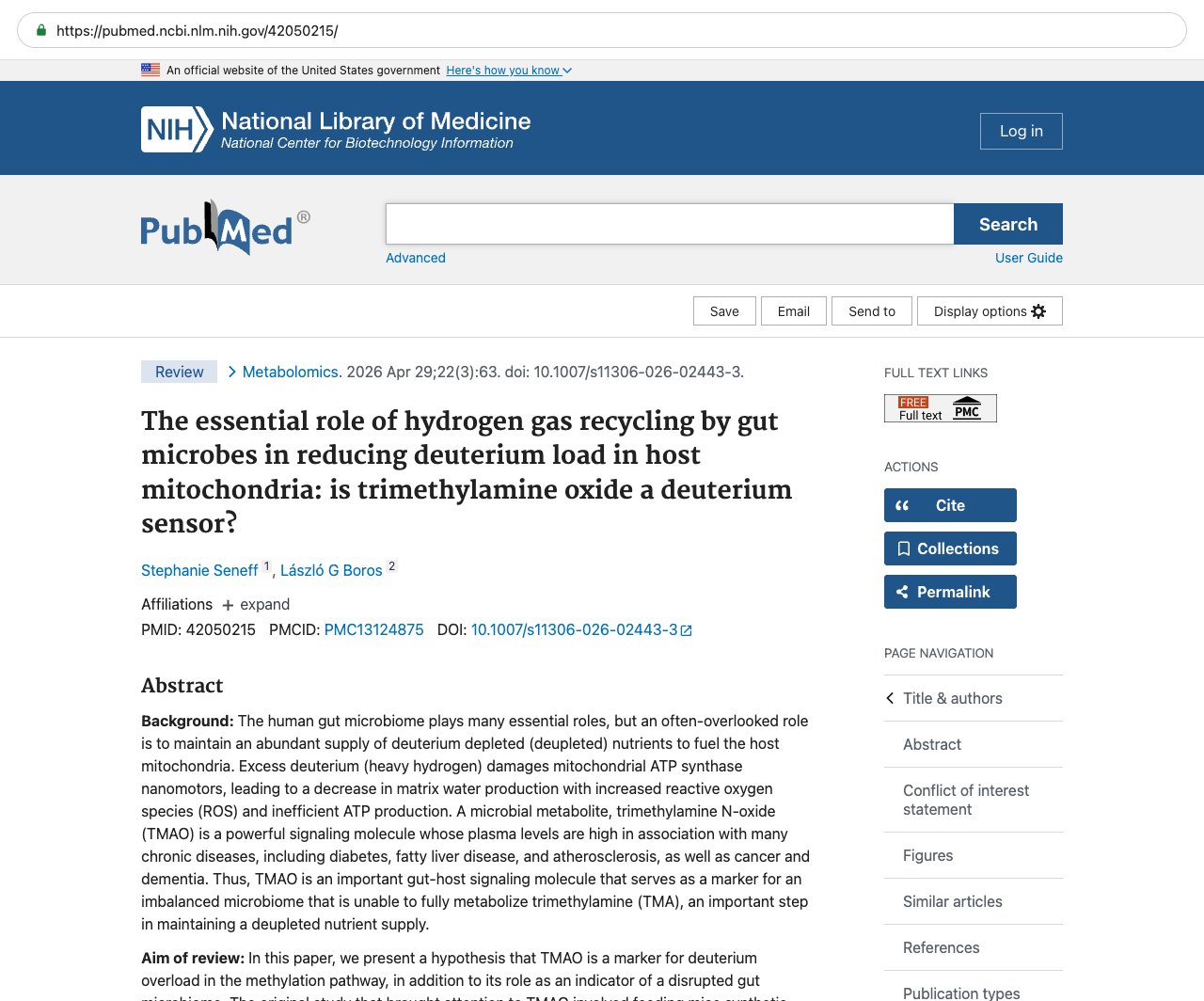
This page mirrors the published abstract (© the authors / publisher) for reference and citation. The canonical source is the PubMed record linked above. This is not medical advice.