2018 · Korovljev — Molecular Hydrogen Affects Body Composition, Metabolic Profiles, and Mitochondrial Function in Middle-Aged Overweight Women
Super-Abstract
A double-blind, placebo-controlled crossover pilot trial in 10 overweight women found that hydrogen-generating mineral caplets significantly reduced body fat percentage and triglycerides while improving fasting insulin levels — without affecting body weight or BMI. This is one of the first controlled human studies on H₂ and metabolic parameters. (Irish Journal of Medical Science, 2018.)
Commentary
Obesity-related metabolic dysfunction is one of the most pressing health challenges worldwide, and the search for safe adjunct interventions continues. This small but carefully designed crossover pilot study tests oral H₂ administration in a specific form: hydrogen-generating mineral caplets (producing approximately 6 ppm H₂/day) in 10 middle-aged overweight women. The crossover design — where each participant receives both H₂ and placebo in random order — is a smart approach for a small sample, as each person serves as their own control. The results are notable: while body weight, BMI, and waist circumference did not change significantly (consistent with expectations for a 4-week intervention), body fat percentage dropped significantly more with H₂ than placebo (3.2% vs. 0.9% reduction), as did arm fat index. Serum triglycerides fell significantly with H₂ but not placebo. Most striking is the insulin finding: fasting insulin dropped 5.4% with H₂ while rising 29.3% with placebo — a statistically significant difference (P = 0.01) suggesting a meaningful effect on insulin resistance. The mitochondrial function assessment in the title is not fully detailed in the available abstract, which is a limitation of the current source data.
Key quotes
- „H2 treatment significantly reduced body fat percentage (3.2 vs. 0.9%, P = 0.05) and arm fat index (9.7 vs. 6.0%, P = 0.01) compared to placebo administration, respectively.“ — significant reduction in fat parameters despite no change in body weight
- „Fasting serum insulin levels dropped by 5.4% after H2 administration, while placebo intervention augmented insulin response by 29.3% (P = 0.01).“ — striking insulin finding — H₂ vs. placebo moved in opposite directions
- „orally administered H2 as a blend of hydrogen-generating minerals might be a beneficial agent in the management of body composition and insulin resistance in obesity.“ — cautious but clinically relevant conclusion
Our assessment
An innovative pilot with mechanistically plausible results, but n = 10 is very small and the study is explicitly a pilot. Limitations: tiny sample (10 women only — results may not generalize to men or other age groups); 4-week intervention is short; the H₂ dose (~6 ppm/day via mineral caplets) is lower than many inhalation or HRW drinking studies; „mitochondrial function“ in the title is not clearly quantified in the available abstract; multiple comparisons increase false-positive risk; the trial is registered (NCT02832219) which adds credibility. The insulin result in particular warrants follow-up in a larger trial — if replicated, it would be clinically significant for metabolic syndrome management.
Study design
- Type: double-blind, placebo-controlled, crossover pilot trial · n: 10 overweight middle-aged women · H₂ delivery: oral hydrogen-generating mineral caplets (~6 ppm H₂/day) for 4 weeks
- Primary endpoint: change in body fat percentage from baseline
- Result: significant reduction in body fat % (P = 0.05) and arm fat index (P = 0.01); significant drop in serum triglycerides (P = 0.04) and fasting insulin (P = 0.01) vs. placebo; no significant change in body weight, BMI, or body circumferences
Abstract
BACKGROUND: Molecular hydrogen (H2) effectively treats obesity-related disorders in animal models, yet no studies have investigated the effectiveness and safety of H2 for improving biomarkers of obesity in humans. AIM: In this double blind, placebo-controlled, crossover pilot trial, we evaluated the effects of H2 intervention on body composition, hormonal status, and mitochondrial function in ten (n = 10) middle-aged overweight women. METHODS: Volunteers received either hydrogen-generating minerals (supplying ~6 ppm of H2 per day) or placebo by oral administration of caplets for 4 weeks. The primary end-point of treatment efficacy was the change in the body fat percentage from baseline to 4 weeks. In addition, assessment of other body composition indices, screening laboratory studies, and evaluation of side effects were performed before and at follow-up. Clinical trial registration www.clinicaltrials.gov , ID number NCT02832219. RESULTS: No significant differences were observed between treatment groups for changes in weight, body mass index, and body circumferences at 4-week follow-up (P > 0.05). H2 treatment significantly reduced body fat percentage (3.2 vs. 0.9%, P = 0.05) and arm fat index (9.7 vs. 6.0%, P = 0.01) compared to placebo administration, respectively. This was accompanied by a significant drop in serum triglycerides after H2 intervention comparing to placebo (21.3 vs. 6.5%; P = 0.04), while other blood lipids remained stable during the study (P > 0.05). Fasting serum insulin levels dropped by 5.4% after H2 administration, while placebo intervention augmented insulin response by 29.3% (P = 0.01). CONCLUSIONS: It appears that orally administered H2 as a blend of hydrogen-generating minerals might be a beneficial agent in the management of body composition and insulin resistance in obesity.
Source & links
Screenshot of the PubMed page
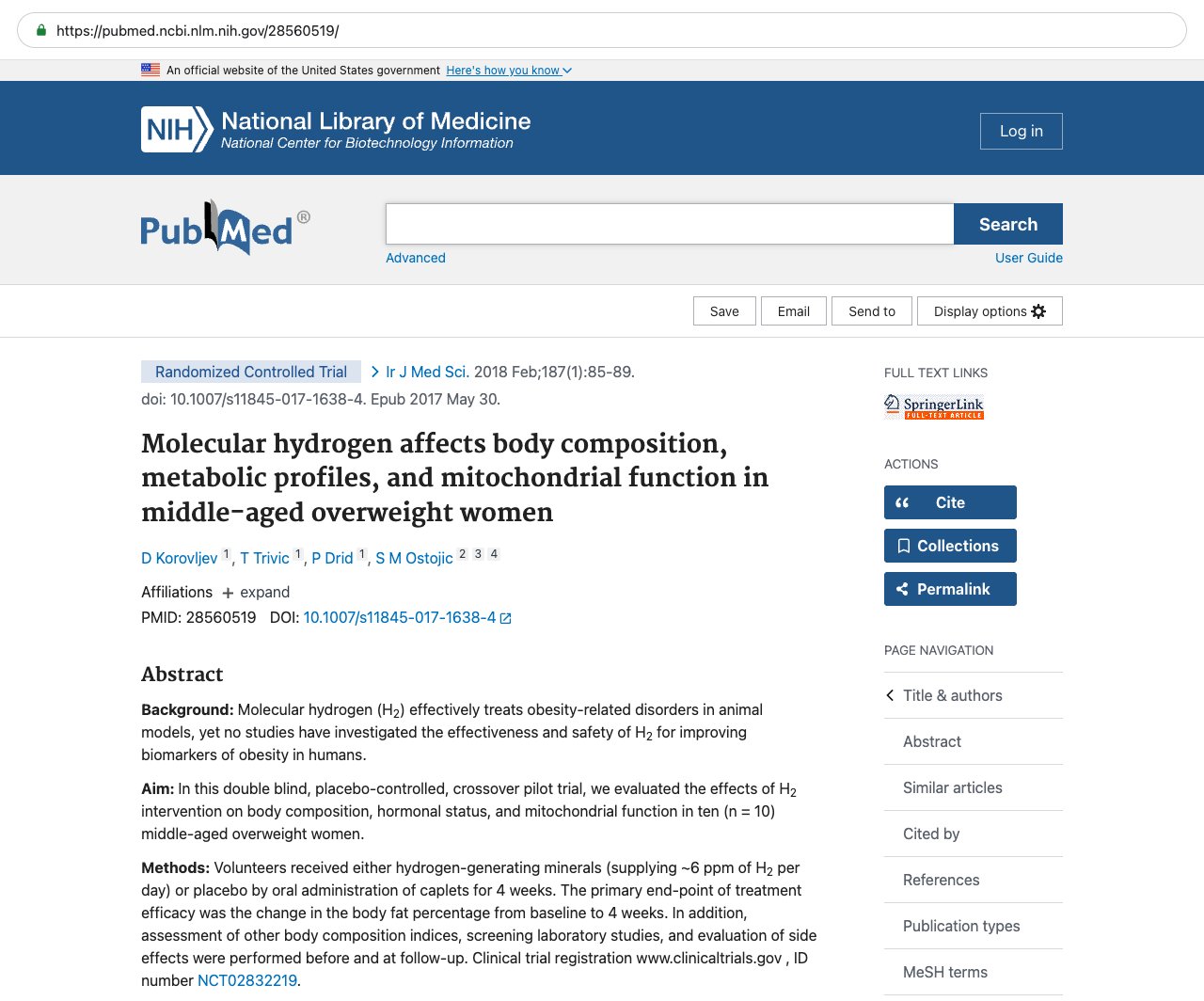
This page mirrors the published abstract (© the authors / publisher) for reference and citation. The canonical source is the PubMed record linked above. This is not medical advice.