2021 · Ostojic — Does drinking water rich in hydrogen gas revive brain hypometabolism in neurodegeneration by SCFAs upregulation?
Super-Abstract
This theoretical commentary proposes a speculative mechanism: that hydrogen-rich water (HRW) might help restore brain energy metabolism in neurodegenerative disease by increasing short-chain fatty acids (SCFAs) in the gut. No experimental data are presented; the abstract is not available in the indexed record. (European Journal of Clinical Nutrition, 2021.)
Commentary
This is a short theoretical opinion piece — no abstract is available in the database record. The title suggests the author proposes a novel mechanistic hypothesis: H₂ (via HRW or inhalation) might upregulate short-chain fatty acids produced by the gut microbiome, which in turn could support the brain's energy supply under conditions of glucose hypometabolism — a hallmark of neurodegenerative diseases such as Alzheimer's. This brain-gut-hydrogen axis is an intriguing hypothesis that connects two areas of growing interest (H₂ biology and the microbiome-brain axis), but it remains speculative without experimental data. For the full argument and references, the complete text should be accessed via DOI: 10.1038/s41430-020-0680-x.
Key quotes
- „Does drinking water rich in hydrogen gas revive brain hypometabolism in neurodegeneration by SCFAs upregulation?“ — title as the only citable text — no abstract available
Our assessment
This is a speculative theoretical commentary without available abstract or experimental data. The proposed gut-brain-H₂ mechanism via SCFA upregulation is intellectually interesting but entirely unvalidated at this point. It should not be cited as evidence for H₂ efficacy in neurodegeneration. It is a hypothesis-generating piece that, if the mechanism is plausible, would require experimental testing in cell, animal, and eventually human models.
Study design
- Type: theoretical commentary / hypothesis paper · n: n/a · H₂ delivery: hydrogen-rich water (HRW) and/or inhalation (proposed, not tested)
- Result: no experimental data — abstract not available in indexed record; speculative mechanistic hypothesis only
Source & links
Screenshot of the PubMed page
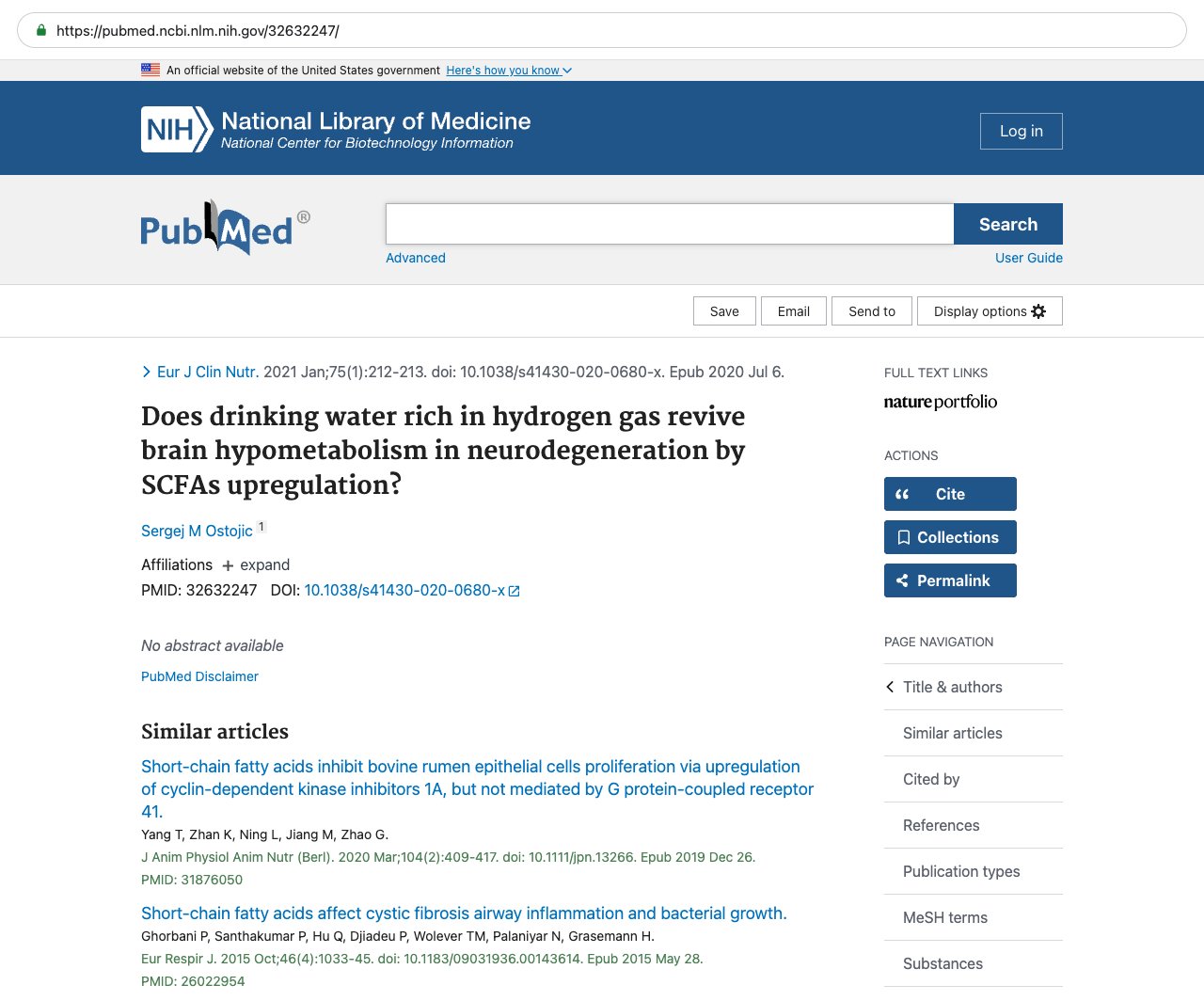
This page mirrors the published abstract (© the authors / publisher) for reference and citation. The canonical source is the PubMed record linked above. This is not medical advice.