2017 · Murakami — Molecular hydrogen protects against oxidative stress-induced SH-SY5Y neuroblastoma cell death through the process of mitohormesis
Super-Abstract
In cultured human neuroblastoma cells, both H₂ gas and hydrogen-rich water boosted mitochondrial membrane potential and ATP levels while triggering a mild oxidative signal that activated Nrf2-pathway antioxidant enzymes — a hormetic response the authors call „mitohormesis“. Pre-treatment protected cells from subsequent H₂O₂ challenge; post-treatment did not. This is an in-vitro study only. (PLOS ONE, 2017.)
Commentary
This study offers a mechanistically distinct perspective on how H₂ works at the cellular level. Rather than acting purely as a passive radical scavenger, H₂ appeared to induce a mild mitochondrial stress signal — slightly decreasing reduced glutathione and slightly increasing superoxide — that then primed cells to express antioxidant enzymes (via Nrf2). This is the concept of hormesis: a mild stressor eliciting a protective adaptation. The practical implication is significant: H₂ only worked as a pre-treatment, not a post-treatment, suggesting it builds cellular resilience rather than acutely neutralising existing damage. The SH-SY5Y cell line is a human neuroblastoma model commonly used in neuroscience, but it is a cancer cell line under artificial culture conditions — not a model of normal neurons or the living brain. The mitohormesis interpretation, while intellectually compelling, requires validation in physiologically relevant models.
Key quotes
- „H2 increased the mitochondrial membrane potential and the cellular ATP level, which were accompanied by a decrease in the reduced glutathione level and an increase in the superoxide level.“ — the hormetic signature: H₂ simultaneously energises mitochondria and induces mild oxidative stress
- „Pretreatment with H2 suppressed H2O2-induced cell death, whereas post-treatment did not.“ — critical timing result: H₂ works as preparation, not rescue — consistent with hormetic adaptation
- „We propose that H2 functions both as a radical scavenger and a mitohormetic effector against oxidative stress in cells.“ — the dual-mechanism hypothesis: scavenging + mitohormesis together explain the protective effect
Our assessment
This is an in-vitro study on a neuroblastoma cell line. The mitohormesis hypothesis is mechanistically novel and well-supported within this model, and the pre/post treatment difference is an important finding that adds nuance to the field. However, SH-SY5Y cells are not normal neurons, and the concept of mitohormesis in vivo — across the blood-brain barrier and in a complex neurological tissue context — remains entirely untested. No human neurological conclusions can be drawn. The study is valuable as a mechanistic hypothesis generator for future preclinical and clinical research.
Study design
- Type: in-vitro cell study · Model: SH-SY5Y human neuroblastoma cell line · Stressor: H₂O₂-induced oxidative cell death
- H₂ delivery: H₂ gas (inhalation model) and hydrogen-rich water · Endpoints: mitochondrial membrane potential, ATP level, reduced glutathione, superoxide level, cell viability (H₂O₂ challenge), Nrf2 pathway antioxidant enzyme expression
- Result: H₂ elevated mitochondrial membrane potential and ATP; mildly reduced GSH and elevated superoxide (hormetic signal); upregulated Nrf2-pathway enzymes; pre-treatment protected against H₂O₂ challenge; post-treatment had no protective effect
Abstract
Inhalation of molecular hydrogen (H2) gas ameliorates oxidative stress-induced acute injuries in the brain. Consumption of water nearly saturated with H2 also prevents chronic neurodegenerative diseases including Parkinson's disease in animal and clinical studies. However, the molecular mechanisms underlying the remarkable effect of a small amount of H2 remain unclear. Here, we investigated the effect of H2 on mitochondria in cultured human neuroblastoma SH-SY5Y cells. H2 increased the mitochondrial membrane potential and the cellular ATP level, which were accompanied by a decrease in the reduced glutathione level and an increase in the superoxide level. Pretreatment with H2 suppressed H2O2-induced cell death, whereas post-treatment did not. Increases in the expression of anti-oxidative enzymes underlying the Nrf2 pathway in H2-treated cells indicated that mild stress caused by H2 induced increased resistance to exacerbated oxidative stress. We propose that H2 functions both as a radical scavenger and a mitohormetic effector against oxidative stress in cells.
Source & links
Screenshot of the PubMed page
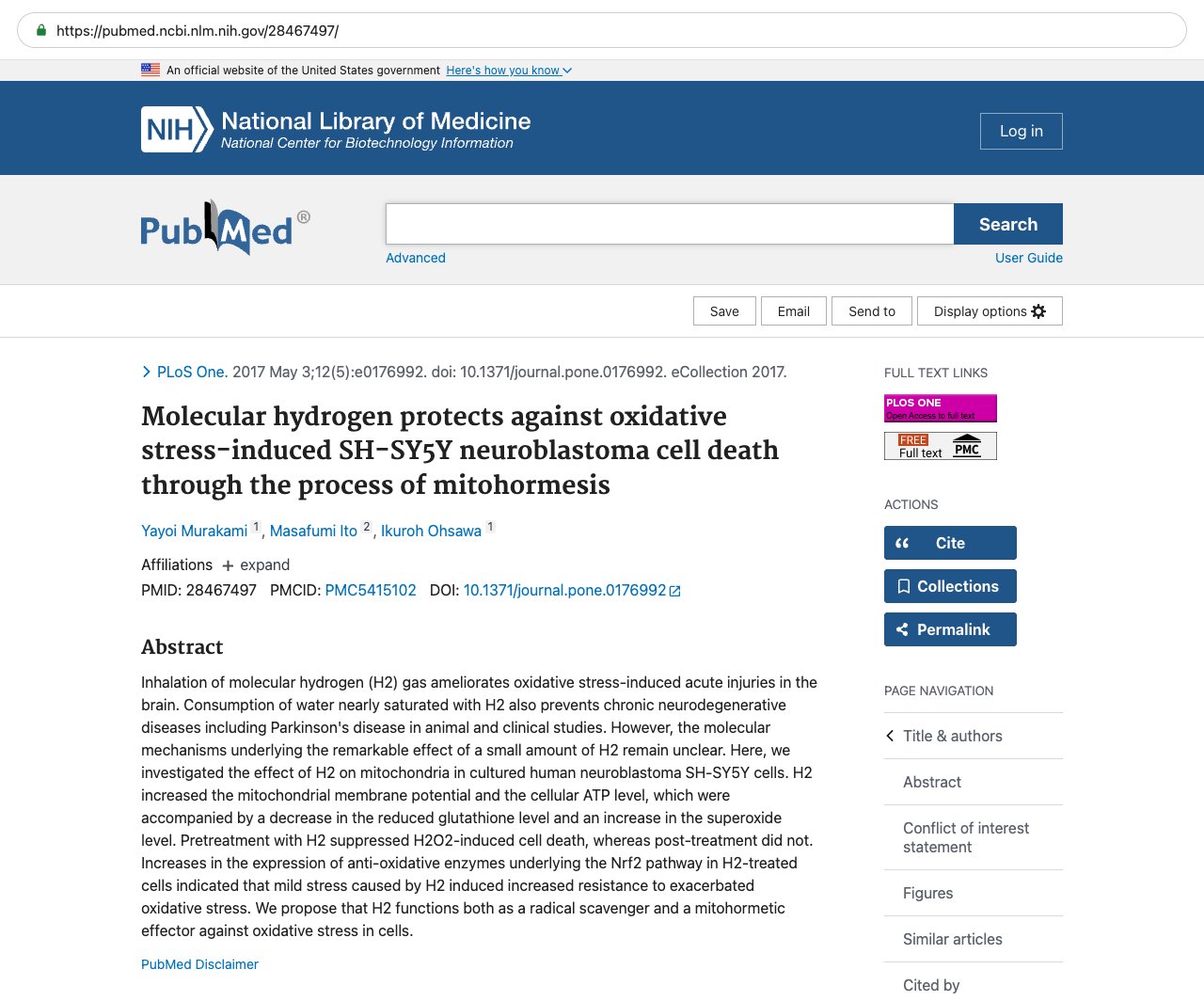
This page mirrors the published abstract (© the authors / publisher) for reference and citation. The canonical source is the PubMed record linked above. This is not medical advice.