2021 · Ostojic — Hydrogen as a Potential Therapeutic in Obesity: Targeting the Brain
Super-Abstract
This short review considers whether molecular H₂ could act directly on brain structures involved in obesity regulation — particularly the hypothalamus. The author notes that H₂ appears to improve obesity-related metabolic markers in peripheral tissues in clinical settings, but whether it reaches and acts on central neural pathways remains speculative. This is a theoretical review, not a clinical trial.
Commentary
Ostojic, a researcher with a track record in H₂ sports science, here shifts focus to the central nervous system and its role in obesity. The paper is brief and primarily conceptual: it maps hypothalamic targets (such as neuropeptide signalling and hypothalamic inflammation) that existing H₂ literature in peripheral tissues might inform. The observation that clinical H₂ use seems to improve peripheral metabolic markers (lipid profiles, glucose metabolism) is based on a selective reading of available human data; the question of whether H₂ crosses the blood-brain barrier in meaningful amounts and modulates hypothalamic circuits remains entirely unanswered. The review is honest about this gap — the word „elusive“ is used in the abstract itself.
Key quotes
- „Clinical applications of molecular hydrogen (H2) seem to favorably affect obesity-related metabolic biomarkers in peripheral tissues, yet whether H2 directly tackles obesity pathways in the brain remains elusive.“ — the core honest statement: peripheral metabolic signals are seen, but brain effects are speculative
- „I summarize here several molecular targets in the hypothalamus and beyond that could be altered by H2 gas in obesity.“ — scope of this review: theoretical mapping of CNS targets, not clinical evidence
Our assessment
This is a short theoretical review by a single author, presenting a hypothesis that H₂ might act on brain obesity pathways. It does not present new experimental data; the mechanistic claims are extrapolations from peripheral tissue studies and from known H₂ biology (antioxidative, anti-inflammatory). The central question the review poses — whether H₂ crosses the blood-brain barrier in sufficient quantity to alter hypothalamic signalling — remains open. This is hypothesis-generating for future research, not a basis for clinical application. Readers should note the absence of clinical or animal brain-specific H₂ data in support of the proposed mechanisms.
Study design
- Type: narrative review (theoretical) · n: n/a — no experimental data presented · H₂ delivery: H₂ gas inhalation discussed conceptually
- Scope: summary of hypothalamic molecular targets potentially modifiable by H₂ in the context of obesity (neuropeptides, hypothalamic inflammation, oxidative stress); references clinical peripheral-tissue H₂ data
- Key claim: H₂ may have central (brain) obesity-relevant effects — speculative; no direct CNS H₂ evidence cited
Abstract
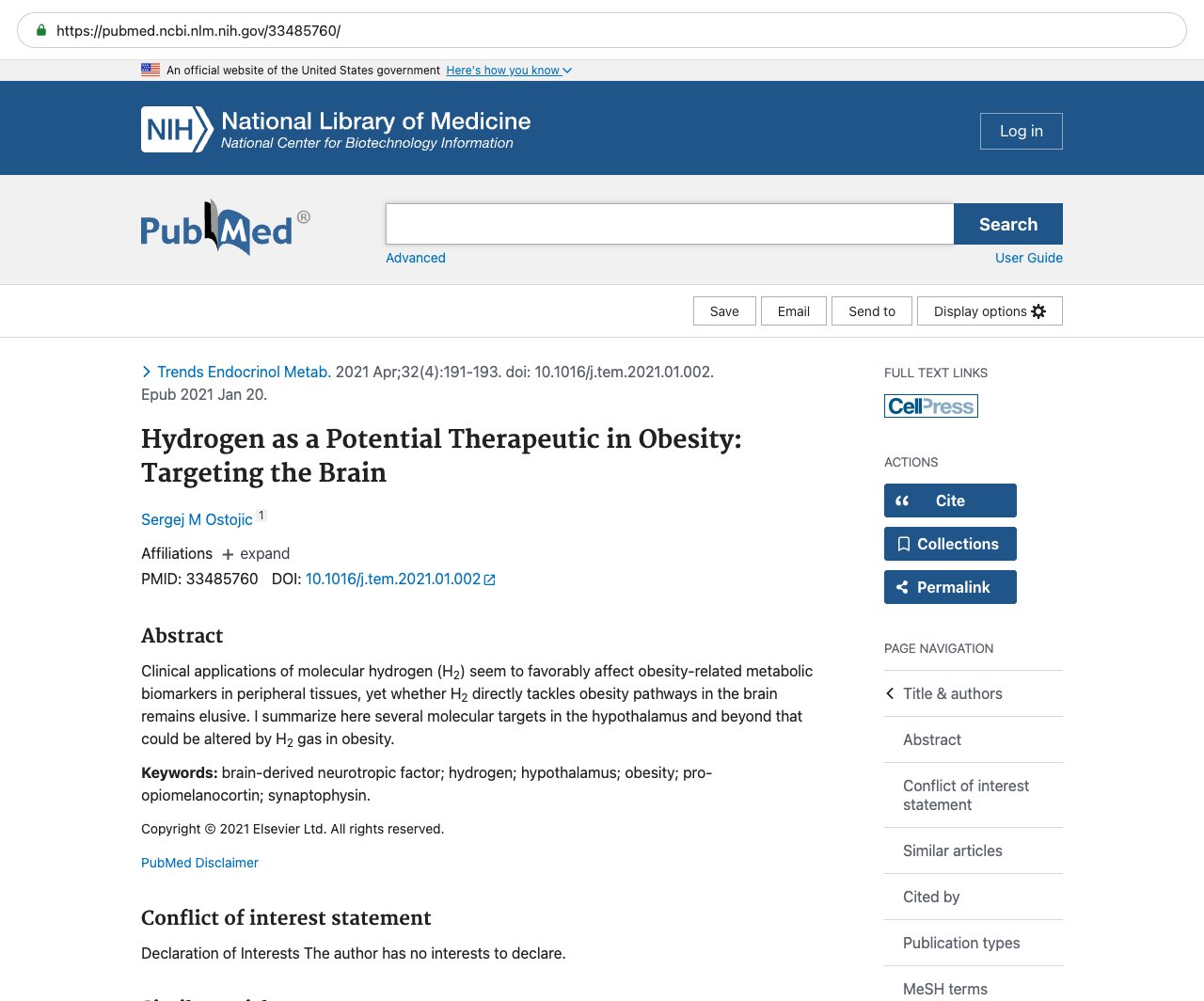
Clinical applications of molecular hydrogen (H2) seem to favorably affect obesity-related metabolic biomarkers in peripheral tissues, yet whether H2 directly tackles obesity pathways in the brain remains elusive. I summarize here several molecular targets in the hypothalamus and beyond that could be altered by H2 gas in obesity.
Source & links
Screenshot of the PubMed page
This page mirrors the published abstract (© the authors / publisher) for reference and citation. The canonical source is the PubMed record linked above. This is not medical advice.