1989 Zentralblatt fur Bakteriologie, Mikrobiologie, und Hygiene. Series A, Medical microbiology, infectious diseases, virology, parasitology Mechanism / Preclinical Inhalation
1989 · Heizmann — GasPak Plus versus Anaerocult A — two carbon dioxide/hydrogen systems for cultivation of anaerobes.
Super-Abstract
Two commercially available CO₂/H₂ gas-generating systems for culturing anaerobic bacteria were compared and found to be equally effective overall, though growth varied considerably between individual bacterial species. This in-vitro laboratory study tested 80 strains of 28 anaerobic species relevant to clinical diagnostics. (Zentralblatt für Bakteriologie, Mikrobiologie, und Hygiene, 1989.)
Commentary
In this study, hydrogen gas is used as a component of an anaerobic incubation atmosphere — it reacts with oxygen in the presence of a catalyst to create the low-oxygen environment needed to grow strictly anaerobic bacteria. This is a purely technical microbiology paper about laboratory methods for culturing clinically relevant anaerobes. Hydrogen here is a chemical tool for microbiological culture, not a therapeutic agent. The finding that H₂S-producing bacteria only inhibited growth of one species (Peptostreptococcus asaccharolyticus) in both systems is a minor methodological note.
Key quotes
- „The presence of H2S only inhibited bacterial growth in the case of Peptostreptococcus asaccharolyticus - an effect observed in both systems.“ — H₂S interference with the gas system was minimal in practice
- „Differences between the systems were not apparent when comparing total CFU/ml of a given species and the systems therefore provide equally effective environments for incubation of anaerobic bacteria.“ — both systems perform comparably overall
- „In both systems, however, growth varied from one species or strain to another. In mixed infections, detection of certain species of anaerobes may therefore be difficult using either system.“ — practical limitation: strain-level variability may affect clinical diagnosis
Our assessment
This is a technical in-vitro microbiology study comparing two laboratory culture systems. H₂ gas here serves as a chemical reducing agent to maintain anaerobic conditions — it has no therapeutic role. The paper is relevant for clinical microbiology laboratories but has no bearing on molecular hydrogen therapy research.
Study design
- Type: in-vitro comparative study · n: 80 strains from 28 anaerobic bacterial species · H₂ role: component of anaerobic atmosphere generator (CO₂/H₂ gas-generating sachets) — not therapeutic
- Result: GasPak Plus and Anaerocult A produced equivalent total CFU/ml per species; intra-species/strain variability significant in both systems; H₂S inhibition limited to one species; both systems equally suitable for anaerobic culture
Abstract
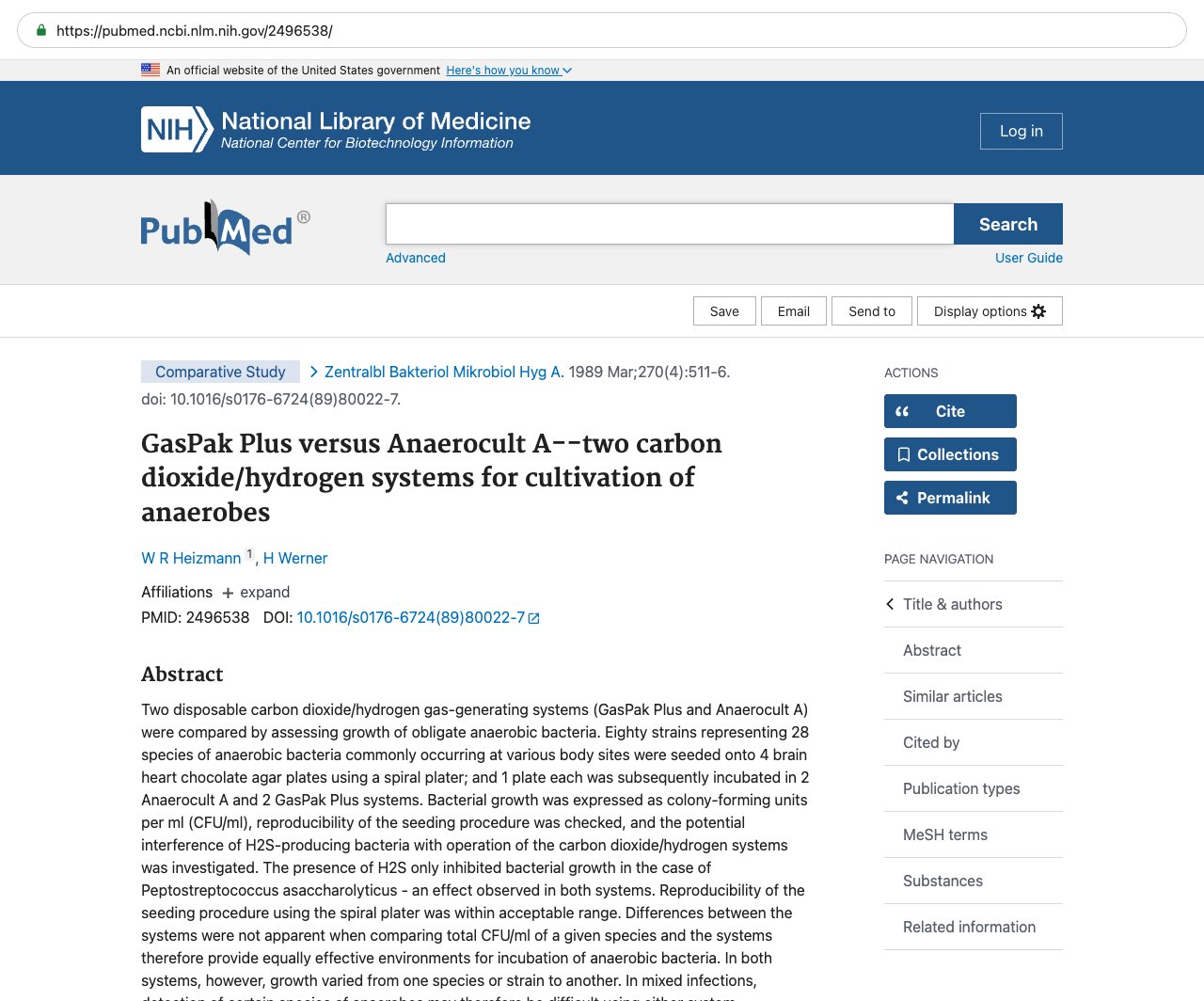
Two disposable carbon dioxide/hydrogen gas-generating systems (GasPak Plus and Anaerocult A) were compared by assessing growth of obligate anaerobic bacteria. Eighty strains representing 28 species of anaerobic bacteria commonly occurring at various body sites were seeded onto 4 brain heart chocolate agar plates using a spiral plater; and 1 plate each was subsequently incubated in 2 Anaerocult A and 2 GasPak Plus systems. Bacterial growth was expressed as colony-forming units per ml (CFU/ml), reproducibility of the seeding procedure was checked, and the potential interference of H2S-producing bacteria with operation of the carbon dioxide/hydrogen systems was investigated. The presence of H2S only inhibited bacterial growth in the case of Peptostreptococcus asaccharolyticus - an effect observed in both systems. Reproducibility of the seeding procedure using the spiral plater was within acceptable range. Differences between the systems were not apparent when comparing total CFU/ml of a given species and the systems therefore provide equally effective environments for incubation of anaerobic bacteria. In both systems, however, growth varied from one species or strain to another. In mixed infections, detection of certain species of anaerobes may therefore be difficult using either system.
Source & links
Screenshot of the PubMed page
This page mirrors the published abstract (© the authors / publisher) for reference and citation. The canonical source is the PubMed record linked above. This is not medical advice.