2022 · Liu — In vivo microelectrode monitoring of real-time hydrogen concentration in different tissues of rats after inhaling hydrogen gas
Super-Abstract
Using implanted electrochemical microelectrodes, researchers measured hydrogen concentrations in seven different rat tissues in real time during and after inhalation of 4 %, 42 %, and 67 % H₂ gas. Brain tissue reached the highest H₂ equilibrium concentrations; muscle and adipose tissue accumulated and cleared H₂ more slowly. Tissue concentrations scaled proportionally with inhaled dose. This is an animal study providing pharmacokinetic baseline data for hydrogen research. (Medical Gas Research, 2022.)
Commentary
A persistent gap in hydrogen medicine has been the lack of real-time, tissue-specific pharmacokinetic data: when you inhale hydrogen, how much actually reaches different organs, and how fast? This study addresses that gap directly by implanting microelectrodes into seven rat tissues simultaneously — brain, liver, spleen, kidney, thigh muscle, inguinal white adipose tissue, and gonadal white adipose tissue — and monitoring H₂ concentration continuously during and after inhalation of three different gas concentrations. The dose-dependent response within each tissue confirms that inhaled concentration translates predictably to tissue H₂ levels. The finding that the brain reaches the highest equilibrium concentration is relevant for neurological H₂ research, while the slow dynamics in muscle and adipose tissue suggest these compartments act as H₂ reservoirs with delayed uptake and release. The data directly inform dosing decisions for basic research and clinical trials — for example, how long inhalation must continue before target tissue concentrations are achieved. This is purely a pharmacokinetic characterization study; no therapeutic effects are tested.
Key quotes
- „Hydrogen concentrations in the same tissue showed a dose-dependent response. The equilibrium concentration values were highest in the brain and lowest in the thigh muscle.“ — the core tissue distribution finding
- „The saturation and desaturation curves changed more slowly in the thigh muscle and white adipose tissues than in other tissues.“ — adipose tissue and muscle act as slow H₂ reservoirs
- „These results provide fundamental information for the selection of hydrogen dose applications in basic research and clinical trials.“ — the stated practical value of the pharmacokinetic data
Our assessment
A technically valuable preclinical pharmacokinetic study filling a genuine gap in hydrogen dose-response data. Real-time in-vivo monitoring of seven tissues simultaneously is methodologically novel. The findings have direct relevance for experimental design in H₂ research. However, this is an animal study in rats; tissue distribution kinetics may differ in humans due to differences in body composition, cardiac output, and tissue perfusion rates. No therapeutic endpoints are measured.
Study design
- Type: preclinical pharmacokinetic animal study (in-vivo) · Model: rats with implanted microelectrodes in 7 tissues (brain, liver, spleen, kidney, thigh muscle, inguinal WAT, gonadal WAT) · H₂ delivery: inhalation of 4 %, 42 %, and 67 % H₂ gas
- Result: dose-dependent H₂ tissue concentrations confirmed in all tissues; brain reached highest equilibrium concentration; thigh muscle lowest; muscle and adipose tissue showed slower saturation/desaturation kinetics than other organs
Abstract
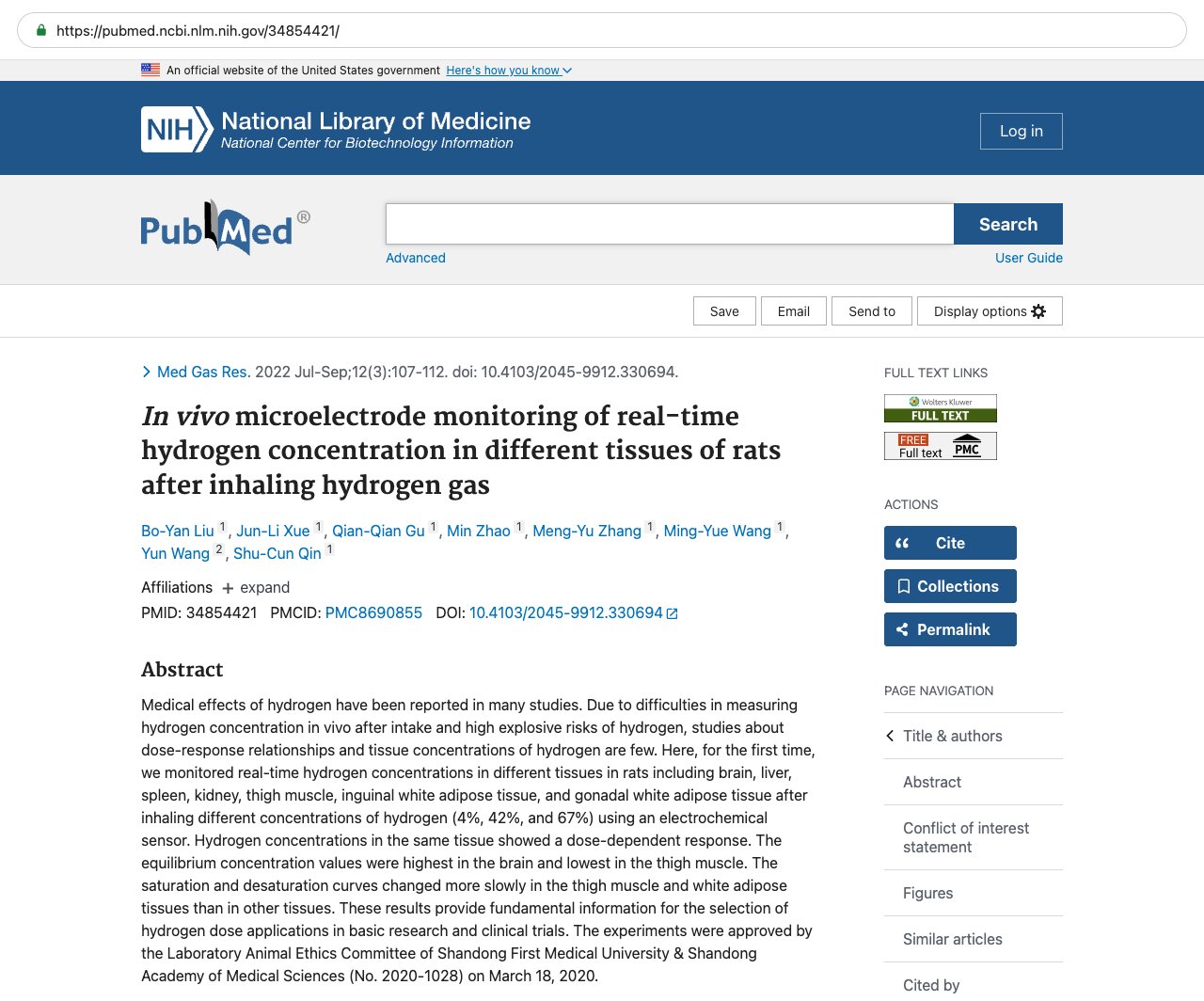
Medical effects of hydrogen have been reported in many studies. Due to difficulties in measuring hydrogen concentration in vivo after intake and high explosive risks of hydrogen, studies about dose-response relationships and tissue concentrations of hydrogen are few. Here, for the first time, we monitored real-time hydrogen concentrations in different tissues in rats including brain, liver, spleen, kidney, thigh muscle, inguinal white adipose tissue, and gonadal white adipose tissue after inhaling different concentrations of hydrogen (4%, 42%, and 67%) using an electrochemical sensor. Hydrogen concentrations in the same tissue showed a dose-dependent response. The equilibrium concentration values were highest in the brain and lowest in the thigh muscle. The saturation and desaturation curves changed more slowly in the thigh muscle and white adipose tissues than in other tissues. These results provide fundamental information for the selection of hydrogen dose applications in basic research and clinical trials. The experiments were approved by the Laboratory Animal Ethics Committee of Shandong First Medical University & Shandong Academy of Medical Sciences (No. 2020-1028) on March 18, 2020.
Source & links
Screenshot of the PubMed page
This page mirrors the published abstract (© the authors / publisher) for reference and citation. The canonical source is the PubMed record linked above. This is not medical advice.