2026 · Nguyen — Advances in hydrogen delivery strategies for therapeutic applications
Super-Abstract
Molecular hydrogen (H₂) has selective antioxidant, anti-inflammatory and anticancer properties — but getting it reliably to target tissues remains the central challenge limiting clinical use. This comprehensive review in Advanced Drug Delivery Reviews catalogues conventional delivery routes (inhalation, H₂-rich water, saline injection), their limitations, and a new generation of advanced delivery systems: nanocarriers, in-situ H₂-generating materials activated by light, sound or electricity, and gut microbiota-based indirect delivery via probiotics and prebiotics. (Advanced Drug Delivery Reviews, 2026.)
Commentary
This is one of the most technically detailed reviews in the H₂ field, with a strong focus on drug delivery engineering rather than clinical endpoints. The authors make an important conceptual distinction: conventional delivery routes are limited not by H₂'s biological activity, but by poor bioavailability, rapid off-gassing, and inability to target specific tissues. The bulk of the review evaluates advanced materials science solutions — a research direction still largely at preclinical or proof-of-concept stage. The microbiota angle (using probiotic bacteria to generate H₂ endogenously in the gut) is an emerging and methodologically distinct approach. Clinicians looking for clinical trial data will find limited material here; engineers and materials scientists will find the technical taxonomy valuable.
Key quotes
- „conventional delivery routes — such as inhalation, oral intake of H2-rich water, or injection of H2-rich saline — face critical limitations in stability, bioavailability, and targeted delivery, impeding clinical translation.“ — honest summary of why current delivery methods fall short
- „Externally stimulated platforms, such as photo-, sono-, and electro-catalysis-based systems, enable spatiotemporally controlled H2 release in response to disease-specific cues.“ — the next-generation delivery paradigm reviewed
- „microbiota-targeted approaches involving probiotics and prebiotics offer indirect yet sustained H2 delivery via gut fermentation.“ — the gut-based H₂ generation strategy — still experimental
Our assessment
This is a technical review — no original clinical data. Its value lies in mapping the delivery engineering landscape, not in providing clinical efficacy evidence. The vast majority of advanced delivery systems described are preclinical or proof-of-concept only. Readers seeking human clinical evidence should consult separate trial reviews; this paper addresses the fundamental bottleneck of how to get H₂ to where it is needed — a prerequisite for future clinical progress.
Study design
- Type: comprehensive technical review · n: n/a (literature synthesis) · H₂ delivery: multiple routes surveyed (inhalation, HRW, saline IV, nanocarriers, in-situ generation, microbiota)
- Therapeutic mechanisms covered: redox regulation, inflammation modulation, tumour microenvironment modulation, apoptosis induction
- Conclusion: advanced delivery systems show preclinical promise; key challenges — material scalability, biosafety, clinical integration — remain; interdisciplinary collaboration identified as essential
Abstract
Molecular hydrogen (H2) has emerged as a promising therapeutic agent owing to its selective antioxidant and anti-inflammatory properties, as well as its ability to modulate cellular signaling, metabolism, and immune responses. Beyond mitigating oxidative stress and inflammation, H2 shows anticancer potential by altering the tumor microenvironment and inducing apoptosis. Despite encouraging findings from preclinical and clinical studies, conventional delivery routes-such as inhalation, oral intake of H2-rich water, or injection of H2-rich saline-face critical limitations in stability, bioavailability, and targeted delivery, impeding clinical translation. This review first outlines the therapeutic mechanisms of H2, including redox regulation, inflammatory modulation, and tumor suppression. It then discusses current delivery approaches, their therapeutic outcomes, and inherent challenges. To overcome these barriers, a variety of advanced H2-delivering systems have been developed, including H2-containing carriers and in situ H2-generating materials based on water-, acid-, and electrochemical reactions. Externally stimulated platforms, such as photo-, sono-, and electro-catalysis-based systems, enable spatiotemporally controlled H2 release in response to disease-specific cues. Additionally, microbiota-targeted approaches involving probiotics and prebiotics offer indirect yet sustained H2 delivery via gut fermentation. The review concludes by addressing key challenges-such as material scalability, biosafety, and integration with existing therapies-and highlights future directions for optimizing H2 delivery through interdisciplinary innovation in materials science and medicine.
Source & links
Screenshot of the PubMed page
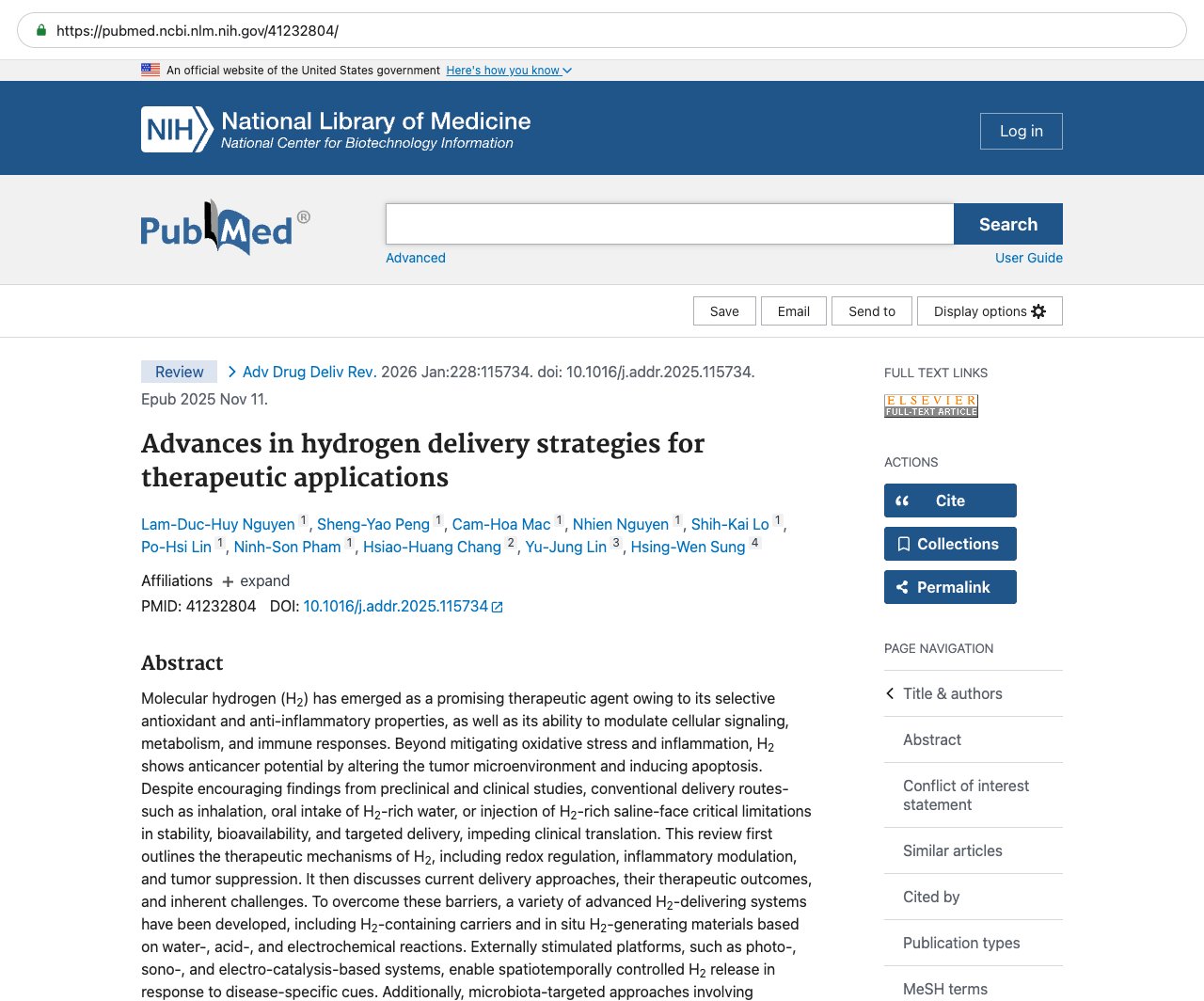
This page mirrors the published abstract (© the authors / publisher) for reference and citation. The canonical source is the PubMed record linked above. This is not medical advice.