2016 Medical science monitor : international medical journal of experimental and clinical research Mechanism / Preclinical Saline / IV
2016 · Qin — Hydrogen-Rich Saline as an Innovative Therapy for Cataract: A Hypothesis
Super-Abstract
This paper proposes a theoretical rationale for using molecular hydrogen as an antioxidant to protect against cataract formation — based on H₂'s known ability to selectively neutralise damaging reactive oxygen species (ROS). No experiments are reported; this is a hypothesis article outlining a plausible mechanism for future investigation. (Medical Science Monitor, 2016.)
Commentary
Cataract is the world's leading cause of preventable blindness. Oxidative stress — driven by accumulation of reactive oxygen species (ROS) in ocular tissues — is a well-established contributor to lens damage. This paper argues that molecular hydrogen, which can selectively scavenge highly cytotoxic ROS such as the hydroxyl radical (·OH), could in principle protect the lens from oxidative injury. The authors highlight a key advantage of H₂: unlike many conventional antioxidants, it can cross biological membranes and diffuse into subcellular compartments including the mitochondria and nucleus, reaching sites where other antioxidants cannot penetrate. The paper is explicitly labelled a hypothesis — it contains no experimental data, no animal or cell studies, and no clinical evidence. Its value is conceptual: it maps the oxidative-stress mechanism of cataract formation onto the known antioxidant profile of H₂, and calls for further biological investigation.
Key quotes
- „Molecular hydrogen has recently been verified to have protective and therapeutic value as an antioxidant through its ability to selectively reduce cytotoxic ROS such as hydroxyl radical (OH).“ — the core antioxidant property motivating the hypothesis
- „Unlike most well-known antioxidants, which are unable to successfully target organelles, hydrogen has advantageous distribution characteristics enabling it to penetrate biomembranes and diffuse into the cytosol, mitochondria, and nucleus.“ — the proposed structural advantage of H₂ over conventional antioxidants
- „We speculate that hydrogen might be an effective antioxidant to protect against lens damage, and it is important to further explore the biological mechanism underlying its potential therapeutic effects.“ — the authors' explicit framing as speculation, not established fact
Our assessment
This is a theoretical hypothesis paper — it contains no experimental data whatsoever. No human, animal, or cell experiments are reported. The proposed mechanism is biologically plausible and internally consistent with published H₂ pharmacology, but speculation is not evidence. No conclusion about the clinical usefulness of hydrogen therapy for cataract can be drawn from this article. It is a starting point for future research, not proof of efficacy.
Study design
- Type: hypothesis/theory paper · n: none (no experiments) · H₂ delivery: hydrogen-rich saline (proposed, not tested)
- Result: no experimental findings; the authors propose that H₂ could plausibly protect the lens against oxidative damage via selective ROS scavenging and unique membrane permeability; calls for empirical investigation
Abstract
Cataract is the leading cause of irreversible blindness worldwide. Increasing evidence indicates that oxidative stress is an important risk factor contributing to the development of cataract. Moreover, the enhancement of the antioxidant defense system may be beneficial to prevent or delay the cataractogenesis. The term oxidative stress has been defined as a disturbance in the equilibrium status of oxidant/antioxidant systems with progressive accumulation of reactive oxygen species (ROS) in intact cells. Superfluous ROS can damage proteins, lipids, polysaccharides, and nucleic acids within ocular tissues that are closely correlated with cataract formation. Therefore, prevention of oxidative stress damage by antioxidants might be considered as a viable means of medically offsetting the progression of this vision-impairing disease. Molecular hydrogen has recently been verified to have protective and therapeutic value as an antioxidant through its ability to selectively reduce cytotoxic ROS such as hydroxyl radical (OH). Hitherto, hydrogen has been used as a therapeutic element against multiple pathologies in both animal models and human patients. Unlike most well-known antioxidants, which are unable to successfully target organelles, hydrogen has advantageous distribution characteristics enabling it to penetrate biomembranes and diffuse into the cytosol, mitochondria, and nucleus. Consequently, we speculate that hydrogen might be an effective antioxidant to protect against lens damage, and it is important to further explore the biological mechanism underlying its potential therapeutic effects.
Source & links
Screenshot of the PubMed page
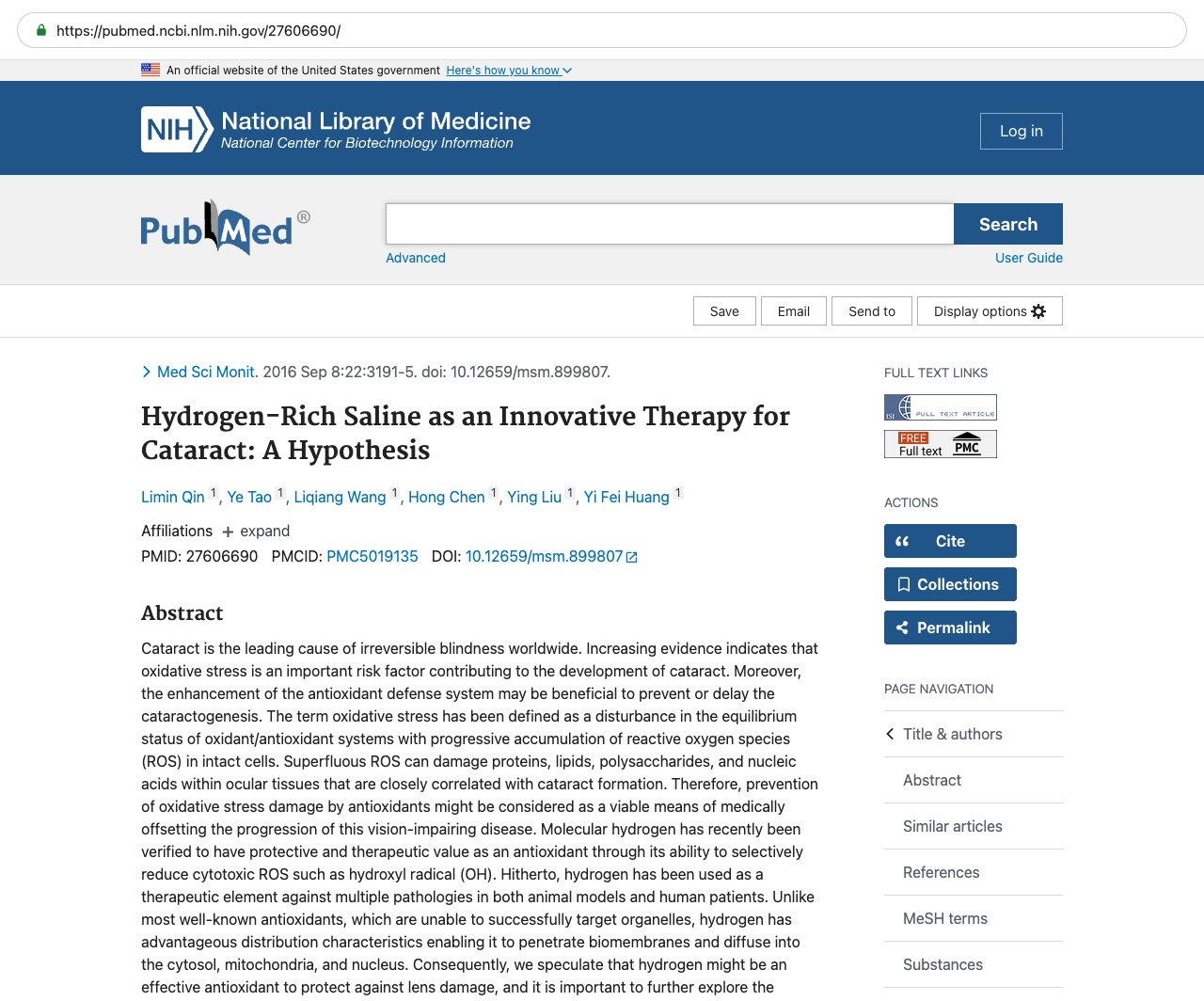
This page mirrors the published abstract (© the authors / publisher) for reference and citation. The canonical source is the PubMed record linked above. This is not medical advice.