2015 · Ohta — Molecular hydrogen as a novel antioxidant: overview of the advantages of hydrogen for medical applications.
Super-Abstract
Molecular hydrogen (H₂) is a mild, selective antioxidant that neutralizes the most damaging reactive oxygen species without disrupting normal cellular redox signaling — a key advantage over broad-spectrum antioxidants. This comprehensive overview by Ohta covers administration methods, biological mechanisms, and the expanding evidence from animal models and clinical studies. (Methods in Enzymology, 2015.)
Commentary
Ohta was one of the pioneering researchers who demonstrated that H₂ selectively reacts with hydroxyl radicals and peroxynitrite inside cells — the central mechanistic insight that launched the modern H₂ research field. This review summarizes the full range of H₂ effects documented up to 2015, including both direct radical scavenging and indirect effects via gene expression regulation. Multiple delivery methods are covered: inhalation, drinking H₂-rich water, intravenous H₂ saline, bathing, and topical eye drops. The distinction the author draws — that H₂ differs from conventional drugs because it is not targeted to one receptor — is intellectually honest about both its potential and the interpretive complexity it introduces for clinical translation.
Key quotes
- „H2 has several advantages exhibiting marked effects for medical applications: it is mild enough neither to disturb metabolic redox reactions nor to affect signaling by reactive oxygen species.“ — the core pharmacological advantage: selective without being disruptive
- „In addition to the direct neutralization of highly reactive oxidants, H2 indirectly reduces oxidative stress by regulating the expression of various genes.“ — H₂ acts beyond direct scavenging — gene-level regulation is a second mechanism
- „Since most drugs specifically act on their specific targets, H2 seems to differ from conventional pharmaceutical drugs. Owing to its great efficacy and lack of adverse effects, H2 has potential for clinical applications for many diseases.“ — honest framing: H₂ is mechanistically unusual — broader but harder to characterize
Our assessment
This is a key review from one of the field's founding researchers, offering a clear mechanistic framework for H₂ as an antioxidant. It is most valuable as a conceptual and methodological reference — cataloguing delivery routes and biological mechanisms. As of 2015, the evidence base was still predominantly animal models and early-phase clinical studies, not large randomized trials. No clinical conclusions should be drawn directly from this review for human therapeutic use. The author's honest acknowledgment that H₂ does not fit the traditional drug paradigm is scientifically important and should not be misread as marketing.
Study design
- Type: narrative review · n: n/a (synthesis of in-vitro, animal, and clinical studies) · H₂ delivery: multiple routes reviewed — inhalation, H₂-rich water (drinking), H₂ saline (IV), bath, eye drops
- Result: H₂ documented as selective scavenger of hydroxyl radical and peroxynitrite; additionally regulates gene expression with anti-inflammatory, antiallergic, and antiapoptotic effects; clinical applications in progress as of 2015
Abstract
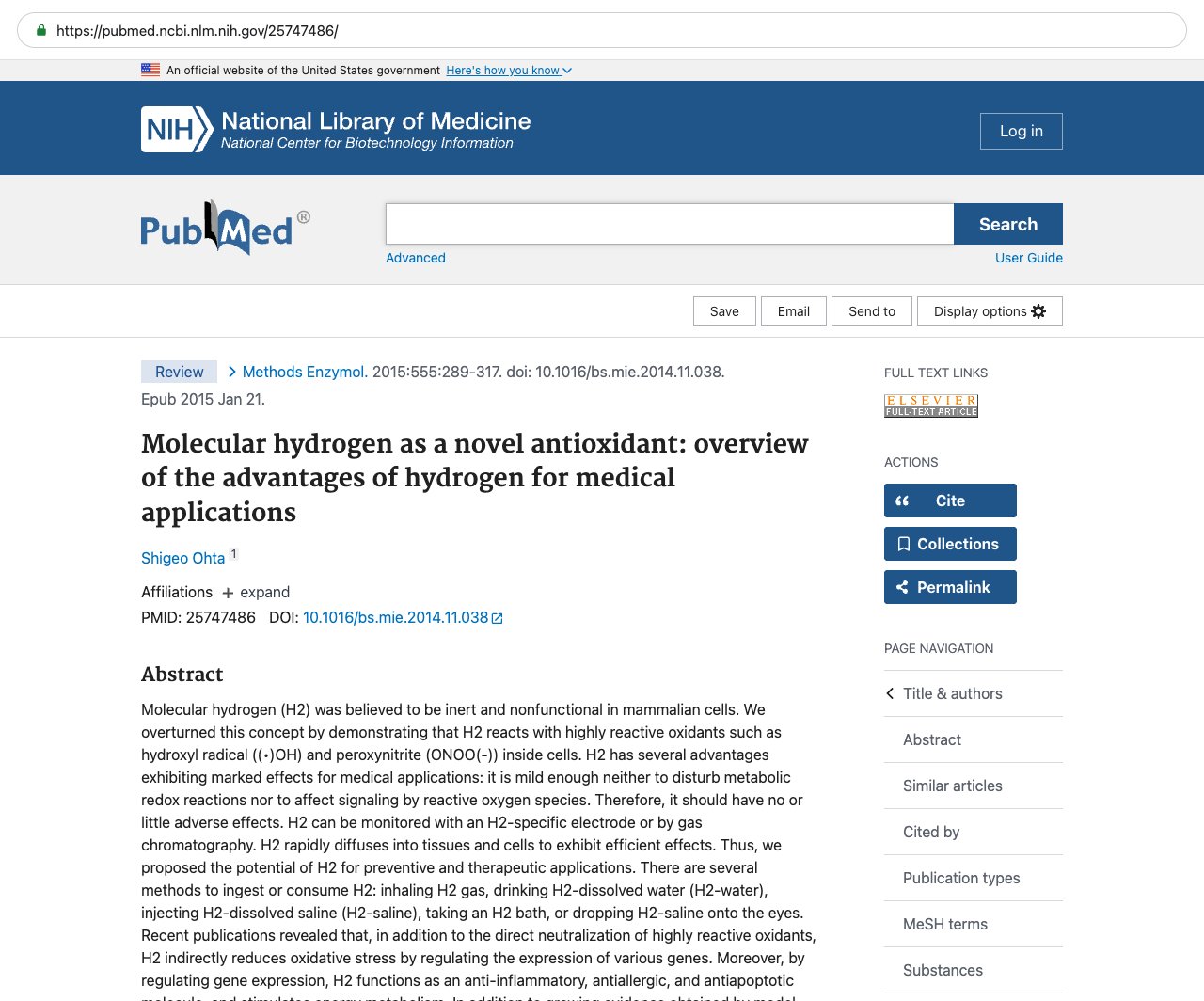
Molecular hydrogen (H2) was believed to be inert and nonfunctional in mammalian cells. We overturned this concept by demonstrating that H2 reacts with highly reactive oxidants such as hydroxyl radical ((•)OH) and peroxynitrite (ONOO(-)) inside cells. H2 has several advantages exhibiting marked effects for medical applications: it is mild enough neither to disturb metabolic redox reactions nor to affect signaling by reactive oxygen species. Therefore, it should have no or little adverse effects. H2 can be monitored with an H2-specific electrode or by gas chromatography. H2 rapidly diffuses into tissues and cells to exhibit efficient effects. Thus, we proposed the potential of H2 for preventive and therapeutic applications. There are several methods to ingest or consume H2: inhaling H2 gas, drinking H2-dissolved water (H2-water), injecting H2-dissolved saline (H2-saline), taking an H2 bath, or dropping H2-saline onto the eyes. Recent publications revealed that, in addition to the direct neutralization of highly reactive oxidants, H2 indirectly reduces oxidative stress by regulating the expression of various genes. Moreover, by regulating gene expression, H2 functions as an anti-inflammatory, antiallergic, and antiapoptotic molecule, and stimulates energy metabolism. In addition to growing evidence obtained by model animal experiments, extensive clinical examinations were performed or are under way. Since most drugs specifically act on their specific targets, H2 seems to differ from conventional pharmaceutical drugs. Owing to its great efficacy and lack of adverse effects, H2 has potential for clinical applications for many diseases.
Source & links
Screenshot of the PubMed page
This page mirrors the published abstract (© the authors / publisher) for reference and citation. The canonical source is the PubMed record linked above. This is not medical advice.