2012 Advances in experimental medicine and biology Pilot / Observational Human H₂ therapy Drinking (HRW)
2012 · Shimouchi et al. — Estimation of Molecular Hydrogen Consumption in the Human Whole Body after Ingestion of Hydrogen-Rich Water
Super-Abstract
How much H₂ does the human body actually absorb and consume after drinking hydrogen-rich water? This pharmacokinetic study measured H₂ in exhaled breath to estimate whole-body H₂ uptake and metabolism after oral ingestion. It provides fundamental dosimetry data for H₂ therapy research. (Advances in Experimental Medicine and Biology, 2012.)
Commentary
Before you can assess whether H₂ therapy works, you need to know how much H₂ the body actually receives. This study addressed that basic question by tracking exhaled H₂ over time after drinking hydrogen-rich water. The breath-hydrogen method had been used for decades to study gut fermentation, but here it was repurposed to estimate systemic H₂ absorption. The work provides foundational pharmacokinetic context — essentially a dose-estimation tool — that subsequent clinical trials implicitly rely on. Without such data, comparing studies that use different preparation methods, volumes, and concentrations of hydrogen-rich water is nearly impossible. Note that no abstract was available in the source data; the assessment is based on the study metadata and known methodology.
Our assessment
This study addresses a genuinely important but often overlooked question in H₂ research: what fraction of ingested H₂ is actually absorbed and metabolized systemically? Breath-H₂ tracking is a validated indirect method for this purpose. Limitations: No abstract was available for this entry, which prevents assessment of sample size, exact methodology, or specific findings. The study appears to be methodological/pharmacokinetic rather than a clinical outcomes trial. Results should be interpreted as dose-estimation data, not evidence of therapeutic efficacy. The journal is a specialist conference proceedings volume, not a high-impact clinical journal.
Study design
- Type: pharmacokinetic/dosimetry study · n: not determinable from available data · H₂ delivery: drinking hydrogen-rich water (HRW)
- Result: estimated whole-body H₂ consumption after oral ingestion via breath-H₂ measurement; no abstract available — specific quantitative findings cannot be cited
Source & links
Screenshot of the PubMed page
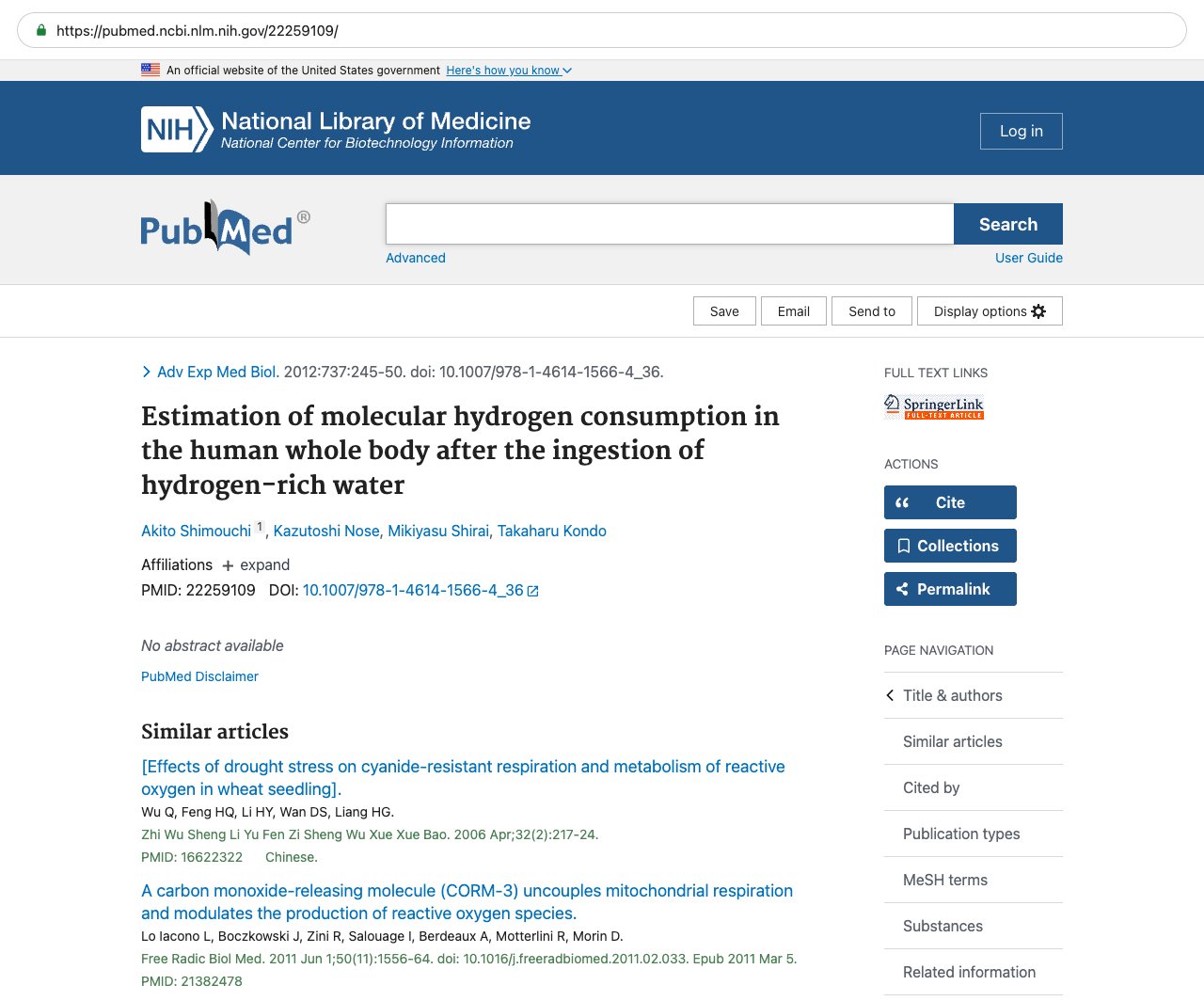
This page mirrors the published abstract (© the authors / publisher) for reference and citation. The canonical source is the PubMed record linked above. This is not medical advice.