2021 · Sugaya — Association of Breath Hydrogen Concentration with Oral Intake and Urinary Diseases
Super-Abstract
Breath hydrogen levels rise temporarily after eating, drinking — including hydrogen water — and with age in women, but are not associated with benign prostatic hyperplasia, overactive bladder, or constipation. Individual variation in breath H₂ is enormous (0.4–188.6 ppm), driven primarily by differences in gut flora rather than therapy. (Nihon Hinyokika Gakkai Zasshi, 2021.)
Commentary
This study approaches H₂ from an unusual angle: not as a therapeutic input but as a measurable physiological output. The gut microbiome produces hydrogen as a fermentation by-product; measuring exhaled H₂ is therefore a window into gut fermentation activity, not a measure of administered H₂ therapy. The study enrolled both healthy volunteers and urological outpatients. Key findings: eating and drinking temporarily raise breath H₂ regardless of what is consumed (even tap water raised it); breath H₂ increased significantly with age in healthy women; and there was no correlation between breath H₂ and prostatic hyperplasia, overactive bladder, or constipation. The individual variation was striking — one person ranged 11.2–188.6 ppm, another 0.4–2.3 ppm across 10+ days of measurement. This has important implications: consuming hydrogen-rich water does transiently raise breath H₂, but the baseline inter-individual variability is so large that breath H₂ is a poor surrogate measure for HRW therapy dose.
Key quotes
- „Breath hydrogen concentration increased temporarily after ingestion of tap water, hydrogen water or food.“ — even plain tap water raises breath H₂ — the response is not specific to HRW
- „In the person with the highest breath hydrogen, concentrations were 11.2–188.6 ppm, whereas in the person with the lowest, they were 0.4–2.3 ppm.“ — the enormous inter-individual variation in gut-produced H₂ — makes breath H₂ a poor therapy proxy
- „There was no association between breath hydrogen and benign prostatic hyperplasia, overactive bladder or constipation.“ — a clear null finding: gut H₂ production does not track with these urological conditions
Our assessment
A useful physiological characterisation study rather than a therapeutic efficacy trial. Its value lies in understanding H₂ pharmacokinetics: gut flora, not supplemental H₂ intake, dominates breath H₂ levels; and individual variability is enormous. Limitations: small sample (85 healthy volunteers, 70 urological patients), not all measurement conditions were standardised, and breath H₂ as a proxy for blood or tissue H₂ bioavailability remains uncertain. The null findings for urological conditions are honest and informative — but this study was never designed to test therapeutic H₂ effects on those conditions.
Study design
- Type: observational cross-sectional measurement study · n: 85 healthy volunteers (40 men, 45 women), 70 urological outpatients (40 BPH, 30 OAB)
- H₂ measurement: exhaled breath H₂ (ppm) — baseline, post-eating, post-drinking (tap water, hydrogen water), diurnal variation, 10+ day repeat in 2 individuals
- Result: ↑ breath H₂ after all oral intake; ↑ with age in healthy women; no association with BPH, OAB, or constipation; individual range: 0.4–188.6 ppm
Abstract
(Purpose) Ingestion of hydrogen is said to prevent oxidation in the body, but hydrogen is produced by intestinal bacterial flora and excreted in the exhaled breath. We investigated how breath hydrogen concentrations change with the diurnal cycle and under various conditions, including after consuming food or drink, and in people with urological disease. (Subjects and methods) Participants were healthy volunteers (40 men, 45 women; 30-83 years old) and urological outpatients (40 men with benign prostatic hyperplasia, 30 women with overactive bladder; 60 years or older). Breath hydrogen levels were measured before and after eating and drinking in three volunteers, and its diurnal variation was examined in one. The relationship between breath hydrogen and age or urological disease status was also analyzed by gender. Additional measurements were taken in the person with the highest breath hydrogen concentration and the person with the lowest; in these two people, breath hydrogen was measured at the same time for 10 or more days to determine the fluctuation range. (Results) Breath hydrogen concentration increased temporarily after ingestion of tap water, hydrogen water or food. It also increased with food intake and in cases of flatulence with intestinal gas accumulation, but decreased after defecation. In the person with the highest breath hydrogen, concentrations were 11.2-188.6 ppm, whereas in the person with the lowest, they were 0.4-2.3 ppm. Breath hydrogen increased significantly with age in healthy female volunteers. There was no association between breath hydrogen and benign prostatic hyperplasia, overactive bladder or constipation. (Conclusion) Breath hydrogen concentration increases with eating, drinking and aging, and is not associated with benign prostatic hyperplasia, overactive bladder or constipation. Breath hydrogen concentration varies widely between individuals, which may be due to differences in intestinal flora.
Source & links
Screenshot of the PubMed page
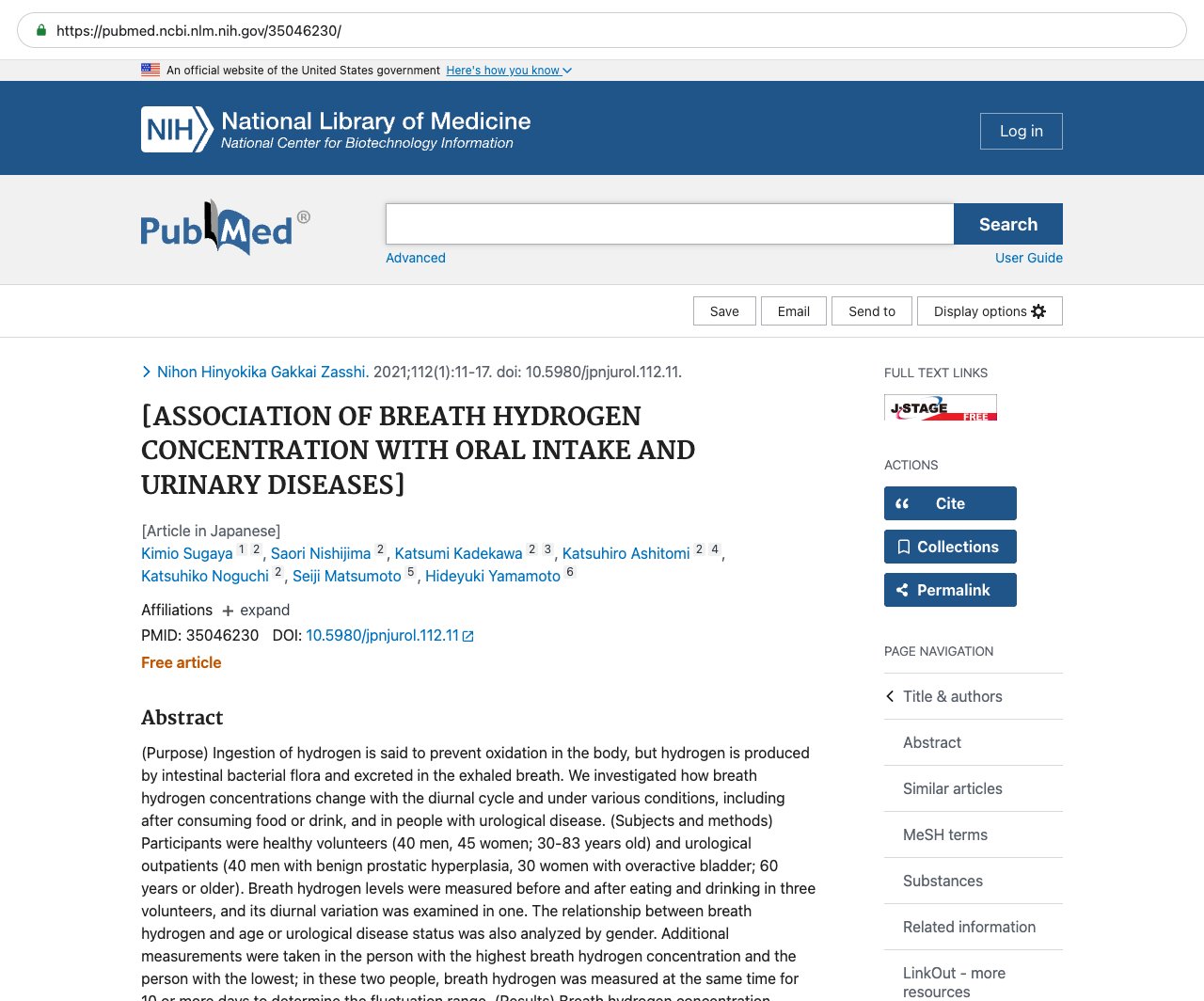
This page mirrors the published abstract (© the authors / publisher) for reference and citation. The canonical source is the PubMed record linked above. This is not medical advice.