2019 · Kou et al. — Acid-responsive H₂-releasing Fe nanoparticles for safe and effective cancer therapy.
Super-Abstract
This preclinical study describes an ingenious drug-delivery strategy: iron nanoparticles coated with carboxymethyl cellulose that release molecular hydrogen (H₂) selectively inside the acidic tumour microenvironment, enabling targeted, imaging-guided cancer therapy in mice. The Fe@CMC nanoparticles showed high tumour accumulation, strong cancer-cell-killing selectivity, and no observable toxicity in healthy tissue — all in animal and cell experiments.
Commentary
Most H₂ therapy approaches rely on systemic delivery (drinking, inhalation), where the gas diffuses broadly and is difficult to concentrate at a tumour site. This study takes a nanomedicine approach: acid-responsive Fe nanoparticles release H₂ specifically in the low-pH environment of tumours, combining drug delivery with photoacoustic imaging (PAI) to track tumour targeting. The proposed anti-cancer mechanism is intriguing — energy metabolism homeostasis disruption by H₂ — rather than simple radical scavenging. Results were obtained in cell culture and tumour-bearing mice only. No human data exist. Translation from mouse oncology models to human cancer therapy is notoriously challenging.
Key quotes
- „The Fe@CMC nanoparticles have demonstrated high intratumoural accumulation capability, high acid responsiveness, excellent PAI performance, selective cancer-killing effect and high bio-safety in vitro and in vivo.“ — summary of the nanoparticle's performance in the animal and cell-culture experiments
- „the selective anti-cancer mechanism of Fe@CMC is discovered to be originated from the energy metabolism homeostasis regulatory function of the released H2.“ — proposed mechanism: H₂ disrupts energy metabolism in cancer cells selectively
- „The proposed nanomedicine-mediated hydrogen therapy strategy will open a new window for precise, high-efficacy and safe cancer treatment.“ — optimistic outlook — but still at the preclinical proof-of-concept stage
Our assessment
This is a preclinical study (cell culture + mouse tumour model) with no human data. It demonstrates a creative and technically sophisticated H₂ delivery strategy. Important caveat: mouse tumour models often fail to predict clinical outcomes in human oncology; nanomedicine candidates face major hurdles in scale-up, safety profiling, regulatory approval, and clinical translation. The energy-metabolism disruption mechanism is novel but needs independent replication. This should be read as an innovative proof-of-concept, not as evidence of cancer therapy in humans.
Study design
- Type: preclinical study (in vitro + in vivo mouse model) · n: tumour-bearing mice (intravenous injection of Fe@CMC nanoparticles) · H₂ delivery: acid-triggered release from Fe@CMC nanoparticles inside tumour microenvironment
- Key results: ↑ intratumoural H₂ accumulation, selective tumour-cell killing, tumour growth inhibition in mice, no systemic toxicity observed · Imaging: photoacoustic imaging (PAI) for tracking
Abstract
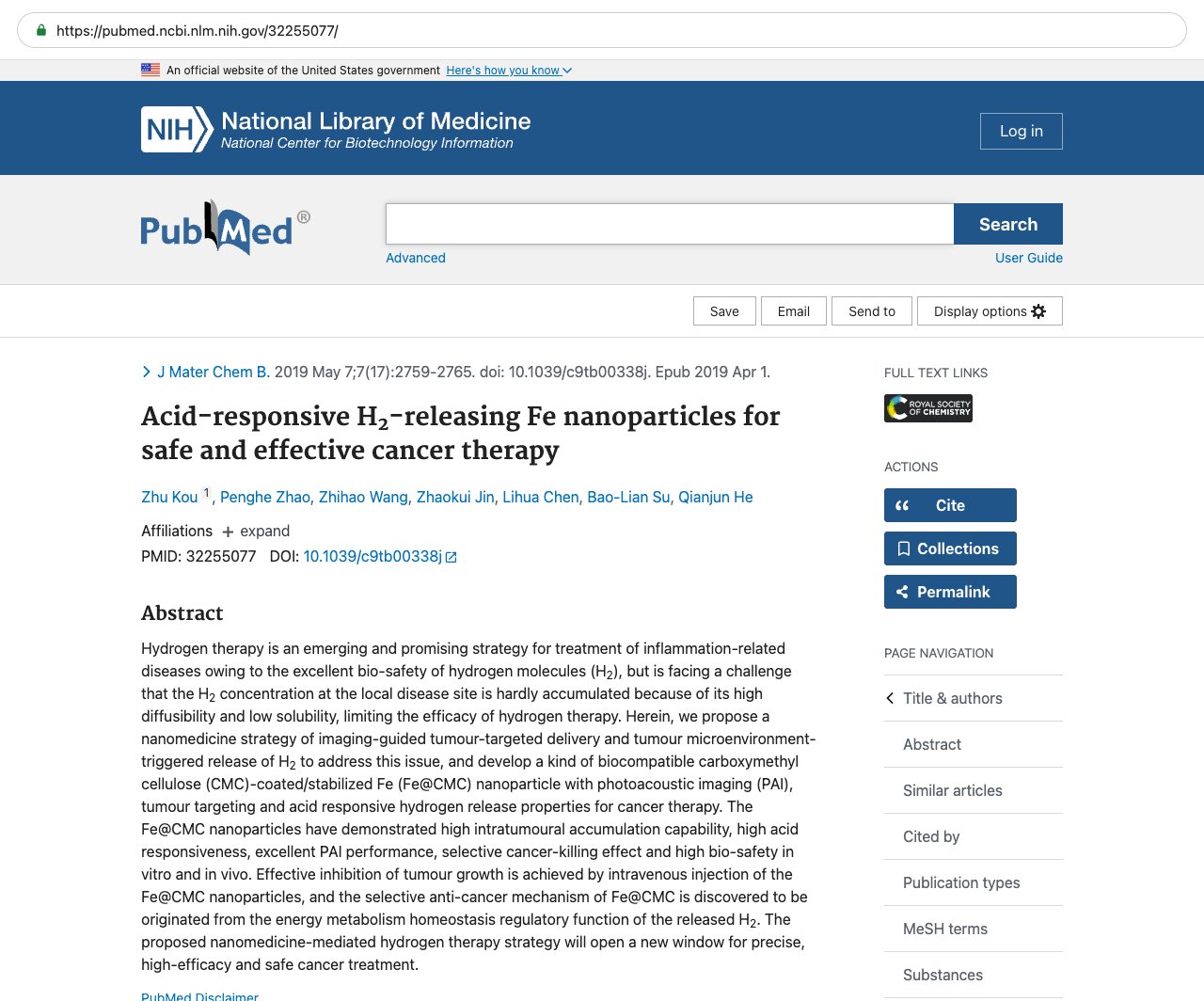
Hydrogen therapy is an emerging and promising strategy for treatment of inflammation-related diseases owing to the excellent bio-safety of hydrogen molecules (H2), but is facing a challenge that the H2 concentration at the local disease site is hardly accumulated because of its high diffusibility and low solubility, limiting the efficacy of hydrogen therapy. Herein, we propose a nanomedicine strategy of imaging-guided tumour-targeted delivery and tumour microenvironment-triggered release of H2 to address this issue, and develop a kind of biocompatible carboxymethyl cellulose (CMC)-coated/stabilized Fe (Fe@CMC) nanoparticle with photoacoustic imaging (PAI), tumour targeting and acid responsive hydrogen release properties for cancer therapy. The Fe@CMC nanoparticles have demonstrated high intratumoural accumulation capability, high acid responsiveness, excellent PAI performance, selective cancer-killing effect and high bio-safety in vitro and in vivo. Effective inhibition of tumour growth is achieved by intravenous injection of the Fe@CMC nanoparticles, and the selective anti-cancer mechanism of Fe@CMC is discovered to be originated from the energy metabolism homeostasis regulatory function of the released H2. The proposed nanomedicine-mediated hydrogen therapy strategy will open a new window for precise, high-efficacy and safe cancer treatment.
Source & links
Screenshot of the PubMed page
This page mirrors the published abstract (© the authors / publisher) for reference and citation. The canonical source is the PubMed record linked above. This is not medical advice.