2020 · Asada et al. — Effects of hydrogen-rich water prepared by alternating-current-electrolysis on antioxidant activity, DNA oxidative injuries, and diabetes-related markers.
Super-Abstract
Hydrogen-rich water produced by alternating-current (AC) electrolysis — reaching nearly the theoretical maximum H₂ concentration of 1.55 mg/L — showed promising effects on blood glucose markers and systemic DNA oxidative damage in nine people with elevated diabetes-related serum markers over eight weeks. Notably, the H₂ nanobubbles in this preparation resisted boiling, which thermodynamically contradicts Henry's law and may explain improved stability. (Medical Gas Research, 2020.)
Commentary
This small pilot study from Japan tests a novel AC-electrolysis method for producing H₂-rich water and pairs the physicochemical characterisation with a brief clinical observation. The most striking technical claim — that nanobubble suspensions survive 10 minutes of boiling — is intriguing but requires independent replication to be accepted; it conflicts with established gas-solubility physics. On the clinical side, the nine participants showed trends toward lower fasting glucose and fructosamine and reduced urinary 8-OHdG (a DNA oxidation marker), but the trial is uncontrolled, unblinded, and far too small to draw conclusions about efficacy. The study is best read as a proof-of-concept for the AC-electrolysis production method rather than evidence of clinical benefit.
Key quotes
- „Oral intake of hydrogen-rich water, 1500 mL per day, lasted for 8 weeks in nine people with the diabetes-related serum markers beyond the normal ranges.“ — study population and intervention
- „The subjects exhibited significant tendencies for the decreased fasting blood glucose and fructosamine, and for the increased 1,5-anhydro-D-glucitol, concomitantly with significant decreases in urinary 8-hydroxy-2-deoxyguanosine contents and its rate of generation.“ — key outcome signals — described as tendencies, not confirmed effects
- „nanoparticle suspensions as abundant as 5.4 × 10⁷/mL were efficiently retained (up to 3.5 × 10⁷/mL) even after boiling for 10 minutes, being thermodynamically contrary to Henry's law.“ — unusual physicochemical claim requiring independent replication
Our assessment
The paper contributes an interesting AC-electrolysis production method that achieves near-saturation H₂ at physiological pH — a meaningful technical advance if confirmed. The clinical arm, however, is very weak: n = 9, no control group, no blinding, and outcomes described only as „significant tendencies“. Limitations: uncontrolled design makes confounding (diet, season, regression to the mean) impossible to rule out; the nanobubble boiling-resistance claim is extraordinary and lacks mechanistic explanation; the abstract is partly replaced by an ethics-approval statement. Overall: promising signal for AC-electrolysis production; insufficient evidence for diabetes claims.
Study design
- Type: uncontrolled open-label pilot · n: 9 (diabetes-related elevated serum markers) · H₂ delivery: AC-electrolysis hydrogen-rich water, 1,500 mL/day orally, 8 weeks · H₂ concentration: 1.55 mg/L
- Result: trends toward reduced fasting blood glucose, fructosamine, and urinary 8-OHdG; increased 1,5-anhydro-D-glucitol; no control group — effect attribution uncertain
- Technical finding: AC-electrolysis produces nanobubbles reportedly stable after boiling — claim conflicts with Henry's law and requires replication
Abstract
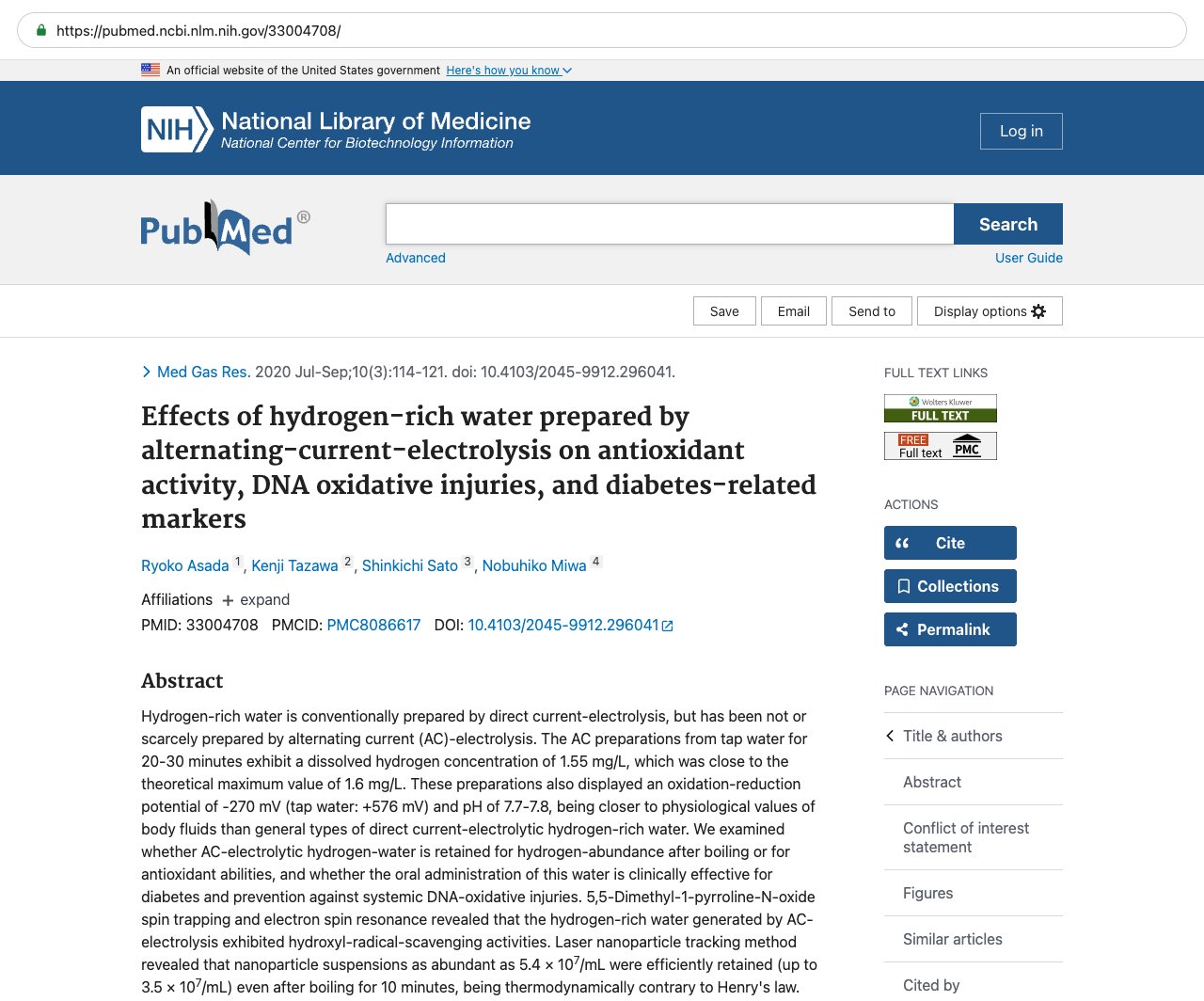
Hydrogen-rich water is conventionally prepared by direct current-electrolysis, but has been not or scarcely prepared by alternating current (AC)-electrolysis. The AC preparations from tap water for 20-30 minutes exhibit a dissolved hydrogen concentration of 1.55 mg/L, which was close to the theoretical maximum value of 1.6 mg/L. These preparations also displayed an oxidation-reduction potential of -270 mV (tap water: +576 mV) and pH of 7.7-7.8, being closer to physiological values of body fluids than general types of direct current-electrolytic hydrogen-rich water. We examined whether AC-electrolytic hydrogen-water is retained for hydrogen-abundance after boiling or for antioxidant abilities, and whether the oral administration of this water is clinically effective for diabetes and prevention against systemic DNA-oxidative injuries. 5,5-Dimethyl-1-pyrroline-N-oxide spin trapping and electron spin resonance revealed that the hydrogen-rich water generated by AC-electrolysis exhibited hydroxyl-radical-scavenging activities. Laser nanoparticle tracking method revealed that nanoparticle suspensions as abundant as 5.4 × 10⁷/mL were efficiently retained (up to 3.5 × 10⁷/mL) even after boiling for 10 minutes, being thermodynamically contrary to Henry's law. Oral intake of hydrogen-rich water, 1500 mL per day, lasted for 8 weeks in nine people with the diabetes-related serum markers beyond the normal ranges. The subjects exhibited significant tendencies for the decreased fasting blood glucose and fructosamine, and for the increased 1,5-anhydro-D-glucitol, concomitantly with significant decreases in urinary 8-hydroxy-2-deoxyguanosine contents and its rate of generation. Hydrogen-rich water prepared by AC-electrolysis may be effective in improving diverse diabetes-related markers and systemic DNA oxidative injuries through the formation of abundant heat-resistant nanobubbles and the increased hydrogen concentrations. The study protocol was officially approved by the Medical Ethics Committee of the Japanese Center for Anti-Aging Medical Sciences (approval No. 01S02) on September 15, 2009.
Source & links
Screenshot of the PubMed page
This page mirrors the published abstract (© the authors / publisher) for reference and citation. The canonical source is the PubMed record linked above. This is not medical advice.